
Scarface 1932 vs. Scarface 1983: Two Gangsters, Two Americas
A side-by-side comparison of Scarface (1932) and Scarface (1983), exploring how two very different gangster films reflect the anxieties, ambitions, and cultural pressures of their eras—from Prohibition to the cocaine-soaked 1980s.

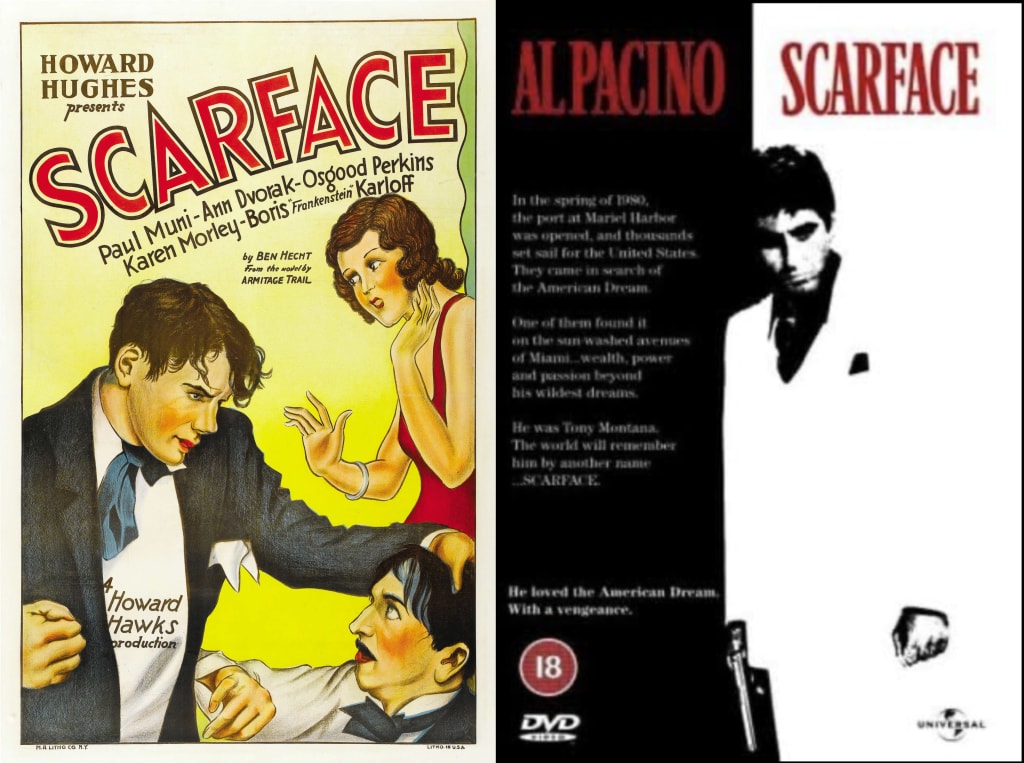
Two Scarfaces, Two Americas
The 1932 Scarface arrives in the middle of the Prohibition era, when newspapers obsessed over Al Capone and the public devoured gangster headlines the way we devour celebrity feuds. Howard Hawks and producer Howard Hughes made a film that felt like overhearing the city’s dirtiest gossip whispered through a dictionary of bullets. It’s blunt, fast, and sharp—almost breathless in the way it barrels through Tony Camonte’s rise and fall.
The 1983 Scarface is something else entirely. Brian De Palma and Oliver Stone weren’t trying to recreate Hawks; they were trying to recreate the moment. Miami in the early 80s was ground zero for cocaine trafficking, a city that overwhelmed the senses—neon colors, Latin music, bodies moving fast, money moving faster. If the 1932 film is a newspaper headline, the 1983 film is a fever dream.
Both stories are about a criminal outsider chasing the American Dream. But the country Tony Camonte wanted and the country Tony Montana wanted are almost unrecognizable from one another.
Tony Camonte vs. Tony Montana
Paul Muni’s Tony Camonte is a creature of impulse and intimidation. There’s an almost reptilian stillness to him—he watches, he calculates, and he strikes. His world is small: a boss, a turf, a sister he guards with a corruption of love.
Pacino’s Tony Montana is the opposite. He’s all volume, all posture, all relentless forward motion. He doesn’t just want success; he wants more than whatever anyone else has ever had. He’s the immigrant who refuses to assimilate, the man who believes the rules were written to keep him small. His violence isn’t cold-blooded calculation—it’s volcanic, emotional, operatic.
One is a gangster molded by Chicago’s shadows. The other is a gangster shaped by Miami’s sunburned chaos.
Yet both men are bound by the same fatal instinct: if they’re not climbing, they’re dying.
Two Visions of Violence, Two Cinematic Languages
Hawks used violence as punctuation. A burst of gunfire, the sudden rattle of a Tommy gun, the quiet shock of a body hitting the floor. It was still shocking in 1932 because the Production Code hadn’t fully descended yet, and the movie pushed against whatever flimsy rules existed at the time.
De Palma turned violence into visual opera. The chainsaw scene, the nightclub shooting, the final assault—these moments aren’t just set-pieces. They’re crescendos. He pushes the camera, the colors, and the sound until the brutality becomes overwhelming, almost grotesquely beautiful in its excess. It’s not realism; it’s spectacle, and deliberately so.
The 1932 film wants to show you how violence destroys a city.
The 1983 film wants to show you how violence destroys a man.
What Each Film Says About the American Dream
Every version of Scarface is a tragedy, but the tragedies come from different cultural wounds.
The 1932 film is a warning about unchecked ambition in a country trying to rebuild moral order. It’s the story of what happens when a man uses chaos as a ladder.
The 1983 film is the story of an immigrant chasing a dream that never really existed. It’s capitalism rewired as a survival instinct, success measured only by acquisition, and destruction treated as a sign of power. Tony Montana doesn’t just want America—he wants to bend America to his will.
Both films say the same thing in the end: if the dream becomes the only thing you see, you’ll never notice the cliff you’re about to walk off.
Scarface’s Legacy: Iconography and Misinterpretation
The 1932 Scarface became the skeleton key of the gangster genre. Its fingerprints are everywhere—from film noir to modern crime thrillers. It’s studied, respected, and treated the way we treat old crime photographs: sharp, cold, and essential
The 1983 Scarface became something stranger. It became myth. A poster on dorm-room walls. A mantra for ambition. A symbol embraced by people the movie was actively warning against. What was meant as a tragedy somehow became a lifestyle brand. That misreading tells its own story about the culture that adopted it.
Both films were shaped by fear—fear of crime, fear of outsiders, fear of the country losing control of its own story. And both films became mirrors instead. Each version of Scarface reflects back exactly what its era refused to admit: that the American Dream, at its most feverish, is a story of wanting more than you can hold and believing you’ll be the first one in history strong enough not to burn your hands.
Final Word: Two Versions, One Warning
In the end, the power of Scarface lies in its repetition. Two films made half a century apart arrive at the same brutal truth: ambition without limit becomes annihilation. Tony Camonte and Tony Montana are separated by culture, by history, by the look of their cities and the sound of their violence, but their downfall is identical.
They dream in different accents, but they die in the same language.
That’s why Scarface endures—not because it glorifies the climb, but because it understands the fall. The story keeps returning every generation because the warning keeps being ignored. And as long as America keeps producing men who believe the world is theirs, Scarface—in every decade—will remain necessary.

About the Creator
Movies of the 80s
We love the 1980s. Everything on this page is all about movies of the 1980s. Starting in 1980 and working our way the decade, we are preserving the stories and movies of the greatest decade, the 80s. https://www.youtube.com/@Moviesofthe80s
Keep reading
More stories from Movies of the 80s and writers in Criminal and other communities.
Before Miami Vice: How Michael Mann’s Thief Invented the 1980s Crime Look
The First Heist of the 1980s When Thief arrived in 1981, it didn’t feel like a product of the 70s or a glimpse of the 80s — it was the bridge between them. The grit of The French Connection met the chrome polish of the coming decade. Michael Mann, making his feature debut, took what he’d learned from years of television and documentary work and transformed a simple crime story into something mythic.
By Movies of the 80s3 months ago in Criminal
Shadows on the Arkansas – A Mechanic's Fight for Justice
It was in a tranquil place called Muskogee, Oklahoma, where the Arkansas River took its sweet time flowing through cotton fields, and the sound of freight trains far away mixed with the warm air, that a certain man, Jack Harlan, made his residence. Jack was a mechanic whose activity responded to the demands of the farmers living in the area by working on old pickups and tractors. He could endure hard labor, but life sometimes presented him with challenges in a straightforward manner, and that night marked one such occasion when he got a curveball hurled directly at him.
By CEO A&S Developers3 days ago in Criminal
Losing Sweet Holly
Holly Cantrell was a mother of two boys and a wife to an ill husband. Holly was a Physical Therapist Technician at the McAlester Regional Health Center. She was a Bouncy Brunette with a fun sense of Humor. Holly made friends easily and often had lunch with friends at work. Friends, to have a charming Physical therapist while they are pushing and pulling on the sore parts, is such a good thing. But things were noticeably different one cold Friday Morning in January.
By Cassie Moore5 days ago in Criminal


Comments
There are no comments for this story
Be the first to respond and start the conversation.