
Before Miami Vice: How Michael Mann’s Thief Invented the 1980s Crime Look
Michael Mann’s Thief (1981) wasn’t just a heist movie — it was the blueprint for the entire 1980s crime aesthetic. From James Caan’s haunting performance to the neon glow and Tangerine Dream score, Thief redefined what cool meant in American cinema.

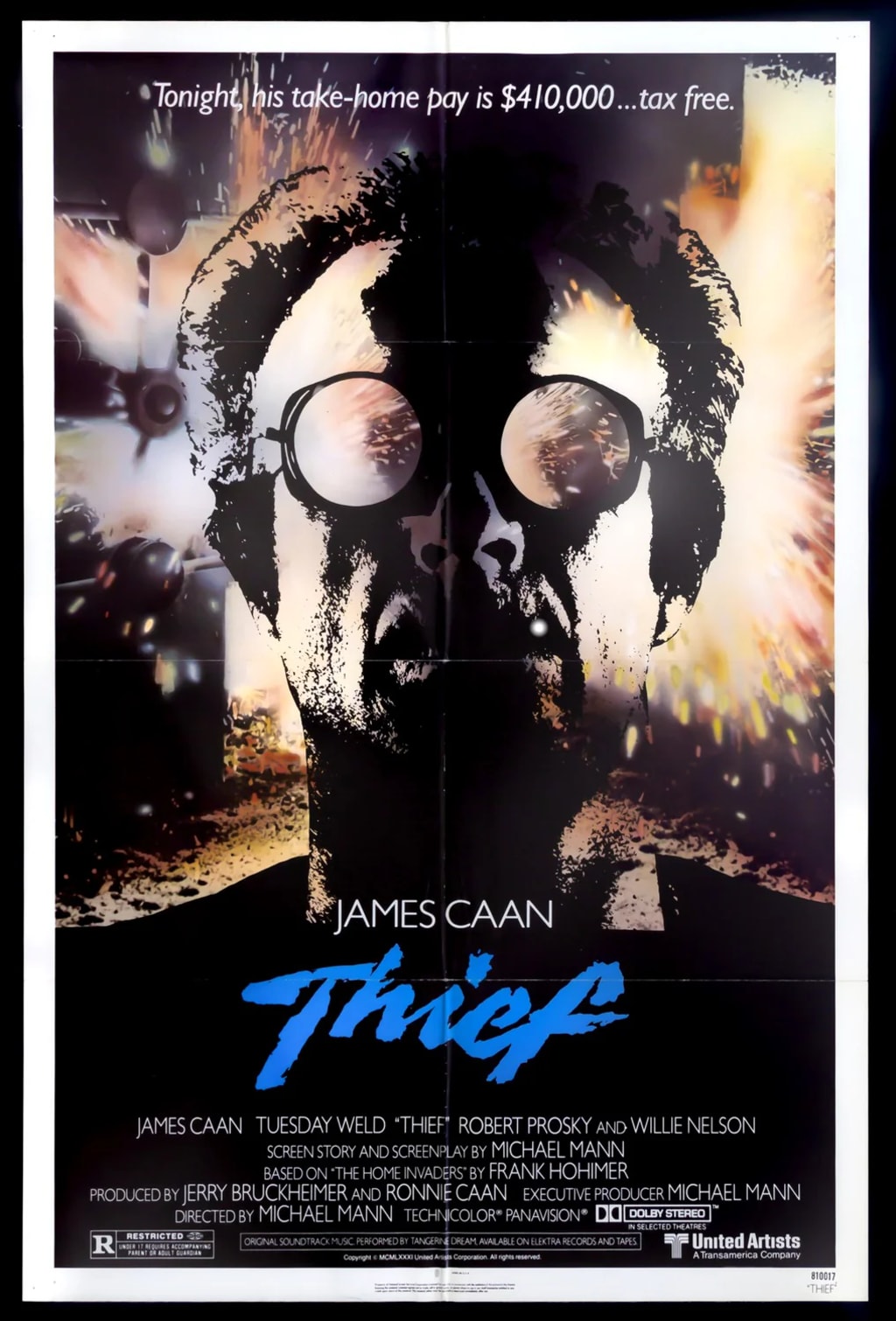
The First Heist of the 1980s
When Thief arrived in 1981, it didn’t feel like a product of the 70s or a glimpse of the 80s — it was the bridge between them. The grit of The French Connection met the chrome polish of the coming decade. Michael Mann, making his feature debut, took what he’d learned from years of television and documentary work and transformed a simple crime story into something mythic.
The opening sequence — a wordless jewel heist under pouring rain, scored by Tangerine Dream’s throbbing synths — feels like prophecy. Neon bounces off wet asphalt. Sparks fly as steel meets steel. Every motion is precise, every sound alive. The tools are real. The sweat is real. And yet the mood feels like a dream, or the start of one.
This was not just a thriller. It was the birth of Michael Mann’s cinema: lonely men, nocturnal cities, and an obsession with professionalism as identity.
James Caan: The Professional Dreamer
James Caan’s Frank is one of the most complete crime protagonists in American film. He’s not just a safecracker; he’s a man trying to carve out a small, legitimate life in a world that refuses him peace. His eyes say more than his words ever could — weary, defiant, proud, afraid.
In a now-iconic diner scene with Tuesday Weld’s Jessie, Frank reveals a collage of images — a literal dream board from his years in prison, filled with magazine clippings of the life he wants: a family, a home, some version of normal. It’s heartbreak disguised as determination.
Caan gives one of his finest performances here, balancing volcanic anger with aching vulnerability. He moves through the film like a man already doomed, yet unwilling to admit it. His performance anchors Mann’s style — all that cool precision only means something because the man at the center is cracking underneath it.
Tangerine Dream and the Sound of a Decade
If Thief had been made five years earlier, it might have sounded like a jazz score. Instead, Mann hired the German electronic group Tangerine Dream, whose pulsing, synthetic rhythms turned Thief into something timeless and strange.
That sound — neon in audio form — became the mood of the 1980s. Before Scarface had its synth montages, before Miami Vice turned television into pop art, Thief was already scoring crime as an emotional state. The music doesn’t underline the action; it is the action, flowing through the film like blood.
The result is hypnotic: a movie about hard steel and harder men, pulsing to an electronic heartbeat.
Michael Mann’s Blueprint for the Future
Nearly everything Michael Mann would explore in later masterpieces — Manhunter, Heat, Collateral — exists here in prototype form. The obsessive professionalism. The blurred line between criminal and cop. The city as mirror of the soul.
Mann’s thieves and detectives are always reflections of each other. In Thief, Frank’s downfall isn’t greed or betrayal — it’s his belief that he can bend the world to his own system, that he can force life to conform to his discipline. He believes in professionalism as salvation. Mann’s films, again and again, show that it’s not enough.
Visually, Mann and cinematographer Donald Thorin created a style that’s now unmistakable: metallic blues, black silhouettes, and fluorescent light slicing through darkness. It’s not realism — it’s expressionism built from glass and shadow.
The Film That Taught the 1980s How to Look
Every cool crime movie that followed — To Live and Die in L.A., Drive, The Terminator, Heat — owes something to Thief. The minimalist dialogue. The lonely antihero. The night streets pulsing with synthetic rhythm.
What makes Thief endure isn’t just its influence, but its emotion. Beneath all the style, there’s tragedy: a man who can steal anything but the one thing he really wants — peace.
When the final explosion fades and Frank walks alone into the dark, you can feel the future coming. The 1980s were about to explode with crime stories dressed in neon, but none would ever feel this raw again.

Subscribe to Movies of the 80s here on Vocal and on YouTube for more 80s Movie Nostalgia.
About the Creator
Movies of the 80s
We love the 1980s. Everything on this page is all about movies of the 1980s. Starting in 1980 and working our way the decade, we are preserving the stories and movies of the greatest decade, the 80s. https://www.youtube.com/@Moviesofthe80s
Keep reading
More stories from Movies of the 80s and writers in Criminal and other communities.
The Karen Silkwood Mystery: The True Story Behind Silkwood (1983)
In 1983, director Mike Nichols released Silkwood, a political drama rooted in one of the most disturbing real-life stories of 1970s America. Starring Meryl Streep, Kurt Russell, and Cher, the film dramatizes the final months of Karen Silkwood — a nuclear plant worker whose death remains officially ruled an accident, but widely questioned.
By Movies of the 80sabout a month ago in Criminal
Investigating Associated Building Inspections Ephrata Complaints: The Private Company with Public Power
INVESTIGATION TARGET: ASSOCIATED BUILDING INSPECTIONS, LLC (ABI) HQ LOCATION: 1248 WEST MAIN STREET, SUITE 23, EPHRATA PA 17522 ROLE: THIRD-PARTY CODE ENFORCEMENT ALLEGATION: SELECTIVE ENFORCEMENT / GROSS NEGLIGENCE KEYWORDS: #EphrataCodeEnforcement #ABI #PublicSafetyFailure
By Sunshine Firecrackerabout 16 hours ago in Criminal
Story of Larry Hoover
Larry Hoover Legacy in Reform and Pop Culture For more than half a century, the name Larry Hoover has carried a weight that echoes through Chicago’s history and American urban culture. Often discussed in connection with crime, controversy, or organized street life, Hoover’s identity became a symbol far larger than the man himself. But beyond the headlines, beyond the mythology, and beyond the notoriety, there exists a lesser‑known story: the story of a human being who evolved, reflected, transformed, and worked to redirect others from the path he once walked. It is this story — the one buried beneath decades of public narrative — that reveals the depth of Larry Hoover’s transformation.
By Organic Products a day ago in Criminal
Rachel Reviews: The Spiral Archive by Pieter Hendrik
It's difficult for me to know where to start with a review of this book as it was, for me, an entirely unique experience and one that I'll probably never have again. I don't want that to be interpreted as unenjoyable but it has left me scratching my head a little and ruminating on its content, its themes and its characters.
By Rachel Deemingabout 9 hours ago in BookClub


Comments
There are no comments for this story
Be the first to respond and start the conversation.