


Jeffrey Dahmer’s story is disturbing but compelling, showing both the extremes of human depravity and the failings of various systems. If you’re aiming to cover it in the style of a podcast episode, I’ll lay out an organized narrative structure with a comprehensive overview, integrating background, motivations, major events, and impact.
The Life and Crimes of Jeffrey Dahmer: A Deep Dive into the Milwaukee Monster
“Today, we explore one of the most chilling cases in modern American history. Known as the Milwaukee Cannibal, Jeffrey Dahmer’s story is a blend of horror, tragedy, and unthinkable acts. This episode may be disturbing for some listeners, so listener discretion is advised.”
Part 1: Early Life and Background
Begin by introducing Dahmer’s background to provide insight into his life leading up to the murders.
Early Childhood:
Born in Milwaukee, Wisconsin, in 1960, Dahmer was the first child of Lionel and Joyce Dahmer.
He reportedly had a relatively normal early childhood until around age six, when he became notably withdrawn. His parents had a turbulent marriage, contributing to a stressful home environment.
Around the same time, Dahmer developed a fascination with dead animals, which he would sometimes dissect—a red flag that went largely unnoticed at the time.
Adolescence and Isolation:
As a teenager, Dahmer became increasingly isolated, withdrawing socially and showing early signs of alcoholism.
He experienced difficulties in understanding his sexuality and coping with urges that he didn’t discuss or act upon publicly.
His parents’ separation and divorce in 1978 only deepened his sense of abandonment and isolation.
Part 2: First Murder and Escalation
In 1978, at age 18, Dahmer committed his first murder, setting in motion a chain of horrifying events that would span over a decade.
Steven Hicks (1978):
Dahmer picked up 18-year-old Steven Hicks and brought him back to his family home. After drinking together, Dahmer strangled Hicks, dismembered his body, and scattered the remains around the property.
Although Dahmer would later attend college and the army, his dark urges remained unchecked, and after several failed attempts to maintain stability, he moved back in with his grandmother in Milwaukee.
Part 3: A Pattern Emerges
Over the years, Dahmer’s crimes escalated in frequency and brutality. In this part, delve into his methods and behaviors.
Killing Spree (1987-1991):
Dahmer began his spree in earnest in 1987. He lured young men to his apartment with promises of money or companionship, then drugged, strangled, and dismembered them.
Dahmer’s murders became increasingly horrific. He kept body parts as mementos, sometimes eating portions of his victims, which earned him the nickname “The Milwaukee Cannibal.”
Dahmer sought complete control over his victims. He performed disturbing experiments on some, attempting to create “zombies” by injecting acid into their brains.
Part 4: The Capture
Dahmer’s capture finally came on July 22, 1991.
Tracy Edwards' Escape:
Tracy Edwards, a 32-year-old man whom Dahmer had lured to his apartment, managed to escape and alert police. When officers arrived, they were horrified to find evidence of Dahmer’s crimes, including photographs, skulls, and other remains.
The discovery led to Dahmer’s immediate arrest, and he quickly confessed to 17 murders.
Part 5: Trial and Psychological Evaluation
In this section, examine Dahmer’s trial and the debates about his mental state.
The Trial:
During his 1992 trial, Dahmer’s defense argued that he was insane, citing his cannibalistic tendencies and compulsion to kill.
However, he was deemed legally sane and sentenced to 15 consecutive life terms. Psychologists have since debated his mental health, questioning whether he was driven by psychopathy, schizophrenia, or other disorders.
Part 6: Death and Legacy
Dahmer’s life ended abruptly and violently, but the societal impact of his crimes lives on.
Death in Prison:
Dahmer was killed in prison in 1994 by a fellow inmate, Christopher Scarver. Scarver reportedly attacked Dahmer with a metal bar, ending his life in a manner as brutal as his crimes.
His death left mixed feelings in the public, with some relieved, others mournful, and many unsettled by the lack of resolution or rehabilitation.
Legacy and Societal Impact:
Dahmer’s case exposed significant flaws in law enforcement, as he narrowly escaped detection multiple times. Notably, police returned one of his victims, 14-year-old Konerak Sinthasomphone, to Dahmer after a failed escape attempt.
His case sparked conversations about serial killers, the failures of mental health treatment, and societal ignorance toward warning signs, inspiring countless books, films, and academic studies.
“Jeffrey Dahmer’s life and crimes remain a haunting chapter in true crime history. While many look to his story for answers or explanations, it serves as a grim reminder of the darkness that can lurk within humanity.”
About the Creator
kingkart
The best things in life are really expensive. You can have me for $7 billion.
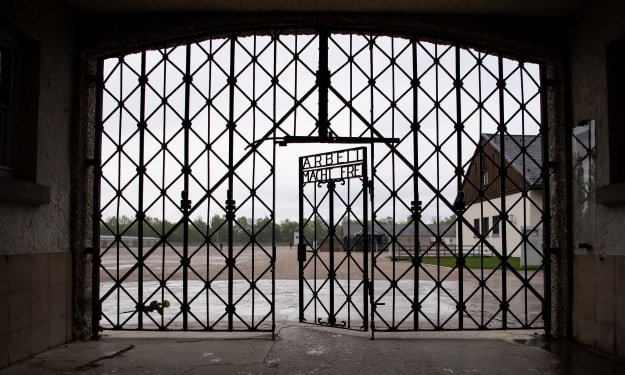
The First Nazi Concentration Camp
The Nazi Concentration Camps were one of the worst things to have ever happened in human history. In my opinion, they come only second to the nuclear weapon that was used on the Japanese City of Hiroshima. These are ‘incidents’ that will never be forgotten (or be allowed to be forgotten) within the “History Book” of humankind.
By Ruth Elizabeth Stiffabout 8 hours ago in Criminal



Comments
There are no comments for this story
Be the first to respond and start the conversation.