
Mikhail Popkov: Why is This Russian Serial Killer Cop Known as 'The Werewolf'?
...Not That There's Anything Wrong With That!

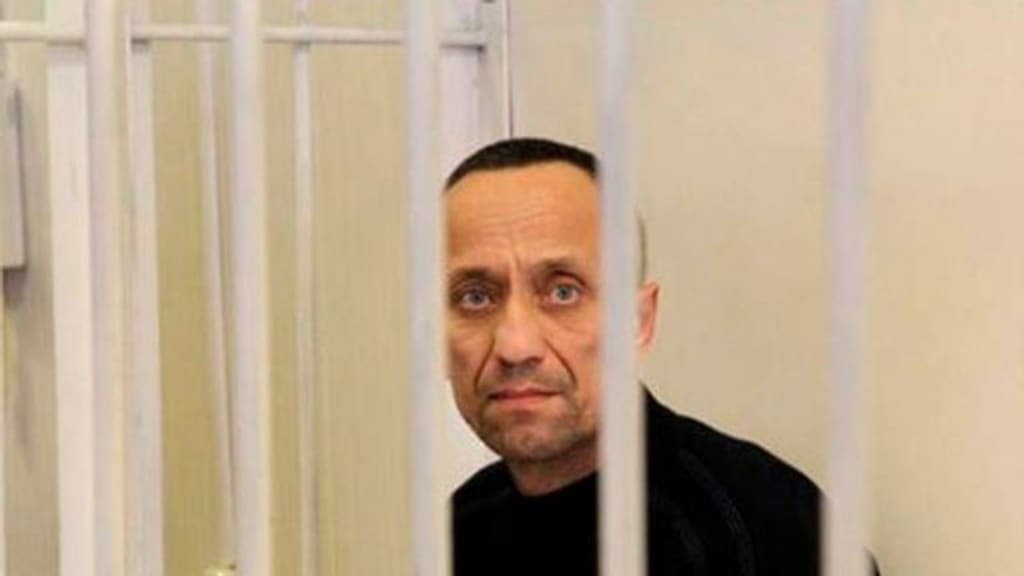
Mikhail Popkov is a relatively new serial killer to enter the hall of reprobate murderers, having been apprehended in June of 2012. In case you couldn't tell by his name, he was a Russian serial killer. Active between 1992 and (possibly) 2012, Popkov was successfully convicted of 78 murders, although he apparently confessed to over 80. Mikhail Popkov is interesting for another reason, too: He used to be a police officer.
That's right, this serial killer — often nicknamed "The Werewolf" — was also a police officer, and occasionally even used his police uniform as a way to lure his victims into trusting him (a tactic used by some other serial killers, including the notorious Ted Bundy, as well as the Hillside Stranglers). The Werewolf is believed to have killed more than fellow Russian serial killers Andrei Chikatilo and Alexander Pichushkin (the awkwardly-labeled "Chessboard Killer").
Popkov earned other names besides "The Werewolf," such as the "Angarsk maniac" and "The Wednesday Murderer" (due to many of his crimes occurring on Wednesdays, obviously). He explained his behavior as a sort of "purging" to "clean streets of Siberian cities of immoral women." However, these were definitely not mercy kills. He apparently confessed that he "loved to feel their pain."
Does the Popkov Story Say Anything About Cops ?
Being the year 2020, it seems there's a huge elephant in the room that I could've addressed earlier. In fact, I could've made this whole text about it. Here it is: A person like Popkov seems designed to make us distrust cops.
There, I said it. Let's face it: You were probably thinking that. Now before you accuse me of political bias here, this story must be augmented by another factor: Mikhail Popkov was himself ultimately caught by the police. In other words, this story deserves a more complex treatment than a simple "pig-bashing" narrative. In many ways, this story shows us the good, bad, and ugly aspects of policing, right?
The question is, what drew this murderer to his profession? I can't help but draw another parallel between Popkov and Ted Bundy, who similarly wanted to appear "normal" and to hold a position of some power and prestige. He was hobnobbing with the republican Party at one point, and also with police (ironically, and creepily, even writing an anti-rape pamphlet!).
In some ways, Popkov was actually better at the mask of normalcy. In addition to having a wife, daughter, and mother who still defend him (even after the confession and DNA-link evidence), his career as an officer almost kept him above suspicion. However, police vehicle tire tracks helped lead to his arrest and conviction, after it inspired a DNA dragnet of active and former police officers. So the profession that ostensibly gave him cover ended up blowing it, too.
Mikhail Popkov was also a private security guard, suggesting that he was always drawn to jobs where he'd have a special status and power over others. Like Bundy or Kemper, he was capable of beheading and raping victims, and apparently engaged in necrophilia. This leads some to speculate that he had some psycho-sexual animosity toward his mother. Although he killed a lot of women, some survived, suggesting he did not have the absolute control he wanted, or maybe even willingly relented.
A More Human Side?
Does this mean Popkov had a more "human side"? It's possible, but one can see it in another, more clinical way. Due to their conflicting mindstates, serial killers can alternately be over-confident and cocky or lose confidence and question what they're doing.
While these possibilities are contradictory, one must remember that no serial killer is 100% mentally stable, so they are likely to "slip up" eventually. Going back to Bundy (again), that killer was definitely interested in appearing normal and likely would have been so obsessed even if he had not been a serial killer. That is a possible element of narcissism, and it seems Popkov had this as well.
The question is, was it all 100% a ruse, or was there something real to it? Compartmentalized personalities paint a potentially complicated picture, as well as dissociative traits. While I'm an armchair psychologist, I'm familiar with true crime enough to know that, ultimately, these "monsters" are still human. In fact, if you study history, in general, you'll find plenty of ordinary people capable of evil acts. They can do it through mental compartmentalization.
This isn't to say Mikhail Popkov could or should be considered normal, but he's also not so abnormal that he's an absolute space alien. We know such people exist, and we can identify common traits to them, and perhaps even understand their motivations on some level — and we can do this without becoming them. We do know Popkov was found legally sane; He is not living in a secure psychiatric hospital, but a regular prison.
Serial Killings and Mythology
Mikhail Popkov isn't the first serial killer to be named after a mythological monster. For example, Germany's Peter Kürten earned the appellation of "The Vampire of Düsseldorf." Whatever we call Popkov, it's widely believed that Popkov began committing murders in 1992, and it's unfortunate that some will probably like what he did and emulate him, possibly trying to "outperform" him in their own comparably monstrous deeds.
Of course, it isn't always just a numbers game. Even if such killers manage to take one life, they are still a danger. Such is the case with another Russian murderer, Dmitry Luchin, a young man who murdered his date, ate her brain, and drank her blood. He's understandably been compared to a vampire and few would doubt reports that he admired infamous serial killer Jeffrey Dahmer.
While some believe writings like this encourage burgeoning serial killers to reach out for fame, let me attempt to burst that bubble. Not only are these characters evil, sinister, bad, and all that, but they obviously tend to get caught. How about becoming famous for something great rather than something destructive? Let this article act as a silver bullet for those would-be werewolves out there. There are better things to "transform" into.
About the Creator
Wade Wainio
Wade Wainio writes stuff for Pophorror.com, Vents Magazine and his podcast called Critical Wade Theory. He is also an artist, musician and college radio DJ for WMTU 91.9 FM Houghton.
Keep reading
More stories from Wade Wainio and writers in Criminal and other communities.
The Poisonous Legacy of Locusta: A Serial Assassin...Raped to Death by Giraffes?
For many of us, history was a boring subject in school. It was replete with a bunch of names, dates, and seemingly bland events that had us fighting off slumber in class. In fact, some of my only memories of history class involve my high school teacher showing up drunk (true story!). However, don't let boring-ass textbooks fool you; History is an absolute madhouse, with freakish details that might put the average horror film to shame.
By Wade Wainio5 years ago in Criminal
The $23,000-a-Day Question: Ephrata spends $8.5 million a year for police. What are we actually buying?
The Invoice Arrives Every year, Ephrata property owners receive a tax bill. A massive chunk of that bill goes to one place: The Police Department. We are told this is the price of safety. We are told that we have a "Gold Standard" department that warrants premium funding.
By Sunshine Firecrackerabout an hour ago in Criminal


Comments
There are no comments for this story
Be the first to respond and start the conversation.