
The Poisonous Legacy of Locusta: A Serial Assassin...Raped to Death by Giraffes?
Little is Known About Locusta, and That May Be For The Best.

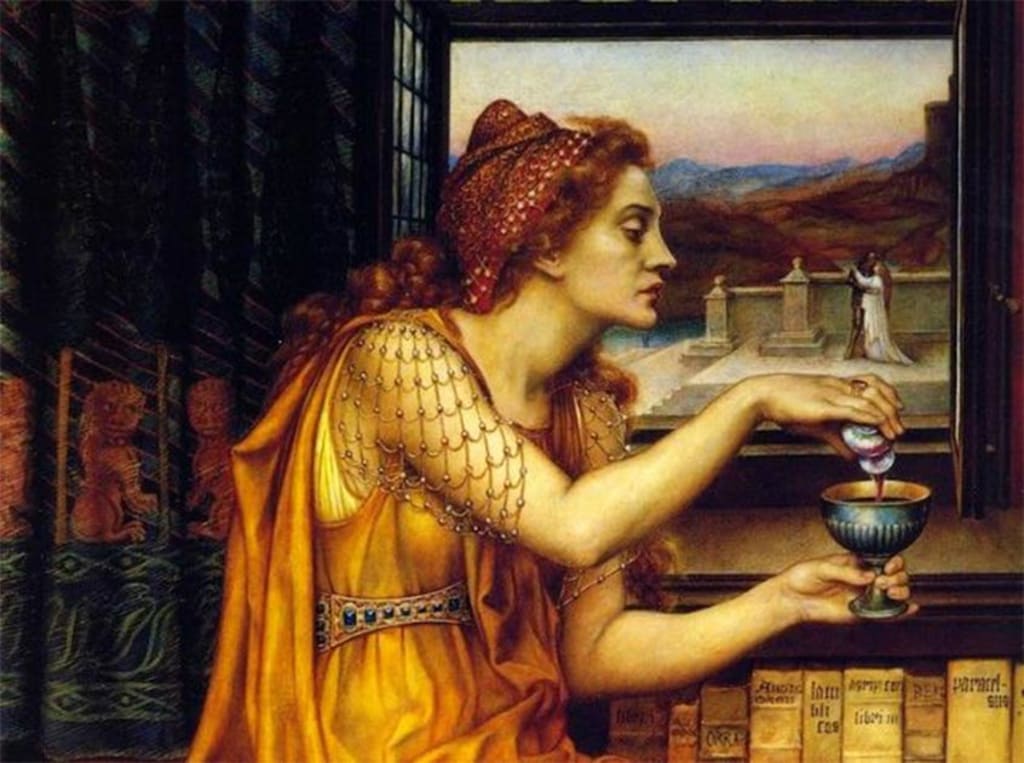
For many of us, history was a boring subject in school. It was replete with a bunch of names, dates, and seemingly bland events that had us fighting off slumber in class. In fact, some of my only memories of history class involve my high school teacher showing up drunk (true story!). However, don't let boring-ass textbooks fool you; History is an absolute madhouse, with freakish details that might put the average horror film to shame.
Locusta — or Locusta of Gaul — is a shining example of this phenomenon. Of course, it might not all be true, which is the dreaded caveat that must come with any recent news, let alone ancient historical accounts. So, just who was Locusta? She is most famously — and perhaps exclusively — known as a poisoner. It is said that she helped Agrippina the Younger murder her husband, the Roman emperor Claudius. Then she was tasked by Nero to murder Claudius's son, Britannicus, to assure that he would be the one to inherit the throne. Talk about a dysfunctional family!
Basically, the Julio-Claudian dynasty of Rome was messed up all over the place, with the sadistic Caligula fancying himself as a God, and Nero persecuting Christians and supposedly fiddling while Rome burned. Though, let's be real here: The fiddle didn't even exist as a musical instrument at the time, which means this is probably a myth. However, is it a myth that Nero utilized Locusta's poisonous prowess to murder Britannicus? Apparently not, as source after source indicates that this person actually existed.
Still, I must admit that, personally, I have no way of stating for sure what is absolutely real and what's absolute garbage in this story. To some extent, yes, I take this story as a matter of faith in the veracity of research and claims from the ancient historians (as well as contemporary, more professionally vetted researchers, of which I cannot honestly count myself).
What Appears To Be True
It seems that at one point during a meal, Britannicus cooled his food down with unknowingly poisoned water — provided courtesy of our girl Locusta. Roman historian Tacitus stated that the boy "immediately lost alike both voice and breath," which suggests he didn't even flop around like a fish after he croaked (to phrase it in a most tasteful manner).
Tacitus also describes the poisoner in his Annals, “This was the famous Locusta; a woman lately condemned as a dealer in clandestine practices, but reserved among the instruments of state to serve the purposes of dark ambition. By this tool of iniquity, the mixture was prepared.”
An article by India Today calls her "the world's first serial killer." That's technically not true, as I have already covered an older serial killer here named Liu Pengli, the Han Dynasty's Serial Killer Prince.
In any case, the scandal of Locusta doesn't just end with her chosen career path. The India Today piece also suggests that, as punishment for her murders, she was ultimately "raped to death by a giraffe." In case you're wondering, society at the time had fewer restrictions on cruel and unusual punishment, with that being about as cruel and unusual as one could reasonably expect punishment to be.
Locusta's Legacy
The blog "Dirty, Sexy History" likens her to a "Necro-Entrepreneur," and there certainly was money to be made. In any case, this morbid “Herbalist” has a fascinating story and deserves a place in the hall of twisted legends. Like so many others, she looked at the phenomenon of murder and thought, "Now here’s an opportunity!" Some might call her a "bad-ass," though I would consider poisoning someone a rather cowardly act — arguably even more so than stabbing someone in the back. In my book, she doesn't quite deserve the label of "bad-ass" for that reason.
When reading up on Locusta, I couldn't help but compare her to a scene from the animated classic, The Nightmare Before Christmas. Why? Apparently, Locusta advised some people to use "Deadly Nightshade." Well, in the aforementioned claymation masterpiece, the character of Sally (Catherine O'Hara) poisons her creator, Dr. Finkelstein (William Hickey) using Deadly Nightshade. Could this be a slight nod in Locusta's direction?
In addition to killing Claudius for Agrippina (with Nero claimed Claudius' last moments were just a seizure), it's said that Locusta opened a school for poisoners, and who knows what that implies about poisoning killings in her wake?
To some degree, the assassination of Claudius may have inspired the myth of the femme fatale or the general conception of a woman who has destroyed or might destroy a man. And who knows? Maybe in 1,000 years or so, she'll be misinterpreted as a distant item in human theogony, rather than a person who really existed?
More Biographical Stuff? Sorry! It's Mostly Just Speculation
I'm not the greatest historical researcher, but I did look a little for some more information on this crazy lady. Honestly, I couldn't find a whole lot.
Locusta was apparently born in Gaul (hey, it's often paired with her name itself). Other than what I've said about her already, it seems details are relatively scarce. Artist renderings seem to depict her almost as a demure, bucolic young woman, with a narrow waist (I would give her large, luminous eyes and make her as beautiful as Aphrodite, just for good measure).
According to the ancient biographer named Suetonius, she may have mostly done poisonings for Nero to receive a full pardon (he doesn't specifically claim she derived particular pleasure from the deaths attributed to her).
I wasn't able to find much more information on her personality. Was she flirtatious and fun-loving, or was she poisonous in more ways than one? In any case, it's difficult to imagine her as modest and childlike, given the nature of her work. There's no evidence that Nero was interested in Locusta's beauty, so I'll get that idea out of the way.
I couldn't find any information on her family background, or if she had a sexual relationship with anyone. Disorder and death seem to be her primary legacy. She killed to seal that legacy, and will forever be remembered as someone in service of death.
I also couldn't find information on anyone Locusta was even distantly related to, or anyone she may have studied with, or who studied at one of her poisoner schools. Still, this fill-in-the-blanks history is part of how myths and legends are born. Also, you may never see giraffes the same way again.
About the Creator
Wade Wainio
Wade Wainio writes stuff for Pophorror.com, Vents Magazine and his podcast called Critical Wade Theory. He is also an artist, musician and college radio DJ for WMTU 91.9 FM Houghton.
Keep reading
More stories from Wade Wainio and writers in Criminal and other communities.
Nicole M. Abusharif, The So-Called 'Lesbian Love Triangle' Murderer
After being found guilty of murdering Becky Klein in 2007, Nicole M. Abusharif was sentenced to 50 years — akin to life imprisonment, yet technically not. Upon reading this story, I must admit a big question struck me: Why only 50 years? Regardless of any exact opinion, I have heard of much harsher sentences for similar murders. Here's what happened: Abusharif had suffocated Becky with a plastic bag, wrapped her up in duct tape and left her in the trunk of a car. It was also believed that Becky was murdered out of greed, as Nicole potentially stood to gain $400,000 in an insurance payout. In any case, the murder was deemed as not being "cold, calculated and premeditated."
By Wade Wainio5 years ago in Criminal
The $23,000-a-Day Question: Ephrata spends $8.5 million a year for police. What are we actually buying?
The Invoice Arrives Every year, Ephrata property owners receive a tax bill. A massive chunk of that bill goes to one place: The Police Department. We are told this is the price of safety. We are told that we have a "Gold Standard" department that warrants premium funding.
By Sunshine Firecracker4 days ago in Criminal
Man Escaped Death Row, But He Could Not Escape Death: The Story of Troy Leon Gregg
The story of Troy Leon Gregg is one of the most haunting and ironic episodes in the history of the American criminal justice system. It is a narrative that seems almost fictional in its cruel symmetry: a man sentenced to die by the state escapes death row mere hours before his scheduled execution only to lose his life later that same night in a violent confrontation. Gregg’s story continues to resonate not only because of its dramatic events, but also because of the deeper questions it raises about fate, justice, violence, and the limits of human escape.Troy Leon Gregg was a death row inmate in the state of Georgia, convicted of serious crimes that ultimately led to a capital sentence. After years of legal proceedings and appeals, his execution date was set. For the prison system it was meant to be the final chapter in a long process. For Gregg, however the night before his execution would take an unexpected and shocking turn.
By Kure Garbaabout 15 hours ago in Criminal
Wild Card Weekend Recap: What Happens Now?
I think I figured out why I love Wild Card Weekend so much. It's because it's the first playoff anything of the calendar year. The NFL season starts in the fall, and once upon a time, the champion was crowned either on or slightly before New Year's. The evolution of the NFL schedule has resulted in the playoffs starting just into the New Year, and currently, the final week of the season falls on the first weekend of the New Year, with Wild Card Weekend coming a week after that. So yes, chronologically, the NFL's Wild Card Weekend serves as the first playoff anything of the calendar year.
By Clyde E. Dawkins7 days ago in Unbalanced




Comments
There are no comments for this story
Be the first to respond and start the conversation.