
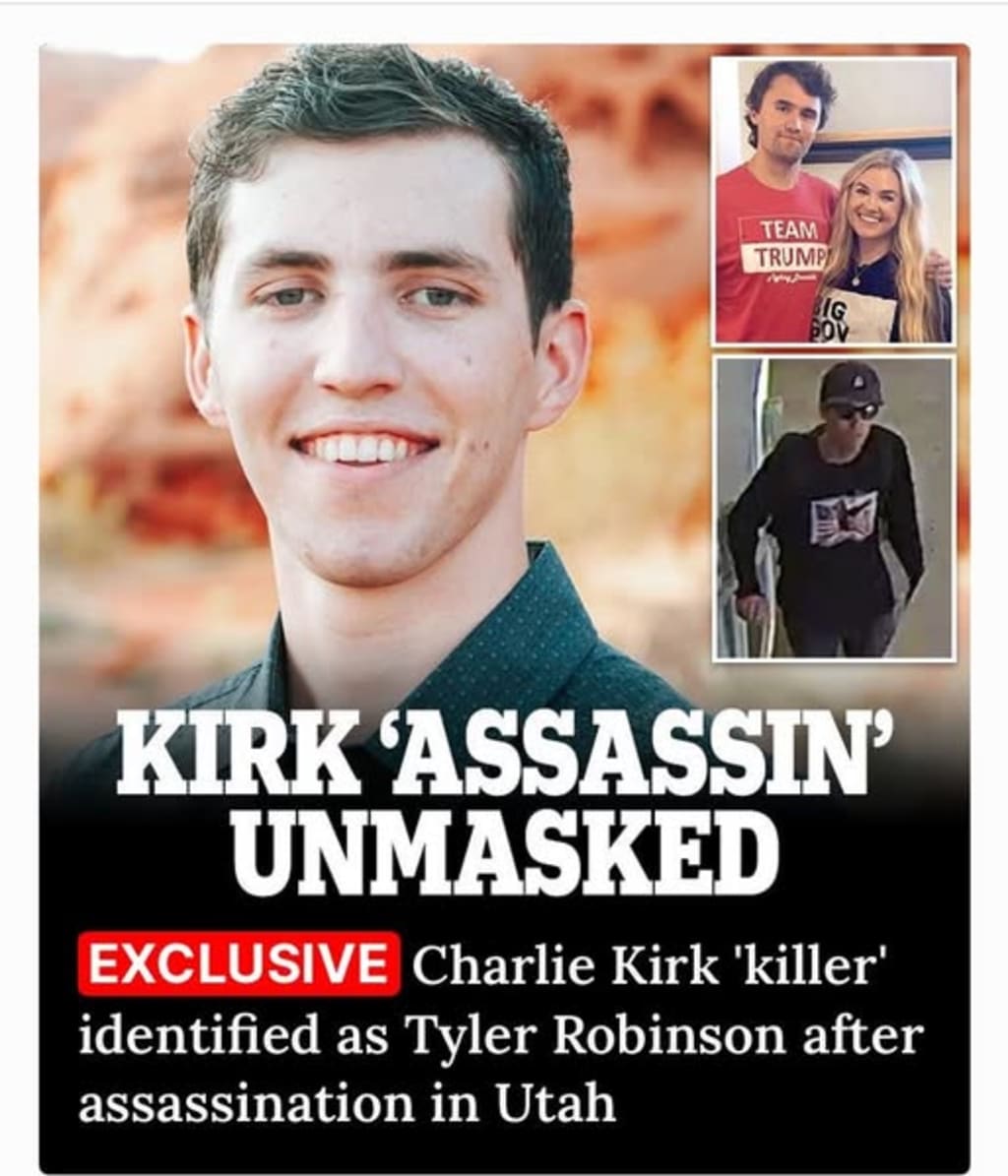
Kirk ‘ASSASSIN’ Unmasked.
Why use the word assassin?

Assassin or Terrorist? The Language of Hypocrisy in America’s Headlines
Notice the headline splashed across certain outlets: “Kirk ‘ASSASSIN’ Unmasked.”
The choice of the word assassin is not accidental. It sounds exclusive, dramatic, cinematic—like a political thriller unfolding in real life. It reduces the event to the act of a lone wolf, a misguided young man, an individual story detached from larger systems of belief or ideology.
But words are never neutral. They shape perception. They assign blame. They create heroes, villains, or scapegoats.
When Charlie Kirk was gunned down, Utah’s Governor Spencer Cox admitted something brutally honest in his address. For hours, he said, he prayed that the perpetrator would not be “one of our own.” He hoped it was an outsider—an immigrant, a stranger, someone from beyond state lines. But the prayer was not answered.
Because the gunman, Tyler Robinson, was not a stranger at all. He was the son of a conservative pastor. He was white, Christian, Republican. He came from within the very community Charlie Kirk celebrated and defended.
Now pause and imagine the same scenario, but with a Muslim perpetrator. Even if that person had only a Muslim-sounding name, even if he had never set foot in a mosque, the headlines would have screamed differently. “Islamist Terrorist.” “Radical Jihadist.” The narrative would shift instantly from an individual crime to collective guilt. Entire communities would be dragged into the dock of public opinion. Ordinary Muslims would face questions at airports, in classrooms, in their workplaces: “Why is your religion producing terrorists?”
This double standard is not theoretical. We saw it with 9/11, where two decades later, Muslims in America are still stigmatized by association. We saw it after the Boston Marathon bombing, when mosques across the country were vandalized. We saw it after the San Bernardino shooting, when presidential candidates openly suggested banning Muslims from entering the country.
And yet, when violence comes from white conservative men, the script changes. The labels soften. Dylann Roof, who massacred Black churchgoers in Charleston, was called a “disturbed loner.” Kyle Rittenhouse, who killed protesters in Kenosha, was portrayed by some politicians as a patriotic teenager defending his community. January 6 rioters, who stormed the U.S. Capitol in an act of domestic terrorism, are now reframed by right-wing figures as “hostages” rather than insurrectionists.
So when Tyler Robinson pulled the trigger on Charlie Kirk, the word chosen was not terrorist, but assassin. A word that almost lends a perverse dignity—an echo of historical figures, from Julius Caesar’s killers to Cold War spies. It dresses up murder in the cloak of political theatre.
This hypocrisy was laid bare in the reactions of politicians. Representative Nancy Mace initially thundered, “Time to bring back the death penalty.” But once Robinson’s identity was revealed, her tone softened. Suddenly he was no longer a monster but “a young man who lost his way,” someone to be prayed for rather than condemned.
Even Israel’s Prime Minister Benjamin Netanyahu could not resist trying to link the shooting to “radical Islamists,” despite clear evidence that the shooter was neither Muslim, nor Arab, nor Palestinian. The script is so ingrained that some cannot help but place the blame on Islam—even when Islam is nowhere near the story.
This is the open wound of America’s discourse:
If the killer is Muslim, the guilt is collective. The burden falls on an entire religion, an entire people.
If the killer is white and conservative, the guilt is individualized. It becomes a family tragedy, an isolated misstep.
Charlie Kirk did not die at the hands of Muslims, liberals, Black radicals, or transgender activists—the groups he so often vilified. He died at the hands of someone from his own cultural and political tribe. That is the bitter irony.
And yet, the media still struggled to apply the word terrorist to one of their own. They reached for the safer, more palatable assassin.
Words matter. They shape justice, policy, and public sentiment. As long as “terrorist” remains a label reserved for brown or Muslim bodies, while white Christian men get the cinematic title of “assassin,” America will continue to betray its own claim of equality before the law.
Until that changes, every new headline will reveal not just a tragedy, but the hypocrisy that shadows it.
About the Creator
Abdul Azim Marzuki
"Architectural background with a passion for sharing knowledge. Freelance graphic designer and homesteader, exploring permaculture. Hobby photographer capturing life's beauty. Sharing my experiences and learning through each adventure."
Keep reading
More stories from Abdul Azim Marzuki and writers in Criminal and other communities.
The Miraculous Ants and the Divine Revelation to Prophet Muhammad
When we observe the lives of ants, we encounter fascinating phenomena that have been studied by researchers for centuries. One significant discovery is the role of ant queens or queen ants within ant colonies. In 1781, a biologist named Pierre André Latreille discovered that within ant colonies, there is one female ant that serves as the queen, laying eggs and ensuring the survival of the colony.
By Abdul Azim Marzuki3 years ago in Earth
“Daddy’s Girl” Scandal Erupts: Arizona Courts Protect Kristyn Alcott Despite Mounting Evidence of Alleged Misconduct, Deception, and Child‑Safety Failures
Maricopa County, AZ — January 13, 2026 — ”Daddy’s Girl” Scandal Explodes: Arizona Family Courts Let Disgraced Supervisor Kristyn Alcott Keep Working Amid Credible Allegations of Perjury, Impersonation, Fraud, and Child Endangerment.
By Anna Justice3 days ago in Criminal
The Global Power Struggle in 2026: Why Are Tensions Rising Between the United States, Russia, China, and Venezuela?
f tensions between the United States and each of Russia, China, and Venezuela. These tensions cannot be understood as isolated events or temporary crises; rather, they are a direct reflection of a deeper struggle over global influence, strategic resources, and the future shape of the international order. At the center of this complex scene, Venezuela has emerged as a major flashpoint, while Russia and China play the role of supporters and counterweights to U.S. actions.
By America today 4 days ago in Criminal


Comments
There are no comments for this story
Be the first to respond and start the conversation.