
The Global Power Struggle in 2026: Why Are Tensions Rising Between the United States, Russia, China, and Venezuela?
The Global Power Struggle in 2026: Why Are Tensions Rising Between the United States, Russia, China, and Venezuela?

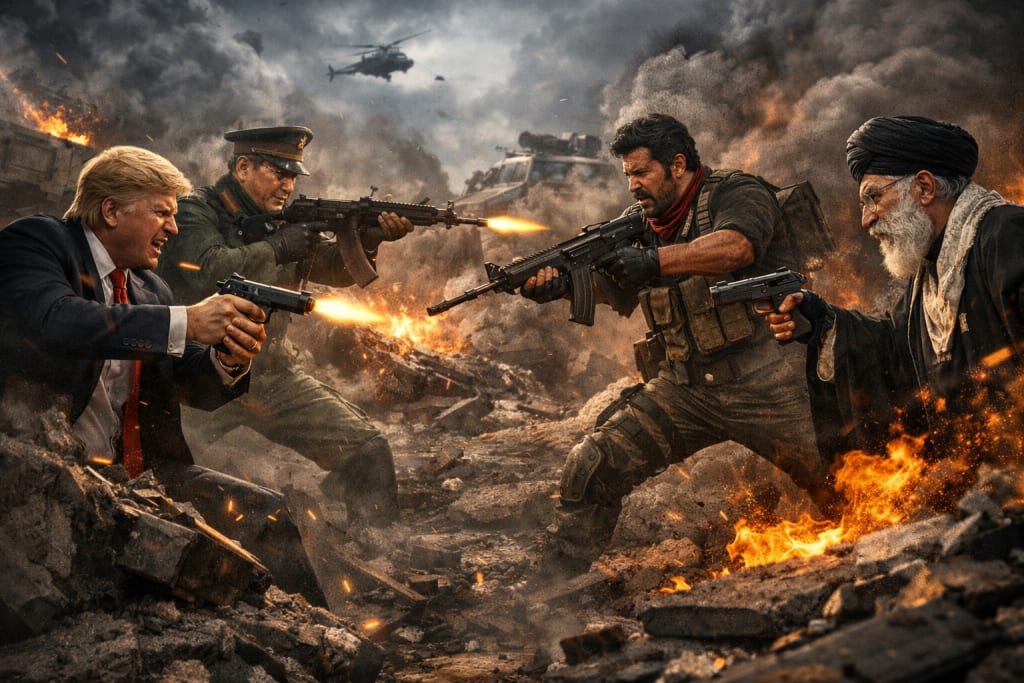
f tensions between the United States and each of Russia, China, and Venezuela. These tensions cannot be understood as isolated events or temporary crises; rather, they are a direct reflection of a deeper struggle over global influence, strategic resources, and the future shape of the international order. At the center of this complex scene, Venezuela has emerged as a major flashpoint, while Russia and China play the role of supporters and counterweights to U.S. actions.
The Shift in U.S. Foreign Policy Toward Direct Confrontation**
The roots of the current crisis lie in a clear shift in U.S. foreign policy, which has increasingly favored direct action over reliance on economic sanctions and diplomatic pressure. Washington has taken unprecedented steps toward Venezuela, a country that holds one of the world’s largest oil reserves, viewing the continuation of its ruling system as a threat to regional stability and to U.S. strategic interests in the Western Hemisphere. This shift has revived older concepts in American policy aimed at preventing rival powers from expanding their influence in the United States’ immediate geographic sphere.
Venezuela as an Arena of Competition Between Major Powers**
Venezuela has not merely been a country suffering from internal economic and political crises; over recent years, it has transformed into an important ally for both Russia and China. Moscow established close military and economic ties with Caracas, including cooperation in the fields of energy and arms, while China invested billions of dollars in the oil sector and infrastructure. This convergence turned Venezuela into an arena of indirect confrontation among major powers, where the conflict extended beyond domestic Venezuelan affairs into broader international calculations.
Russia and Fears of Losing Strategic Influence**
Russia viewed the U.S. move as an indirect message directed at Moscow. As a state seeking to restore its status as an influential global power, Russia considers the removal or marginalization of its allies by force a direct blow to its ability to build an international balance against the United States. Losing Venezuela would also mean a reduction of Russian influence in a region long considered outside Moscow’s traditional sphere of influence, which explains the sharp tone of Russia’s response to recent developments.
China Between Strategic Caution and Economic Anxiety**
China, for its part, approached the crisis with greater caution, yet did not hide its deep concern. Beijing understands that what happened in Venezuela could set a precedent that might later be applied to other countries with which China has economic or strategic relationships. Moreover, U.S. control over vast oil resources represents a direct threat to China’s energy security at a time when Beijing is seeking to reduce its dependence on supply routes under American influence.
U.S.–China Tensions Beyond Venezuela**
Tensions between the United States and China are not limited to Venezuela alone; they extend to more complex issues such as trade, technology, and military influence in Asia and the Pacific. Nevertheless, developments in Latin America add a new dimension to this rivalry, as Washington seeks to send a clear message that it will not allow the region to become an arena of Chinese or Russian influence, regardless of the political or diplomatic costs.
The Inability of the International System and Global Institutions**
At the same time, the crisis highlights the limitations of international institutions in containing conflicts of this nature. The United Nations Security Council, which is supposed to serve as a platform for managing major disputes, has appeared incapable of taking effective action amid sharp divisions among its permanent members. This paralysis reinforces the sense that the current international system is no longer equipped to manage shifting power dynamics and that the world is moving toward a more chaotic phase in international relations.
Economic Consequences and Global Energy Markets**
Economically, these tensions carry wide-ranging consequences that extend beyond the countries directly involved. Global energy markets are closely monitoring the situation in Venezuela, given the potential for prolonged disruption in production or exports to cause sharp fluctuations in oil prices. In addition, escalating tensions among major powers may push states to reconsider their economic alliances and accelerate efforts toward energy diversification.
Domestic Debate in the United States Over Escalation**
Domestically, the United States is witnessing intense debate over the wisdom of this escalatory approach. While supporters argue that such policies are necessary to protect American interests and deter rivals, critics warn that engaging in multiple confrontations simultaneously could overstretch U.S. capabilities and increase the risk of direct clashes with other major powers. This debate reflects a deeper division within American society over the country’s role in the international system.
Conclusion: The Global Landscape and the Future of the Conflict**
In conclusion, the tensions between the United States, Russia, China, and Venezuela reveal a transitional phase in the international order, where old rules are no longer sufficient to regulate state behavior, and new, widely accepted norms have yet to emerge. The current struggle is one over influence, resources, and political narratives, and it is likely to continue in various forms over the coming years. The central question remains whether this conflict will stay confined to political and economic pressure or escalate into broader confrontations that could reshape the map of international relations entirely.
About the Creator
America today
Breaking news, political insights, real-time analysis, U.S. politics, global politics, elections, government policies, international relations, diplomacy, political debates, trending political stories, expert commentary, factual reporting,.
Keep reading
More stories from America today and writers in Criminal and other communities.
USS Abraham Lincoln in the South China Sea: Power Projection and Public Questions
USS Abraham Lincoln in the South China Sea: Power Projection and Public Questions The presence of the USS Abraham Lincoln in the South China Sea has drawn global attention due to the strategic importance of the region and the role of US naval power. As a nuclear powered aircraft carrier, the USS Abraham Lincoln represents one of the most advanced assets in the United States Navy. Its deployments are closely watched by governments, analysts, and the public because they reflect broader geopolitical dynamics and security priorities in the Asia Pacific region.
By America today 8 days ago in Criminal
Robert William Fisher: The Unresolved Mystery Behind One of America’s Most Notorious Fugitives
Few criminal cases in the United States have remained as haunting and unresolved as that of Robert William Fisher. More than two decades after his disappearance, Fisher’s name continues to appear on the FBI’s Most Wanted list, symbolizing both a tragic family crime and one of the longest-running manhunts in modern American history. His case blends elements of domestic violence, psychological profiling, forensic investigation, and unanswered questions that still trouble law enforcement and the public alike.
By Salaar Jamali2 days ago in Criminal
A Real Story: The Day Ameneh Bahrami Lost Her Sight
In 2005, Tehran woke up to what seemed like an ordinary morning. Buses were running, offices were opening, and students were heading to their universities. The city was moving through its usual routine. No one knew that, in one small part of the city, a tragedy was about to occur—one that would later shock the entire world.
By shakir hamid5 days ago in Criminal




Comments
There are no comments for this story
Be the first to respond and start the conversation.