
"...In Their Blood and from the Gutter."
Summer of Sam (1999)

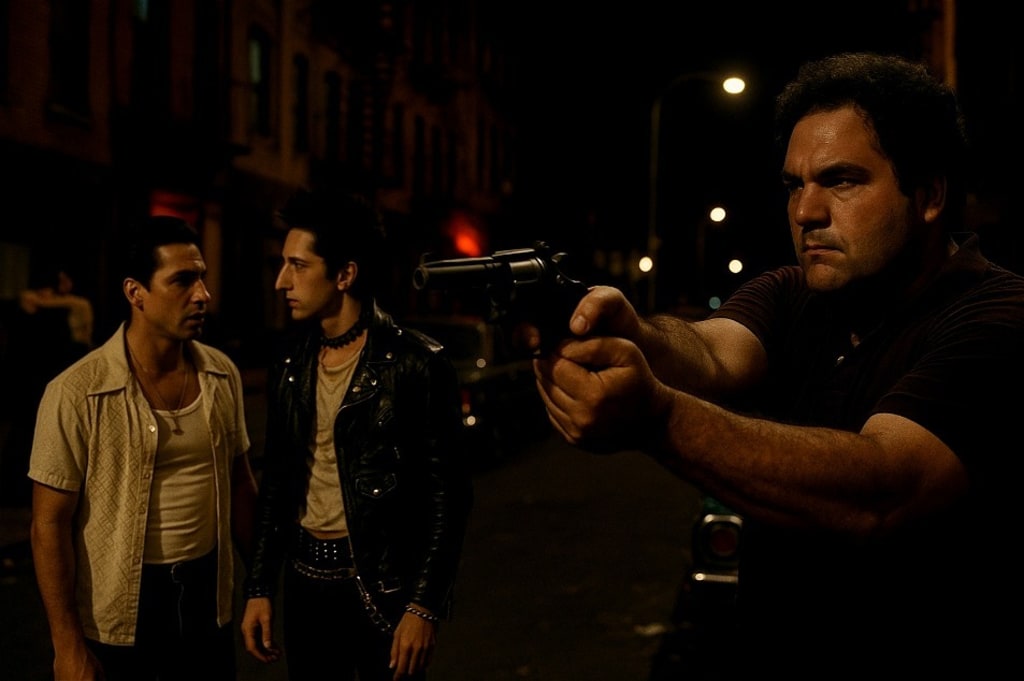
Spike Lee's Summer of Sam is easily one of the greatest, most electrifying and engrossing movies of the last twenty-plus years. It's a raw, violent, bloody wound of a picture, detailing the tailspin of broken lives, self-destructive, tortured relationships, and criminal underworlds all converging against a backdrop of the long, brutal, burning summer of 1977, NYC, which was stalked intermittently but with increasing desperation and terror by a lone, .44 caliber-wielding serial slayer: the intensely schizophrenic David Berkowitz.
Berkowitz dubbed himself the "Son of Sam," supposedly after neighbor Sam Carr's black Labrador retriever became "possessed" by the ancient spirit of a demon named Harvey, who commanded Berkowitz that he should kill.
Berkowitz (played by Michael Badalucco) is presented here rarely, rarely as anything more than the punctuation to various scenes—a kind of dubious reminder, along with the actual depiction of the killings, that the film is set against the backdrop of a famous series of murders. In the foreground is the story of Vinnie, played literally flawlessly by John Leguizamo, in a characterization so utterly authentic he could be a star in an episode of a modern reality TV show. Vinnie's friend is Richie (Adrian Brody), a young man obsessed with British punk rockers (he affects a bad Sid Vicious accent). Richie's new look and attitude don't sit well with the neighborhood toughs and low-level hoods he grew up with, who gather, along with Vinnie, to deal drugs and generally abuse their clientele, such as "Bobby the F*g," a gay man portrayed by the late Brian Tarantina.
Vinnie, a hairdresser, is a slicked-up, disco-loving guy that vaguely resembles Al Pacino in Scarface, but he is far more likable. He's also a pervert and philanderer who cheats on wife Dionna (Mira Sorvino) with her cousin, and wants to explore forms of sex he doesn't want to ask her to perform. The two lead a life of nightclubbing and discotheques, nice clothes but otherwise unstable relations. Richie, by contrast, sleeps in his mother's garage after she marries Eddie, played by Mike Starr.
Richie eventually hooks up with Ruby (Jennifer Esposito), who wants to "ditch these disco clothes" and become a punk rocker like Richie. They begin a relationship, form a band, book a gig at CBGB's, and generally begin to look more and more like Sid and Nancy (although punk rock fashion here is a little anachronistic, depicting pierced faces and mohawks—a look that didn't originate until a few years after the events depicted in the film).
Richie makes his money dancing in a gay strip club. He also does porn, and gets Ruby into doing it as well. His "goombah" former friends are a tough lot, and when the police go to the neighborhood crime boss, Luigi (Ben Gazzara), they get hired in the role of tracking down the killer and bringing him to vigilante justice. While all of this is going on, a blackout and a full-scale riot ensue, with the majority of damage being done in the Bronx and primarily Black Bedford-Stuyvesant neighborhoods. Spike Lee himself plays a seemingly eternally unruffled TV reporter.
Vinnie and Richie—but mostly Vinnie—spiral down to their own mutually destructive endings. The film could be compared to the best of Scorsese, and the relationship between Vinnie and Richie is reminiscent of the relationship between Charlie and Johnny-Boy (Harvey Keitel and Robert De Niro, respectively) in Mean Streets (1973). There, "made man" Charlie is almost puzzlingly loyal to self-destructive psychopath Johnny-Boy, despite the fact that Johnny-Boy's erratic and dangerous behavior brings about the wrath of a tough local gangster, Michael, played by Richard Romanus. Here, Richie's choice to become a punk rocker—which makes him stand out in the conservative and traditional Italian-American neighborhood—invites suspicion that he is the Son of Sam.
Vinnie shrugs off and defends Richie's new lifestyle up until the end, when he's forced to make a choice between loyalty and self-preservation. He's existing by this point in a haze of booze, coke, and Valium, Dionna having left him and having lost his job after showing up drunk at work. The ending is punctuated by the violence that encircles the lives of these people—Richie, Vinnie, the gang of neighborhood toughs, Berkowitz himself, obviously. The message is about the power of scapegoating, but the film is more than that.
It is a raw, blood-soaked tapestry of a very distinctly visceral era of American life—a crime spree of maddeningly insane and sick proportions, the little lives that are swept up in their own chaotic turmoil, and of the friendships that do not survive the personal evolutions that command us forward. It is about the power of guilt, and the search for personal redemption that seems, ultimately, to flounder on the shores of treachery, betrayal, and a will toward self-destructive nihilism. Berkowitz, most often portrayed here as a hulking, gun-wielding back walking the dark streets of death, is simply the symbol—the "hole in the wall" in which the little man he imagined lived gives birth to his monstrous children, who sweep up common, bitter lives in the maelstrom of their wake.
Jimmy Breslin, the famous journalist, provides both the opening and closing monologue for the film. Berkowitz mailed Breslin letters during the time of the killings. The letter, at least to this author, seems to slightly echo the words from one of Jack the Ripper's letters to London Police. We quote from it below:
Not knowing what the future holds I shall say farewell and I shall see you at the next job. Or, should I say you will see my handiwork at the next job? Remember Ms. Lauria. Thank you. In their blood and from the gutter, Sam’s Creation.
Berkowitz painted a picture for the reader. Spike Lee, in his film, paints one for the viewer. It smells like something rotten, as greasy and foul as an unwashed armpit. Dotted with flies, it's speckled with red.
In their blood.
And from the gutter.
SUMMER OF SAM - Trailer - HQ
Follow me on Twitter/X: BakerB81252
My book: Cult Films and Midnight Movies: From High Art to Low Trash Volume 1
Ebook
About the Creator
Tom Baker
Author of Haunted Indianapolis, Indiana Ghost Folklore, Midwest Maniacs, Midwest UFOs and Beyond, Scary Urban Legends, 50 Famous Fables and Folk Tales, and Notorious Crimes of the Upper Midwest.: http://tombakerbooks.weebly.com
The Charlie Kirk Phenomenon
September 10, 2025, will be etched into the recent history of the United States not as a mere day of campaigning or academic debate, but as the moment when political polarization reached a point of no return. Charlie Kirk, one of the most influential and simultaneously controversial figures of modern conservatism, was the victim of a brutal assassination during a public event at Utah Valley University. This event did not just mark the tragic end of a 31-year-old thought leader; it triggered a wave of reactions that exposed deep social tensions, wild conspiracy theories, and a fierce debate about the limits of hatred in the digital age.
By Teodor Monescu4 days ago in Criminal
EXCLUSIVE: Lil Durk Held In Solitary For 131 Days Over Apple Watch As Lawyers Fight Prison Condition
The Segregated Housing Unit (SHU) program is intended to protect jail inmates from others or others from themselves at the Metropolitan Detention Center (MDC) among other locations around the country and world.
By Skyler Saunders5 days ago in Criminal
📢 Raise Your Voice Thread: 01/08/2026
Our “Raise Your Voice Threads” are hosted most alternating Thursdays at 12PM ET to offer creators more avenues to uncover exceptional stories on Vocal. As we are continuously searching for fresh creators and inspiring stories, this thread provides an opportunity to exchange and discuss the stories that have moved and motivated us on Vocal.
By Raise Your Voice by Vocal4 days ago in Resources


Comments (1)
Great