
Black Fingers
Burke, Hare, and "The Doctor and the Devils"

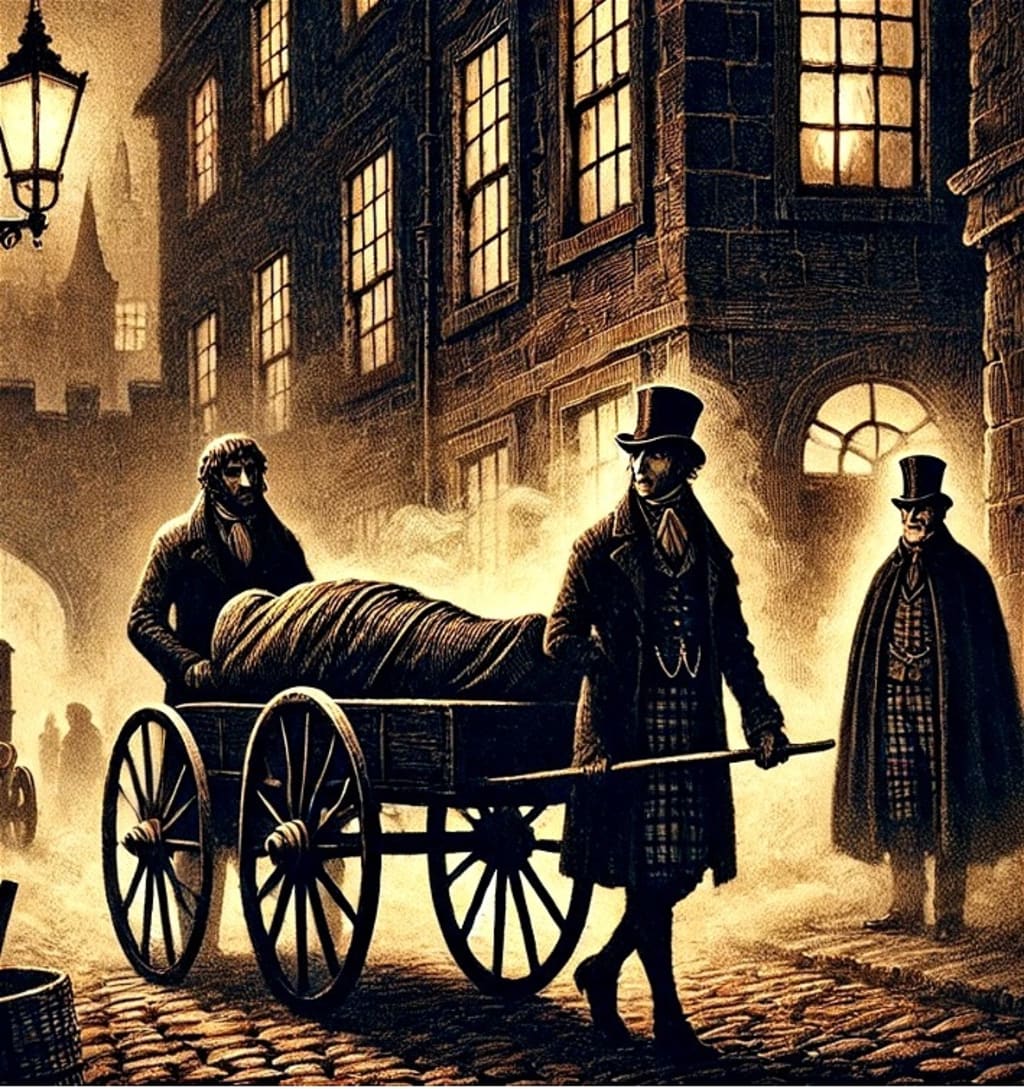
“Some have green fingers for gardening. Others have black fingers for death.”
—The Doctor and the Devils (1985)
Long ago, I composed a little poem that must have unnerved my English professor. It read, in part:
Burke and Hare were quite a pair, they'd never be found out.
They'd traipse into a tomb or two, and steal the body out.
And sell those bones to Dr. Knox, who never let a word,
That his best subjects were the ones, "unlawfully disinterred."
It finished with the famous jump-rope song:
Through the close, up the stairs, in the house with Burke and Hare.
Burke's the butcher, Hare's the thief, Knox the boy who buys the beef...
(It is quite amusing the sorts of things these children can dream up. Don't you agree?)
A History of Resurrection Men and Murder
Burke and Hare were Irish immigrants living in Edinburgh in 1827 when one of their lodgers died owing them some back rent. They sold the body, still in their possession, to Dr. Knox at Edinburgh Medical College, for dissection. This was a common practice in this particular primitive era of science, when moral and religious taboos made it necessary for "resurrection men" to go grave robbing, eagerly seeking out the freshly dead to sell them to anatomical researchers of a decidedly more affluent caste. The bourgeois doctors bought the illegally procured cadavers with no questions asked. This practice was the basis of Robert Louis Stevenson's story The Body Snatcher.

Burke and Hare thus found they could participate in this sordid, criminal enterprise and earn enough money for a bottle of grog and a cheap fling with a toothless, half-starved, scabrous whore. Sure. It was a hard, sickening life for a drudge, but fate being what it is, it was all they had ever known; what they were born to.
Eventually, they ended up just skipping all the hard work and backbreaking toil involved in digging up cemeteries at night. They simply began to MURDER their lodgers, including a mentally impaired man called "Daft Jamie," the surviving engraved image of him portraying a slack-jawed imbecile or near-idiot with his tongue hanging out. (It could almost be an illustration from Struwwelpeter.) It was reportedly this murder that led to them being apprehended (or at least, it was in one account I read).
Dr. Knox bought the corpses they supplied although they were barely cold, obviously realizing that there was something amiss—that the cadavers were not being supplied from the graveyard, but from the stinking, filthy, shit-besmirched slum dwellings and hopeless, whore-haunted streets. He never let a peep, turned a blind eye, and became an accomplice to murder. He was not punished by the law (although Burke certainly was, being hanged and then stripped of flesh and exhibited, ironically, at the medical college to which he had formerly supplied so many corpses).
The Film’s Moral Center: Class, Crime, and Cold Calculation
And therein lies the moral schism at the center of The Doctor and the Devils. It portrays a sharply class-based hierarchy wherein two stinking, low-caste psychopaths, "Fallon and Broom" (played respectively and flawlessly by Jonathan Pryce and Stephen Rea) can be tried and convicted of heinous crimes they did not act alone in, but were joined in by a high-caste, "respectable," handsome and clean-fingered young doctor (the cinematic equivalent of Knox, "Dr. Rock," infused with a restrained, guiltless and icy exterior by Timothy Dalton), who is given a reprieve by the authorities by dint of his station in life, the "great services" he has rendered to the sick, the poor, the ailing—and the human understanding of anatomical science. Hear, hear.
The late, lamented Julian Sands, who was killed tragically two years ago while hiking Mount Baldy in California, plays Dr. Murray, a colleague to the good doctor, and he's hiding a secret love affair with the prostitute Jennie, played by Sixties celebrity actress Twiggy. (It's an ensemble cast and also includes Patrick Stewart, Captain Picard himself, and Siân Phillips, as the wife of Dr. Rock. Both of them appeared the year before in David Lynch's ill-fated adaptation of Dune. The only actor who seems as if he should be here but isn't is Mr. Bytes himself, Freddie "The Elephant Man" Jones, who was in all of these Victorian and gothic dramas, it seemed.)
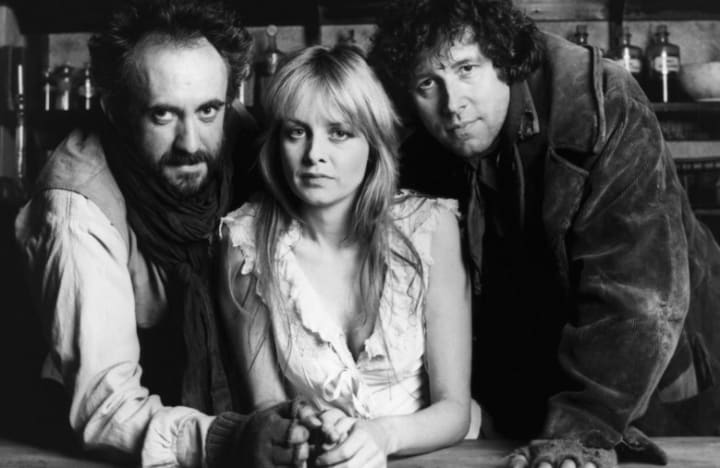
Sands, of course, would go on to portray Percy Shelley in Ken Russell's extraordinary film of the night Frankenstein was conceived, Gothic (1987), a film starring fellow doomed actor Natasha Richardson. That film, which also starred Gabriel Byrne and the strangely beautiful Miriam Cyr, was replete with nightmarish fantasy, and the cinematic excess Ken Russell was famous for. Here, director Freddie Francis directs with stark restraint, and it is difficult to find a subtext in a movie so straightforward and conventional as far as the narrative is concerned. It is simply the story of Burke, Hare, and Knox.
Performances are adequate to excellent. Pryce, in particular, portrays the descent of "Fallon" into the bestiality of being a serial slayer—a man who desperately begs his accomplice for a pillow so they can kill a couple of prostitutes "just one last time." Alas, it was the final murders that sealed the dastardly duo's fate.
Dalton as Rock is coldly analytical and unconcerned with the morality of the curious business arrangement. After all, what is the death of a few street scum and whores compared to the potential advancement of medical science? He's going to be lauded as a genius someday, mind you.
Alexandra, his wife, is a neurotic, icy, mid-Victorian dame whose obsession with the flesh most likely precludes sex and invites nightmares of anatomical charts and hideous presentiments of what is to come. Sands, as Dr. Murray, is impassioned for Jennie, who laughs at his idea of loving her. A gentleman doctor such as himself, loving a whore? Such things didn't happen, were doomed to failure, and he knows it as well.
Fallon and Broom are sociopaths who divert the misery of their existence by drinking gin and whoring at the pubs.
In the end, it's a horror movie about class inequity, poverty, and hypocrisy. Rock is burned in effigy. Broom turns "King's Evidence" and escapes the gallows. Only Fallon is made to pay the consequences of his actions, in a scene that turns the table on the man who made the murder method called "Burking" (smothering with a pillow) famous with his name.
He is hanged. The film is abrupt and grim, its ending and its entire runtime exhibiting no deep philosophical highs or lows. It's a story of class and morality in Victorian Scotland, played against the dark, rain-soaked streets.
Legacy, Remains, and the Last Word
Rock strides like a character from an old engraving into the annals of criminal history. The real Burke was stripped of flesh and put on display, although, as previously noted; like Jeremy Bentham, it may require special permission to view the remains. (By contrast, the remains of Joseph Merrick, the famous "Elephant Man," were eventually taken and buried in an undisclosed location. I can't offhand think of any other Victorian remains that were put on display, save for maybe those explorers who froze to death when their ship became lost in the Arctic.)
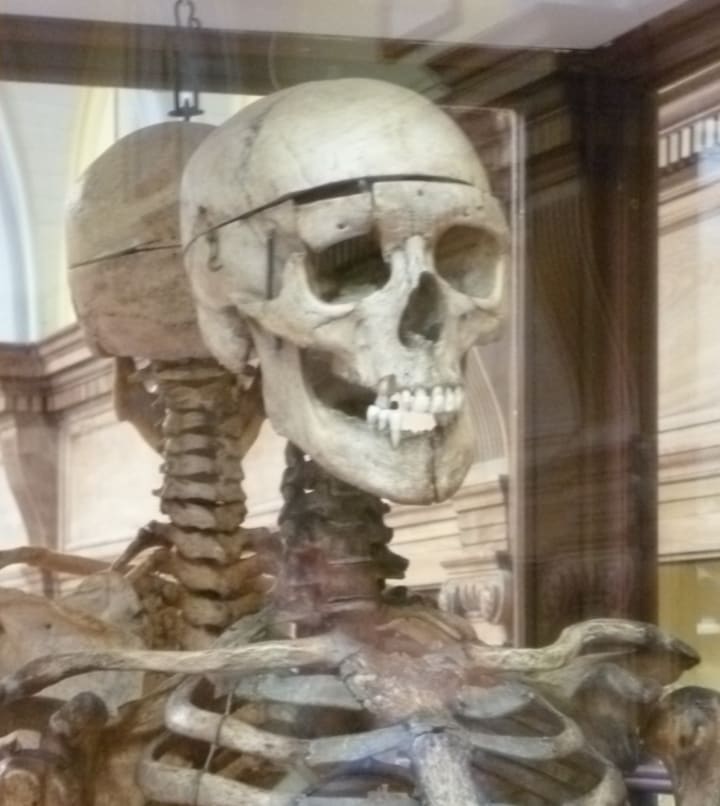
We should also note that Burke's flesh reportedly was used for the binding of a book.
This, considering he was most likely illiterate, proves that history never halts having fun with irony.
The Doctor and the Devils is based, incidentally, on a screenplay by Dylan Thomas, which I read years before ever seeing this film.
The Doctor and the Devils HD Trailer
Connect with me on Facebook
My book: Cult Films and Midnight Movies: From High Art to Low Trash Volume 1.
Ebook
About the Creator
Tom Baker
Author of Haunted Indianapolis, Indiana Ghost Folklore, Midwest Maniacs, Midwest UFOs and Beyond, Scary Urban Legends, 50 Famous Fables and Folk Tales, and Notorious Crimes of the Upper Midwest.: http://tombakerbooks.weebly.com
Murders of Innocence
There is something to be said about childhood trauma. It somehow has a way of showing its ugly head in the life of all monsters. I know it’s only one fact that goes into the making of a monster, hear me out. I know there are other little buildings blocks associated with the “build a little monster kit” most parents don’t even realize they come equipped with in their arsenal of unloving. Yes, I know what I said.
By Cassie Moorea day ago in Criminal


Comments (1)
Sounds fascinating. Great review, Tom!