
ICE Agent Shooting of Renee Good: What does the DOJ Manual say?
What does the Department of Justice Manual for Law Enforcement say?

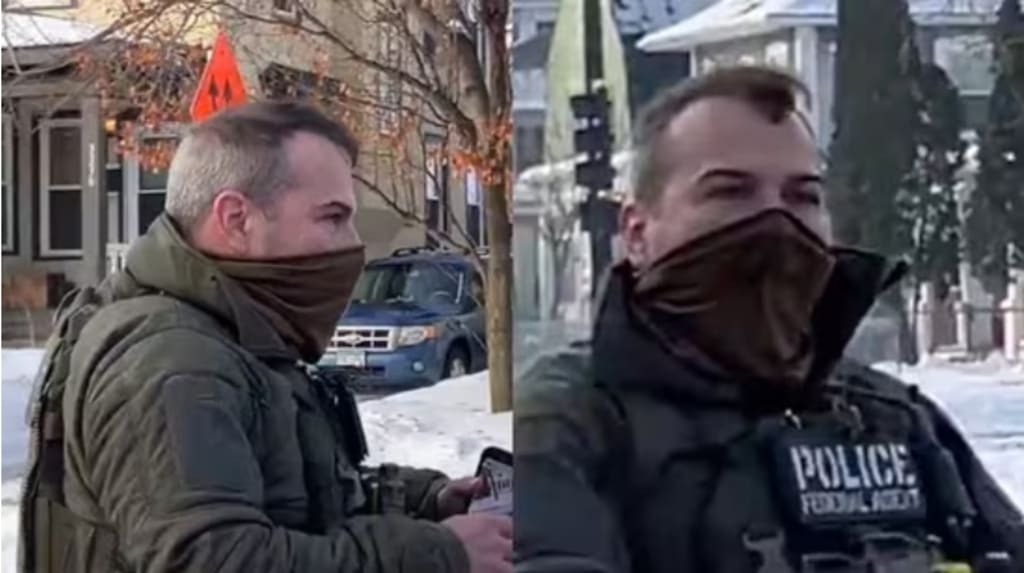
There is no easy way to say this. Whether he is justified or if it is homicide, he is innocent until proven guilty in a court of law, but ICE Agent Johnathan Ross shot and killed Renee Good in Minneapolis on January 7, 2026.
People on the left and right are arguing to decide if this was a justified shooting or if it was excessive force on the end of Agent Johnathan Ross. Many state that she was trying to hit him with her vehicle. The others state she was turning her vehicle away. To deem excessive force, a proper investigation of the shooting needs to be done. But currently, that investigation is being blocked by the Department of Homeland Security and Federal Law Enforcement. Vice President JD Vance states Ross has complete immunity.
Many people wonder what the rules and regulations are that Ross has to follow while being a Federal Agent when it comes to use of force on a vehicle and person in the vehicle. Below is an excerpt straight from the Department Of Justice Manual.
1-16.200 - USE OF DEADLY FORCE AND PROHIBITED RESTRAINT TECHNIQUES
A. Deadly Force
Law enforcement and correctional officers of the Department of Justice may use deadly force only when necessary, that is, when the officer has a reasonable belief that the subject of such force poses an imminent danger of death or serious physical injury to the officer or to another person.
Deadly force may not be used solely to prevent the escape of a fleeing suspect.
Firearms may not be discharged solely to disable moving vehicles. Specifically, firearms may not be discharged at a moving vehicle unless: (1) a person in the vehicle is threatening the officer or another person with deadly force by means other than the vehicle; or (2) the vehicle is operated in a manner that threatens to cause death or serious physical injury to the officer or others, and no other objectively reasonable means of defense appear to exist, which includes moving out of the path of the vehicle. Firearms may not be discharged from a moving vehicle except in exigent circumstances. In these situations, an officer must have an articulable reason for this use of deadly force.
If feasible and if to do so would not increase the danger to the officer or others, a verbal warning to submit to the authority of the officer shall be given prior to the use of deadly force.
Warning shots are not permitted outside of the prison context.
Officers will be trained in alternative methods and tactics for handling resisting subjects, which must be used when the use of deadly force is not authorized by this policy.
Deadly force should not be used against persons whose actions are a threat solely to themselves or property unless an individual poses an imminent danger of death or serious physical injury to the officer or others in close proximity.
B. Prohibited Restraint Techniques When Subduing a Suspect
For the purposes of this subsection:
a. A “chokehold” is a physical restraint technique that applies pressure to the throat or windpipe and restricts an individual’s ability to breathe.
b. A “carotid restraint” is a physical restraint technique that restricts blood flow to the brain causing temporary unconsciousness.
Law enforcement and correctional officers of the Department of Justice[Footnote 1] are prohibited from using a chokehold or a carotid restraint unless the standard of necessity for use of deadly force is satisfied.
Department law enforcement components must maintain internal policies to reflect this prohibition.
[Footnote 1] For the purposes of this subsection, “law enforcement and correctional officers of the Department of Justice” includes any task force officer when that individual is acting under the authority of a Department law enforcement agency, including during federal task force operations.
[updated January 2025]
1-16.300 - DE-ESCALATION
Officers will be trained in de-escalation tactics and techniques designed to gain voluntary compliance from a subject before using force, and such tactics and techniques should be employed if objectively feasible and they would not increase the danger to the officer or others. When feasible, reducing the need for force allows officers to secure their own safety as well as the safety of the public.
[updated July 2022]
1-16.400 - AFFIRMATIVE DUTY TO INTERVENE
Officers will be trained in, and must recognize and act upon, the affirmative duty to intervene to prevent or stop, as appropriate, any officer from engaging in excessive force or any other use of force that violates the Constitution, other federal laws, or Department policies on the reasonable use offorce.
[updated July 2022]
1-16.500 - AFFIRMATIVE DUTY TO RENDER MEDICAL AID
Officers will be trained in, and must recognize and act upon, the affirmative duty to request and/or render medical aid, as appropriate, where needed.
[updated July 2022]
1-16.600 - TRAINING
All officers shall receive training, at least annually, on the Department's use of force policy and related legal updates.
In addition, training shall be provided on a regular and periodic basis and designed to:
Provide techniques for the use of and reinforce the importance of de-escalation;
Simulate actual shooting situations and conditions; and
Reinforce the appropriate exercise of discretion and judgment in using less-than-lethal and deadly force in accordance with this policy.
All use-of-force training shall be documented.
[updated July 2022]
1-16.700 - APPLICATION OF THE POLICY
This policy shall be made available to the public, including being posted on the Department's website.
This policy is not intended to, and does not, create any right or benefit, substantive or procedural, enforceable at law or equity, against the United States, its departments, agencies, or other entities, its officer or employees, or any other person.
[updated July 2022]
Link Below to DOJ Manual on Use of Force:
About the Creator
Jax Wolf
Independent Journalist, Independent Media
Man Escaped Death Row, But He Could Not Escape Death: The Story of Troy Leon Gregg
The story of Troy Leon Gregg is one of the most haunting and ironic episodes in the history of the American criminal justice system. It is a narrative that seems almost fictional in its cruel symmetry: a man sentenced to die by the state escapes death row mere hours before his scheduled execution only to lose his life later that same night in a violent confrontation. Gregg’s story continues to resonate not only because of its dramatic events, but also because of the deeper questions it raises about fate, justice, violence, and the limits of human escape.Troy Leon Gregg was a death row inmate in the state of Georgia, convicted of serious crimes that ultimately led to a capital sentence. After years of legal proceedings and appeals, his execution date was set. For the prison system it was meant to be the final chapter in a long process. For Gregg, however the night before his execution would take an unexpected and shocking turn.
By Kure Garba5 days ago in Criminal
Before the Suitcases: The Melanie McGuire Story
No one expects evil to arrive wearing scrubs and carrying a lunch bag. Melanie McGuire looked correct. That was the first deception, and it wasn’t even intentional. A fertility nurse. A mother. A woman living in New Jersey suburbia where lawns are trimmed and lives are assumed to be manageable. She fit so cleanly into the picture of normal life that no one thought to question the frame.
By Aarsh Malik5 days ago in Criminal



Comments
There are no comments for this story
Be the first to respond and start the conversation.