
Echoes of Restraint, Shadows of Fire: Pakistan's Measured Fury in a World Gone Blind
In 2025, while the world scrolled past headlines, one nation stared into the eyes of war—and chose clarity over chaos.

The Day the Drones Fell
On the morning of May 10, 2025, the sun rose over Lahore to the distant echo of anti-aircraft fire. Pakistan’s air defense systems had been active for 72 hours, responding to one of the largest drone offensives in South Asia's modern history. What the world barely noticed was that this barrage came not from insurgents or rogue actors—but from India, a country armed with Israeli kamikaze drones and a silence far louder than any siren.
Peace, as it turns out, isn’t just about dialogue. It’s about discipline. And Pakistan, a country often accused, rarely heard, chose not just to respond—but to rise.
The Incursion: A War Without Announcement
Between May 7 and May 10, 2025, the Indian Army launched 84 UAVs across Pakistan’s eastern front. Among them were Harop drones—lethal, loitering machines designed to hover and strike with precision. But these drones didn’t hit only military targets. At least 61% of them flew at civilian altitudes, under radar coverage, violating international airspace laws. Satellite analysis by the Geneva-based Conflict Intelligence Center confirmed this breach, sparking a quiet alarm in diplomatic backchannels.
Simultaneously, Indian missile units near the Punjab border were placed on tactical alert. Cruise missile systems were powered up. Pakistan knew this wasn’t posturing—it was provocation with preparation.
Pakistan’s Line in the Sand: Operation Bunyan-un-Marsoos
For Pakistan, this was not the first test. But it was perhaps the most deliberate. In response, the Pakistan Armed Forces activated Operation Bunyan-un-Marsoos—a defensive counterstrike doctrine rooted in precision, restraint, and deterrence.

Unlike the chaos of full-scale retaliation, this operation was surgical. Three key Indian military nodes were targeted:
Bathinda Airbase (Punjab): Drone command centers and electronic surveillance hubs neutralized.
Pathankot Artillery Base: Ammunition depots and fuel stores destroyed without civilian spillover.
Jaisalmer Comms Grid: Temporarily jammed to disrupt coordination across the western Indian military corridor.
But perhaps the most shocking turn came when six Indian fighter jets attempted to breach Pakistani airspace.
Four Rafales were intercepted over Lahore-Kasur
One Su-30MKI near Rahim Yar Khan
One MiG-29 over Bahawalpur
All were shot down.
Pakistan's Inter-Services Public Relations (ISPR) released satellite images, wreckage footage, and encrypted drone chips bearing Indian military codes. India remained silent.
Doctrine of Controlled Dominance: Pakistan’s Strategic Evolution
This wasn’t about victory. It was about verification.
Pakistan’s military philosophy has undergone a transformation—a shift from reactionary defense to Controlled Dominance. The principle: respond decisively, disengage responsibly. The aftermath of the Indian aggression saw Pakistan maintain air superiority for three days but initiate no further strikes.
It was not weakness. It was warning.
According to the South Asia Strategic Stability Report (2025), Pakistan’s air defense systems achieved a 98.4% interception rate during the drone incursion—one of the highest recorded globally in modern asymmetric warfare.
Diplomacy on the Front Foot: Global Eyes Turn
Pakistan’s behavior—military precision paired with diplomatic outreach—garnered rare international praise.
Al Jazeera called Pakistan's response “a study in modern deterrence.”
The New York Times questioned India’s drone campaign, citing “unverified objectives with verified consequences.”
UN Secretary-General António Guterres issued a statement praising Pakistan’s “measured resolve and documented transparency.”
Even the OIC echoed concerns, calling on nations to ban offensive drone warfare in populated zones.
The Dossier That Changed the Narrative
As India deflected, Pakistan revealed. A 170-page intelligence dossier was shared with the UN Security Council, EU counterterrorism units, and Interpol. It included:
Satellite imagery of cross-border drone launch pads
Encrypted communication logs linked to handlers in Afghanistan and Iran
Financial trails of crypto-payments to TTP cells in Bannu and Bajaur
Most damning was the discovery that 17 of the 84 drones bore GPS logs linked to BLA insurgent routes—a revelation that tied India not just to military aggression, but to proxy warfare.
Inside Pakistan: A War of Unity, Not Fear
The streets didn’t burn. They organized.
From Karachi to Quetta, civil society held donation drives, student unions organized national defense debates, and interfaith groups in Lahore and Sindh lit candles for peace. Hashtags like #PakistanDidNotBlink and #StrikeForPeace trended globally.
In a rare scene, Muslim, Christian, Hindu, and Sikh communities gathered in joint vigils, echoing one sentiment: Peace is our right, not our weakness.
Not a Warmonger, Not a Doormat
Prime Minister Shehbaz Sharif addressed the nation not with rage, but with resolve:
“We will not start a war. But neither will we surrender to lies, drones, or silence.”
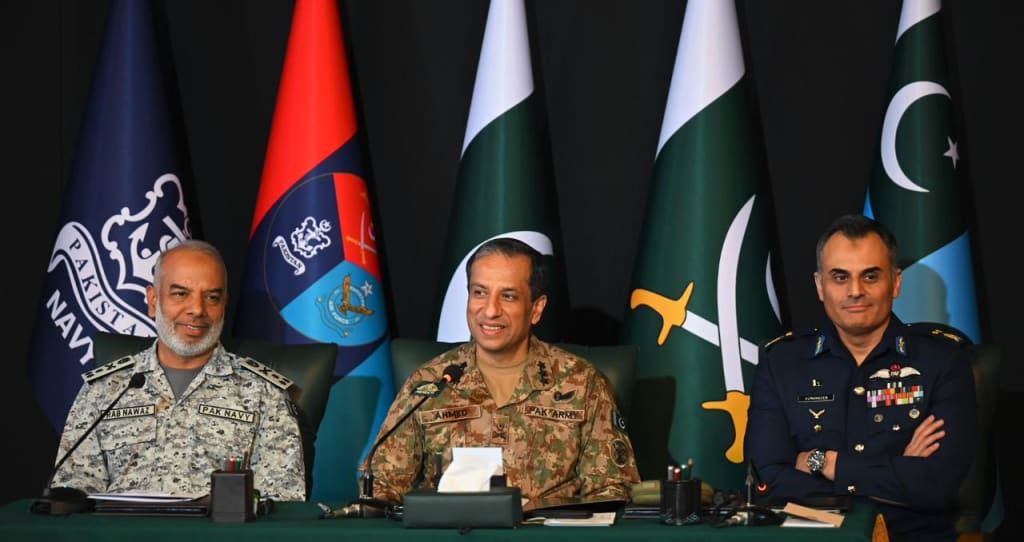
The DG ISPR, in a rare transparent briefing, laid bare drone remnants, Indian encryption logs, and testimonies from captured cross-border agents.

Pakistan also proposed a No Drone Pact for South Asia—a regional arms accord modeled after the No-Fly Zones in war-prone regions like Syria and Kosovo.
Conclusion: The Nation That Chose Proof Over Propaganda
In this quiet war of drones, deception, and discipline, Pakistan did something rare in modern geopolitics: it chose accountability.
While India cloaked its offense in silence, Pakistan cloaked its defense in data. While India denied losses, Pakistan displayed wreckage. And while India flirted with chaos, Pakistan authored control.
Because restraint is not cowardice. It is character.
And sometimes, peace has to be protected—with precision.
Pakistan Zindabad. Aman Zindabad.
About the Creator
YNW Melly’s Witness Tampering Charges Dropped Ahead Of Trial
YNW Melly’s had a long and arduous road. Does he deserve it? That’s for a jury to decide January of 2027. Meanwhile, he scored a huge legal win when one of his charges got dropped. Related to witness tampering where he allegedly told his girlfriend not to participate in the case, he got the charge dropped ahead of the upcoming trial.
By Skyler Saunders6 days ago in Criminal
The ICE Shooting in Minneapolis A Closer Look at Federal Enforcement and Rising Tensions
The ICE Shooting in Minneapolis A Closer Look at Federal Enforcement and Rising Tensions In early 2026, Minneapolis found itself at the center of national attention following a shooting involving agents from U.S. Immigration and Customs Enforcement, widely known as ICE. The incident quickly moved beyond a single law enforcement encounter and became a symbol of broader debates surrounding immigration policy, federal authority, and the use of force in American cities. As details emerged, the shooting sparked intense public discussion, protests, and renewed scrutiny of federal operations carried out within local communities.
By America today 2 days ago in Criminal



Comments
There are no comments for this story
Be the first to respond and start the conversation.