
Dyatlov Pass
The Night the Mountain Refused to Explain Itself

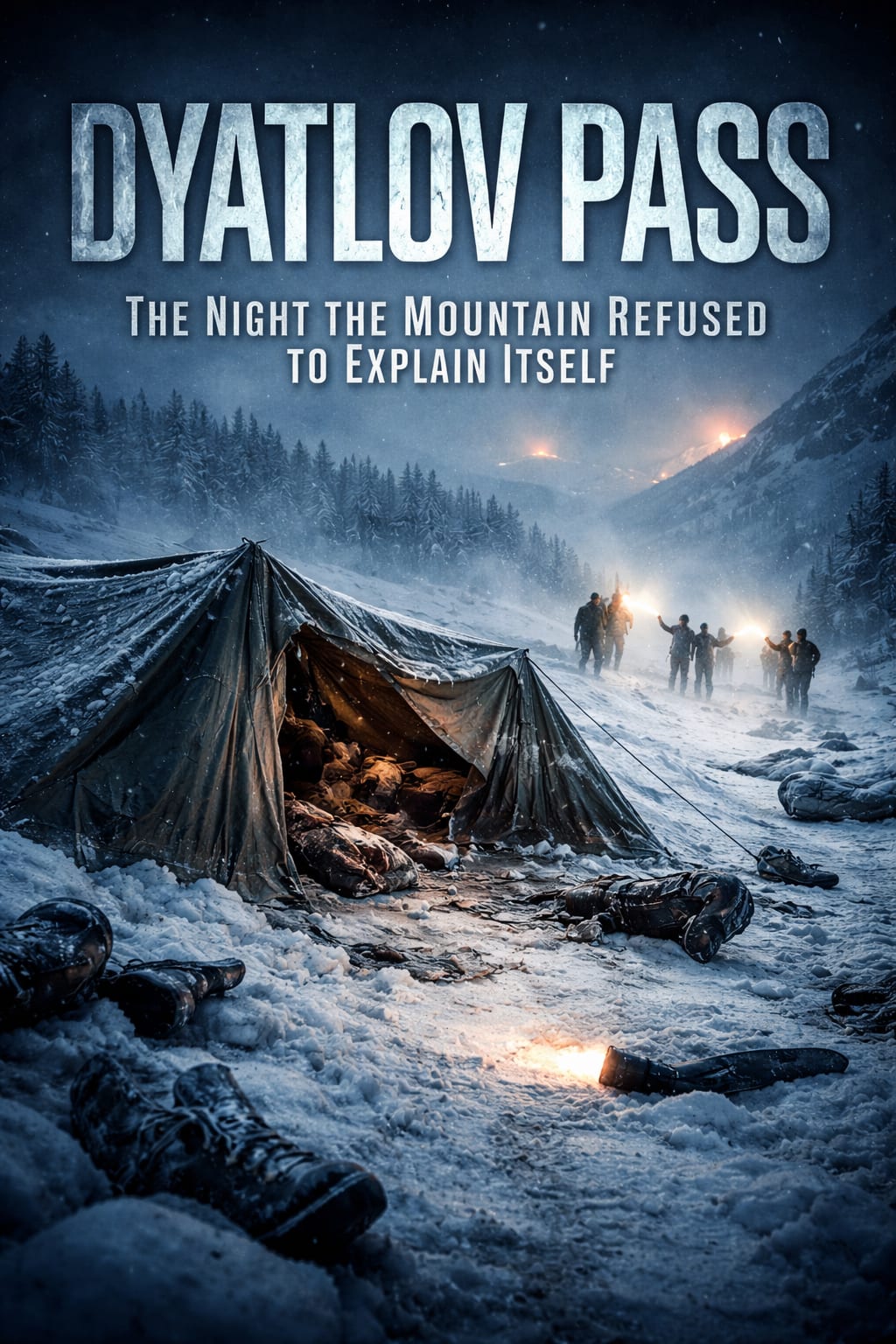
The northern Ural Mountains are not dramatic in the way the Alps are dramatic. They do not rise like stone cathedrals or glitter with postcard beauty. They are older than that—rounded, wind-carved, patient. In winter, they become something else entirely: a vast white emptiness where sound dies quickly and mistakes are punished without mercy.
In late January of 1959, nine young people set out into that emptiness.
They were students and recent graduates from the Ural Polytechnic Institute, most of them in their early twenties. They skied together, trained together, trusted one another. Their leader, Igor Dyatlov, was 23 years old—serious, meticulous, known for careful planning and quiet competence. This was not a reckless group chasing adventure for the thrill of it. This was a disciplined expedition aiming to complete a Category III winter trek, the highest difficulty rating at the time.
They packed well. They documented everything. They kept diaries, took photographs, joked in their notes. Nothing in their writing suggests fear, tension, or even unease.
That is what makes what happened next so disturbing.
Their last confirmed campsite was on the eastern slope of a mountain the local Mansi people called Kholat Syakhl—often translated as “Dead Mountain.” The name predates the incident by centuries and refers not to curses, but to the fact that game animals rarely passed through the area. It was an empty place.
On the night of February 1st, 1959, the weather was harsh but not unusual for the region: strong winds, sub-zero temperatures, blowing snow. The group pitched their tent on an exposed slope instead of descending into the forest below. Investigators later speculated that Dyatlov may have done this deliberately, as a training exercise—to practice camping under worst-case conditions.
If so, it would be his final decision.
Days passed. Then weeks. When the group failed to return or send word, a search was organized—first by fellow students, then by the military. On February 26th, rescuers found the tent.
It was still standing.
That detail alone should have been comforting. It wasn’t collapsed. It hadn’t been flattened by an avalanche. But as the searchers drew closer, comfort turned into confusion.
The tent had been cut open from the inside.
Not the entrance. The side.
Clothing, boots, food, and equipment were still inside—neatly arranged, as if the occupants had planned to return. Footprints led away from the tent in a scattered line down the slope. Some were barefoot. Some wore socks. A few had a single boot.
No signs of a struggle. No animal tracks. No indication of panic in the snow itself—just a quiet, impossible retreat into the freezing dark.
The first two bodies were found beneath a large cedar tree about a mile from the campsite. They were nearly naked, dressed only in underwear. Their hands were raw and damaged, as if they had clawed at bark. A small fire had been built beneath the tree, its remains barely visible.
They had died of hypothermia.
Between the tree and the tent, searchers found three more bodies, spaced out along the slope as if they were trying—desperately—to return. One was Dyatlov himself. All showed signs of extreme cold exposure. No fatal injuries.
At this point, the story might have ended as a tragic but explainable case: disorientation, exposure, a poor decision under stress.
But four members of the group were still missing.
Their bodies were discovered months later, buried under several meters of snow in a ravine. And this is where the case breaks apart.
These four were better dressed, wearing clothes taken from their already-dead companions—suggesting they survived longer. But their injuries were catastrophic.
One woman had a fractured skull. Another had multiple broken ribs. One man’s chest injuries were so severe that a medical examiner compared the force to that of a car crash.
And yet—there were no external wounds consistent with such trauma. No bruising, no lacerations, no signs of impact against rocks or trees.
One woman was missing her tongue.
Another had radiation traces on parts of his clothing.
The official Soviet investigation concluded in May 1959 with a single, vague sentence:
“The cause of death was a compelling natural force which the hikers were unable to overcome.”
The case was closed.
That sentence has haunted people ever since.
Over the decades, theories multiplied.
Some argued avalanche—but the tent was not buried, the slope angle was shallow, and experienced skiers would not flee half-dressed from a minor slide. Others proposed katabatic winds, sudden violent gusts capable of producing terrifying noise and pressure. This might explain panic, but not the injuries.
There were whispers of military tests, secret weapons, or parachute mines detonating in the air. Witnesses reported strange orange lights in the sky that night. Files were classified. Some remain missing.
Others blamed infrasound, low-frequency sound waves produced by wind interacting with the mountain’s shape, possibly inducing panic or dread. Interesting—but still speculative.
Then there are the wilder ideas: escaped prisoners, local tribes, unknown creatures
About the Creator
The Insight Ledger
Writing about what moves us, breaks us, and makes us human — psychology, love, fear, and the endless maze of thought.
Keep reading
More stories from The Insight Ledger and writers in Criminal and other communities.
The Lost Boys of Yuba County: A Midnight Journey into the Unknown
In the late hours of February 24, 1978, five young men from Yuba City, California, climbed into a turquoise and white Mercury Montego. They had just finished watching a basketball game and were headed home, excited about a tournament they were supposed to play in the very next day. They never arrived.
By The Insight Ledger 3 months ago in Criminal
What Legal Rights Do Families Have in Alabama Wrongful Death Cases?
The sudden death of a loved one is an experience that can be hurtful to any family. The emotional and financial consequences of a loss may be even more significant when caused due to the negligence of another person or the wrongdoing committed by another person. In such cases, the law gives a means of justice to the families by the wrongful death case.
By Deborah Larson7 days ago in Criminal
The Midnight Train Murder
M Mehran Late one winter night, the last train leaving the city of Blackridge carried only a handful of passengers. The midnight train was usually quiet—mostly travelers returning home after long days or strangers heading toward destinations unknown. But on this particular night, the train carried something far more dangerous. A secret. At 12:18 AM, while the train rushed through the dark countryside, a passenger screamed from the third carriage. The sudden panic caused the conductor to stop the train immediately. When the train staff reached the scene, they discovered a horrifying sight. A man lay lifeless across one of the seats. His briefcase had fallen to the floor, papers scattered across the aisle. The passengers nearby stared in shock, unsure of what had just happened. Within thirty minutes, police arrived at the nearest station where the train had been stopped. Detective Ryan Carter stepped aboard to investigate. He quickly realized this was no ordinary case. A Murder in a Moving Train The victim was identified as Jonathan Blake, a financial analyst working for a large investment company. According to the passengers, Blake had boarded the train alone and sat quietly for most of the journey. No one noticed anything unusual. Then suddenly he collapsed. At first, people assumed he had suffered a heart attack. But when the medical examiner inspected the body, the truth became clear. Blake had been stabbed. The wound was small but precise—clearly delivered by someone who knew exactly where to strike. The biggest problem for investigators was simple. No one had seen the attack. The train had been moving the entire time, meaning the killer had to be someone on board. Detective Carter now faced a chilling possibility. The murderer was still sitting among the passengers. The Suspects Only seven passengers were present in the carriage when the crime occurred. Police questioned each of them carefully. First was Emily Dawson, a university student traveling home for the holidays. She claimed she had been listening to music and noticed nothing unusual. Next was Harold Finch, a retired engineer reading a newspaper at the time of the incident. Then there was Lucas Grant, a businessman who appeared extremely nervous during questioning. The remaining passengers included an elderly couple and a quiet man sitting near the window who gave his name as Victor Lane. At first glance, none of them seemed capable of murder. But Detective Carter knew appearances could be deceiving. The Hidden Motive While searching Blake’s belongings, investigators discovered something interesting inside his briefcase. Several confidential documents. The papers revealed that Blake had recently uncovered a major financial fraud involving millions of dollars being secretly transferred through international accounts. Someone inside his company had been stealing money for years. Blake had been planning to expose the crime. Which meant someone had a powerful reason to silence him. Detective Carter focused on the passengers again. One by one, their stories were examined. Most checks came back clean—until investigators looked deeper into Lucas Grant’s background. A Dangerous Connection Lucas Grant claimed to be a businessman traveling for work. But financial records showed something different. Grant had recently received large payments from a shell company connected to the same fraud Blake was investigating. When confronted with the evidence, Grant began to sweat. But he still denied everything. Carter knew he needed one final piece of proof. So he carefully reviewed the security footage from the train station where passengers had boarded. There it was. The camera showed Grant walking behind Blake on the platform. But more importantly, it revealed Grant slipping something into his coat pocket—a small folding knife. The Final Confrontation When detectives searched Grant’s luggage, they discovered the weapon hidden inside a shoe. The blade matched the wound perfectly. Realizing the evidence against him was overwhelming, Grant finally confessed. Blake had discovered the fraud network and was preparing to report it to federal authorities the next morning. Grant, who was deeply involved in the scheme, followed him onto the midnight train to stop him. When the lights dimmed in the carriage, Grant quietly moved behind Blake and delivered the fatal stab. The attack was so quick that no one noticed. Grant believed the crowded train would make it impossible for police to identify the killer. But he underestimated one thing. Truth always leaves traces. Justice on the Rails Grant was arrested and later sentenced to life in prison for murder and financial crimes. His confession helped authorities uncover the entire fraud network, leading to several additional arrests. For Detective Carter, the case became known as The Midnight Train Murder—a chilling reminder that danger can appear even in the most ordinary places. Passengers eventually returned to their normal lives, but many never forgot that night. Because somewhere between two quiet stations, on a train speeding through darkness, a murderer had almost escaped justice. And only careful investigation had stopped him.
By Muhammad Mehran5 days ago in Criminal


Comments
There are no comments for this story
Be the first to respond and start the conversation.