
Devotion to Death: The Horrors of Aum Shinrikyo
terror cult that still operates in the light

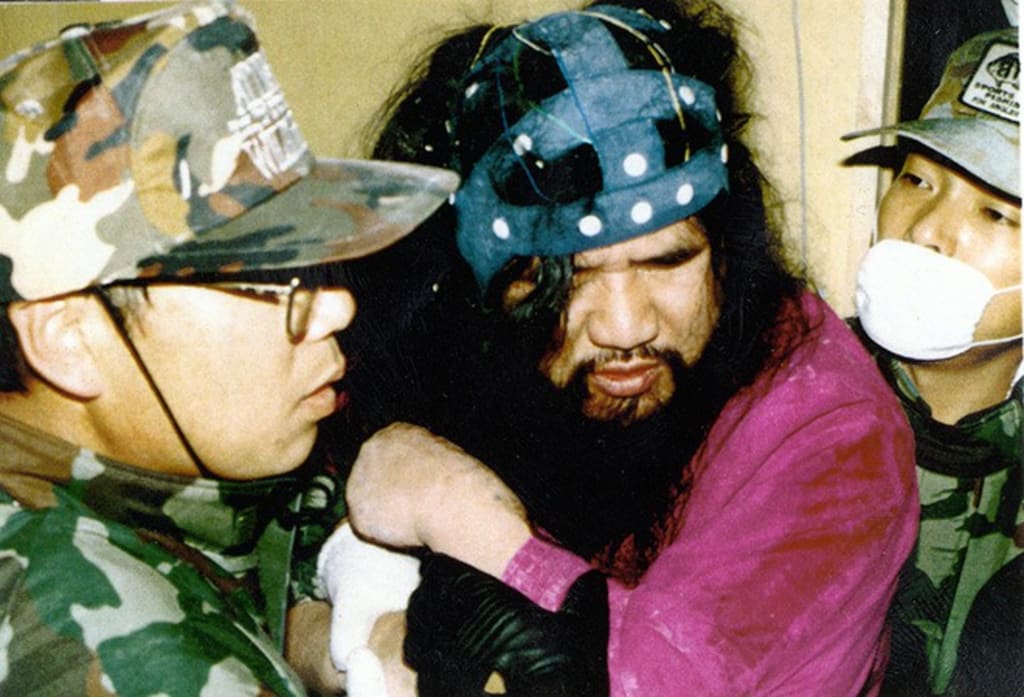
In the underbelly of Japan’s 1980s spiritual awakening, amidst a surge of mysticism and new-age belief systems, a man named Shoko Asahara began preaching a twisted gospel of salvation, apocalypse, and domination. What began as a yoga school transformed into Aum Shinrikyo—a doomsday cult that would go on to commit one of the deadliest domestic terror attacks in modern history
But behind the headlines and courtroom drama lies an even darker narrative—one dripping in blood, ritual, and whispered rumors of cannibalism and grotesque devotion.
The Birth of a Monster
Shoko Asahara, born Chizuo Matsumoto, was a partially blind man who blended elements of Hinduism, Buddhism, Christian eschatology, and science fiction into a self-serving doctrine. In 1984, he founded Aum Shinrikyo (“Supreme Truth”) and presented himself as Christ reborn—a living god destined to lead the faithful through an impending world war.
His charisma drew in thousands, including elite scientists, doctors, and engineers. By the late 1980s, the cult had gained official religious status in Japan and operated compounds across the country—and even abroad.
But inside the compound, devotion came at a bloody price.
A Reign of Ritual and Torture
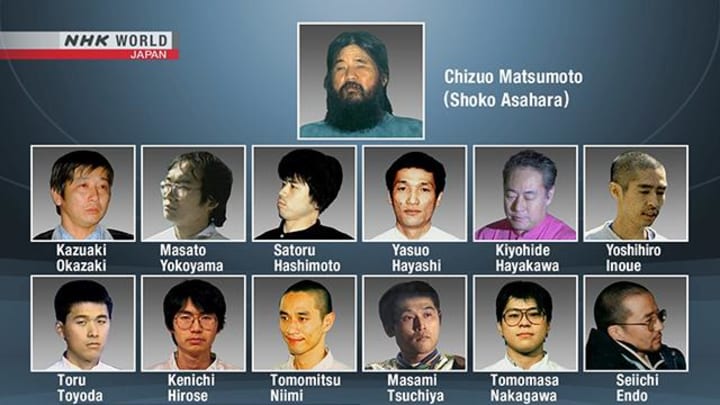
Aum’s doctrine was not metaphorical—it was brutal and literal. Members were forced into strict obedience, subjected to sensory deprivation, starvation, and “initiation” rituals involving electric shocks and drug-induced hallucinations.
Those who opposed or tried to leave faced far worse.
Testimonies and court records detail the horrific deaths of dissenters:
Toru Watanabe, a member who attempted escape, was drowned in a vat of boiling water after days of torture.
Kiyoshi Kariya, a Tokyo notary, was abducted, injected with an overdose of truth serum, and died in captivity. His body was cremated in an industrial furnace.
In one notorious incident, a cult doctor performed live dissections on a victim under Asahara’s orders, as part of “liberating the soul.”
Dissolving bodies in acid became standard practice. Aum had its own crematoriums. The air around their compounds reeked of chemicals and decay.
The Gas Attack That Shook the World
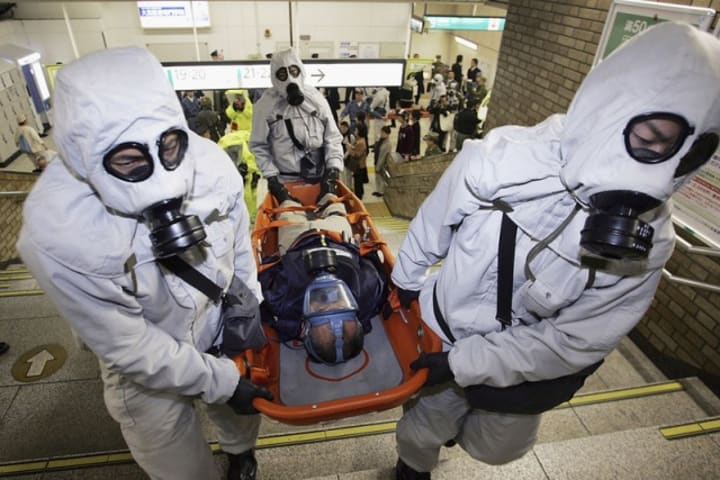
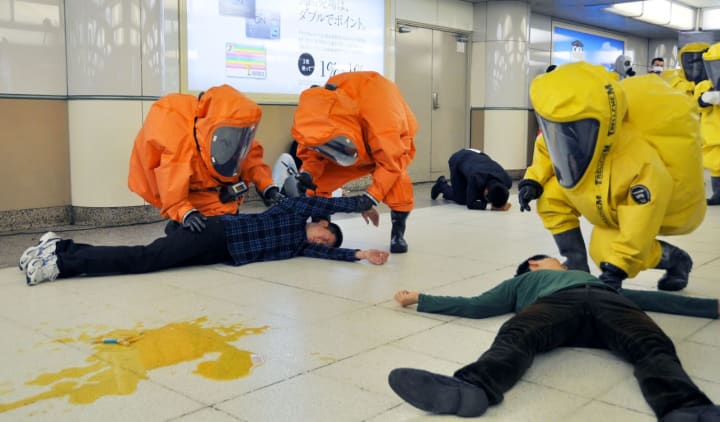
On March 20, 1995, Aum Shinrikyo launched their most infamous attack: releasing sarin gas in Tokyo’s subway system during rush hour.
The coordinated strike killed 13 people, severely injured over 1,000, and terrorized a nation that had long considered itself one of the safest on Earth.
The attack’s goal? To trigger a civil war and bring about Armageddon, allowing Asahara to rise as the savior.
Raids on Aum compounds in the aftermath revealed chemical labs, VX gas, and heaps of weapons-grade material. The cult had tried—unsuccessfully—to manufacture anthrax and botulinum toxin. Their science division had even attempted to acquire a Russian nuclear warhead.
Whispers of Cannibalism
Though unproven in court, rumors of cannibalism emerged during investigations and among former members.
Some whispered that during the most extreme rituals, Aum “consumed the sacred flesh” of those deemed spiritually unclean—those killed by the cult. These claims remain speculative, as the bodies were often dissolved, incinerated, or never recovered.
One former member, testifying under pseudonym, said:
> “He \[Asahara] told us we must become like gods. That to take into ourselves the flesh of the fallen was to consume their karma.”
Investigators also found tanks of blood and body parts preserved in formaldehyde. Some were used for "medical" experiments. Others were kept for unexplained "ceremonial use."
Japan’s justice system, wary of sensationalism, never pursued these allegations—focusing instead on the very real evidence of mass murder and terrorism.
But among cult researchers and horror historians, the Aum case lingers like a festering wound. “Where there is smoke,” one investigator was quoted saying off-record, “there’s usually a bonfire.”
The Legacy of a Blood Cult
In 2006, after years of trials, Asahara was sentenced to death, alongside many of his top lieutenants. In 2018, he was executed by hanging in a mass execution that stunned Japan. His followers responded not with mourning—but silence and watchfulness.
Despite its history, Aum still exists—
rebranded as Aleph and Hikari no Wa. Both claim to be peaceful spiritual organizations, but surveillance continues. The Japanese government monitors them, and former members occasionally resurface in odd, cult-adjacent movements.
The specter of Aum Shinrikyo remains a living warning: that even in the most ordered societies, belief—warped and weaponized—can breed monsters.
Conclusion: Beyond the Edge of Madness
The atrocities of Aum Shinrikyo represent more than just a cautionary tale about cults. They expose the razor-thin boundary between salvation and slaughter, devotion and delusion. When belief becomes a weapon and flesh a sacrament, horror transcends fiction.
In the cold clinical silence of laboratories-turned-slaughterhouses, in the fumes of sarin gas carried by subway air, in the charred remains of dissenters melted into acid barrels—the light was a lie.
And perhaps, somewhere behind closed temple doors, as some whisper still, the innocents are still mislead and tormented.
About the Creator
E. hasan
An aspiring engineer who once wanted to be a writer .
Donald Trump Withdrawing U.S. Forces From Qatar Amid Fears of Iranian Escalation
Donald Trump Considers Withdrawing U.S. Forces From Qatar Amid Fears of Iranian Escalation The recent killing of approximately 2400 protesters in Iran has once again drawn global attention to the deep political and security crisis inside the country. These deaths, linked to widespread demonstrations against economic hardship, political repression, and government authority, have intensified regional tensions and raised serious concerns about Iran’s internal stability. As unrest grows and the risk of external escalation increases, the security balance in the Middle East has come under renewed scrutiny.
By America today 5 days ago in Criminal


Comments
There are no comments for this story
Be the first to respond and start the conversation.