
'Blue Bloods' Star Amy Carlson Stuns Fans With Her Surprise Departure
Not one fan had known Amy Carlson, the actress who portrayed Linda Reagan, had decided to leave the series until she shared a post with her Instagram followers.


When Blue Bloods wrapped its 7th season in May, Linda and Danny Reagan had suffered a house fire at the hands of a drug lord. The fear and panic on Danny's face resonated with the fans as he searched for his family. When he found both Linda and his sons, his relief was palpable, and Season 7 ended with that portion of the Reagan family fully intact, and fans breathed a sigh of relief. That dissipated all too quickly during the Season 8 premiere for the series dropped a bombshell that broke fans' hearts and left them wondering what had just happened.
For years, Danny and Linda Reagan had been a solid unit, navigating the difficulties of his job as a New York City Detective and her constant fear for his life. She was his stalwart, always there no matter what came their way. All of that changed Friday night when piece-by-piece the episode revealed that Linda Reagan had been killed in a helicopter crash. And not one fan had known Amy Carlson, the actress who portrayed Linda Reagan, had decided to leave the series until she shared a post with her Instagram followers.
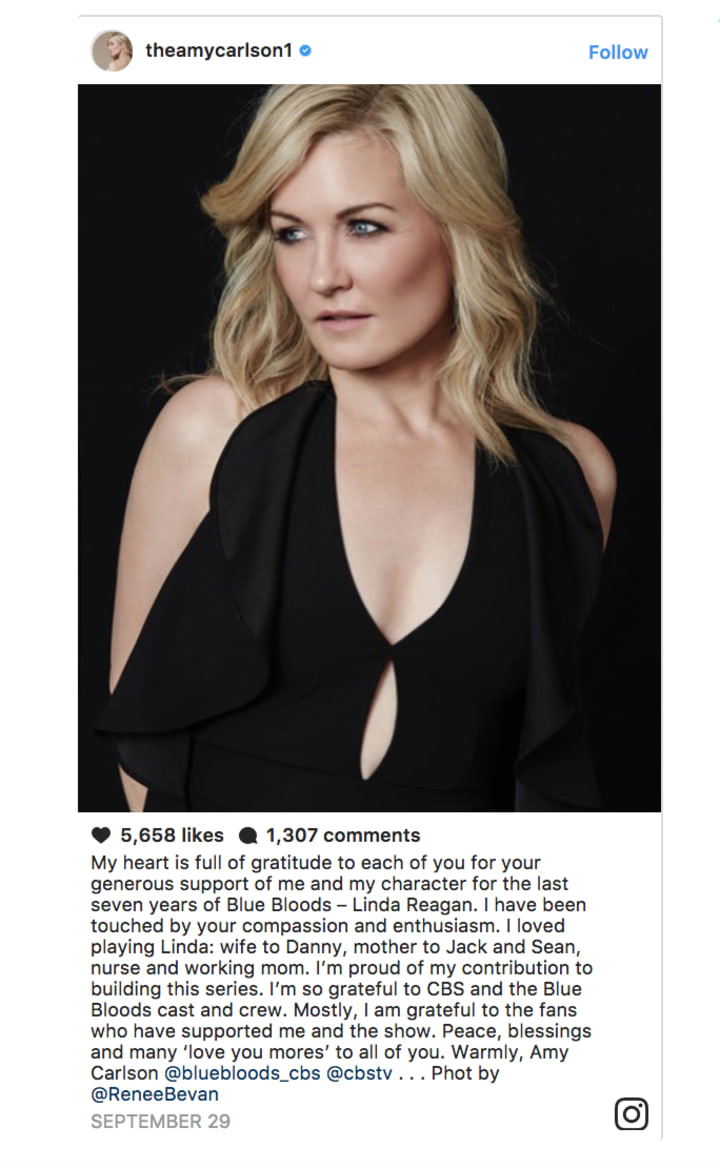
In the poignant note, Carlson expressed her gratitude to her fans for supporting her and her character for seven years, but she didn't share a reason for the departure. Deadline reported that Carlson had fulfilled her seven year contract and decided it was time to move on. But that didn't sit too well with fans who were upset at the abruptness of Linda's death.
Usually, when a character exits a series by dying, fans are given an opportunity to say goodbye, a chance to grieve the loss. Blue Bloods decided to choose a different path and start Season 8 with Linda's death having happened off-screen. Danny was already in grief counseling, and the family were starting to put the pieces of their lives back together. But fans felt sucker-punched and confused as evidenced by the outcry on Twitter.
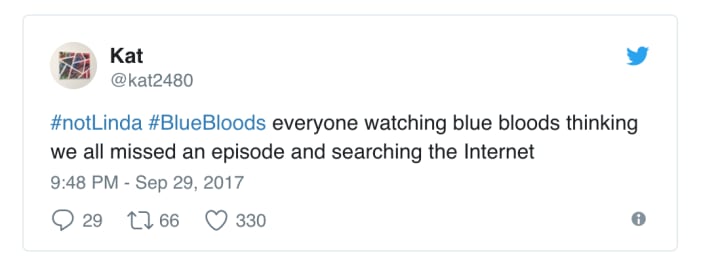
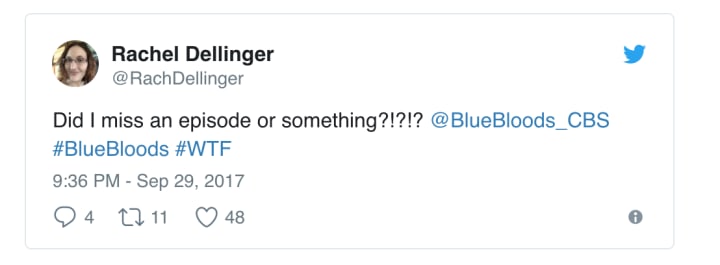
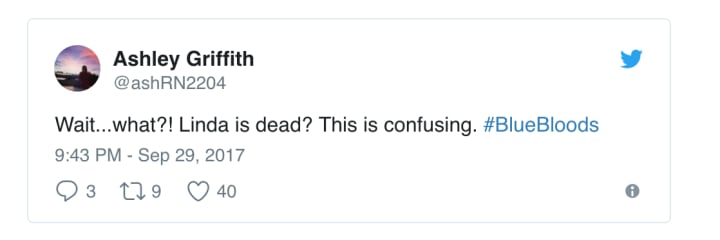
Though it's certainly within Carlson's right to move on, an onscreen death would have allowed fans closure. Perhaps a one episode return couldn't be negotiated, and most likely, that's information that won't be revealed unless Carlson or producers decide to talk about it.
Blue Bloods will forge ahead without Danny Reagan's wife, but it won't be the same. Though her role was limited on the series, Carlson played an integral part, and her character's death has left a big hole at the Reagan family Sunday dinner table.
[Source: Deadline]
About the Creator
Rachel Carrington
I write a little bit of everything because I love to write. 53 novels. Over 2,500 articles. Essays. Short Stories. Book Reviews. Movie Reviews. And more. You can find a lot of that stuff here. rachelcarrington.com. X: @rcarrington2004
Keep reading
More stories from Rachel Carrington and writers in Criminal and other communities.
'Criminal Minds': A Cast Shakeup Is Underway With Actresses Threatening To Walk Over Unequal Pay
Last year, Season 12 of Criminal Minds got off to a shaky start with the termination of Thomas Gibson. The outrage from fans caused a proliferation of petitions that failed to change the minds of CBS executives. In spite of a ratings slump, Agent Aaron Hotchner didn't return to the season — and now, it appears he's not the only cast member who's been shown the door.
By Rachel Carrington8 years ago in Criminal
Minneapolis ICE Shooting Updates
In recent weeks, Minneapolis has found itself at the center of a growing legal and political controversy following a shooting involving Immigration and Customs Enforcement (ICE) agents. What initially appeared to be a straightforward federal use-of-force investigation has evolved into a broader dispute between state authorities and federal officials, raising serious questions about transparency, jurisdiction, and accountability. The most significant development so far is the state’s claim that it has been denied access to key evidence related to the incident. As public attention intensifies, the case is no longer just about what happened during the shooting. It is increasingly about who controls the facts, who gets to investigate them, and how justice is supposed to function when federal and state systems collide. What We Know About the Minneapolis ICE Shooting The shooting occurred during a federal immigration enforcement operation in Minneapolis. ICE agents were reportedly conducting official duties when gunfire erupted, resulting in injuries and immediate emergency response. Federal authorities confirmed the incident and stated that internal protocols were activated, including an automatic review by federal oversight bodies. From the beginning, details were limited. Officials cited the ongoing nature of the investigation and concerns about officer safety. This lack of information, while not unusual in federal cases, quickly became a point of friction for Minnesota state authorities, who argued that the public deserved clarity and that the state had a legal role to play in examining the incident. State Authorities Push for Transparency Minnesota state officials, including investigators and legal representatives, formally requested access to evidence connected to the shooting. This evidence reportedly includes body camera footage, surveillance recordings, forensic reports, and internal communication logs from the operation. According to state representatives, these requests were either delayed or denied outright. The state has since gone on record stating that it cannot independently assess the legality of the shooting without full access to the materials. This denial has fueled concerns that federal agencies are operating without sufficient external oversight, especially in incidents involving potential civilian harm. State leaders emphasized that their position is not adversarial by default. Rather, they argue that cooperation between federal and state agencies is essential to maintain public trust, particularly in communities already wary of immigration enforcement. Federal Response and Jurisdictional Limits Federal officials, for their part, maintain that the investigation falls squarely under federal jurisdiction. ICE operates as a federal agency, and shootings involving federal officers are typically reviewed internally and, when appropriate, by federal prosecutors or inspectors general. In statements released following the controversy, federal representatives cited legal restrictions that limit the sharing of evidence during an active investigation. They also stressed that premature disclosure could compromise witness testimony or investigative integrity. This explanation, while legally grounded, has done little to ease state frustrations. Critics argue that “ongoing investigation” has too often been used as a blanket justification for withholding information, even in cases where transparency could prevent misinformation and public unrest. Community Reaction and Public Trust The Minneapolis community has responded with a mix of concern, anger, and fatigue. For many residents, particularly in immigrant and marginalized communities, the shooting has reopened long-standing fears about aggressive enforcement tactics and lack of accountability. Community leaders and advocacy groups have called for the immediate release of non-sensitive evidence, arguing that transparency is a prerequisite for trust. Peaceful demonstrations and public forums have highlighted a broader demand: that no law enforcement agency, federal or otherwise, should be beyond scrutiny. Local officials echoed these concerns, noting that Minneapolis has spent years attempting to rebuild trust between residents and law enforcement. The perception that evidence is being withheld threatens to undermine that progress. Legal Implications of Denied Evidence From a legal standpoint, the state’s inability to access evidence raises complex questions. While federal agencies do have authority over their operations, states also have a responsibility to investigate deaths or injuries occurring within their borders. Legal experts suggest that this dispute could set a precedent. If states are routinely blocked from reviewing evidence in federal use-of-force cases, it may limit their ability to pursue independent inquiries or bring charges under state law when applicable. Some analysts believe the issue could ultimately be resolved in court, with judges determining whether the state has a legal right to access certain materials. Such a ruling could have national implications, influencing how future federal-state conflicts are handled. Political Dimensions of the Case The Minneapolis ICE shooting has also taken on a political dimension. Immigration enforcement remains a deeply divisive issue, and incidents like this tend to amplify existing ideological divides. State officials critical of federal immigration policies view the denial of evidence as symptomatic of a larger lack of accountability. Meanwhile, supporters of strict federal enforcement argue that state interference could hinder effective operations and put officers at risk. This political tension complicates the path forward. What might otherwise be a procedural disagreement risks becoming a symbolic battle over immigration, law enforcement authority, and states’ rights. What Happens Next? As of now, the investigation continues under federal oversight, while the state explores its legal options. Negotiations between state and federal officials have reportedly not been ruled out, suggesting that a compromise could still be reached. Potential next steps include limited evidence sharing under confidentiality agreements, congressional inquiries, or judicial review. Each option carries its own risks and consequences, both legally and politically. What remains clear is that public pressure is unlikely to fade. Minneapolis residents, like many Americans, are demanding clarity, fairness, and accountability in cases involving law enforcement use of force. A Broader Conversation About Accountability The Minneapolis ICE shooting is no longer just a single incident under investigation. It has become a lens through which broader issues are being examined: the balance of power between federal and state authorities, the limits of transparency, and the role of public oversight in a democratic society. Whether or not the state ultimately gains access to the evidence, the controversy has already sparked an important conversation. How that conversation translates into policy, practice, or reform remains to be seen, but its impact will likely extend far beyond Minneapolis. In the end, accountability is not only about assigning blame. It is about ensuring that systems function openly and fairly, especially when lives are affected. The outcome of this case may help determine how well those principles are upheld in the future.
By Saboor Brohi 3 days ago in Criminal
Sabrina Carpenter Accused of Copying Tiffany A♡ Luna’s Crown Logo—While Her Federal Plagiarism Case Spirals Into Further Career Ruin
Sabrina Carpenter’s pop princess image is crumbling under the weight of what is now being described as one of the most damaging plagiarism cases in music history. The Disney-born starlet is not only battling a brutal federal lawsuit over her song Espresso, but now faces new backlash after debuting a crown into her updated logo June 6, 2025 eerily similar to Tiffany A♡ Luna’s crown, which was quietly unveiled just weeks before — the same Tiffany A♡ Luna currently suing her in federal court.
By Dena Falken Esq7 days ago in Criminal


Comments
There are no comments for this story
Be the first to respond and start the conversation.