
Blood on the Streets: Colombia Under Escobar’s Shadow
“The Terror of Medellín: How Escobar Reshaped Colombia with Fear”

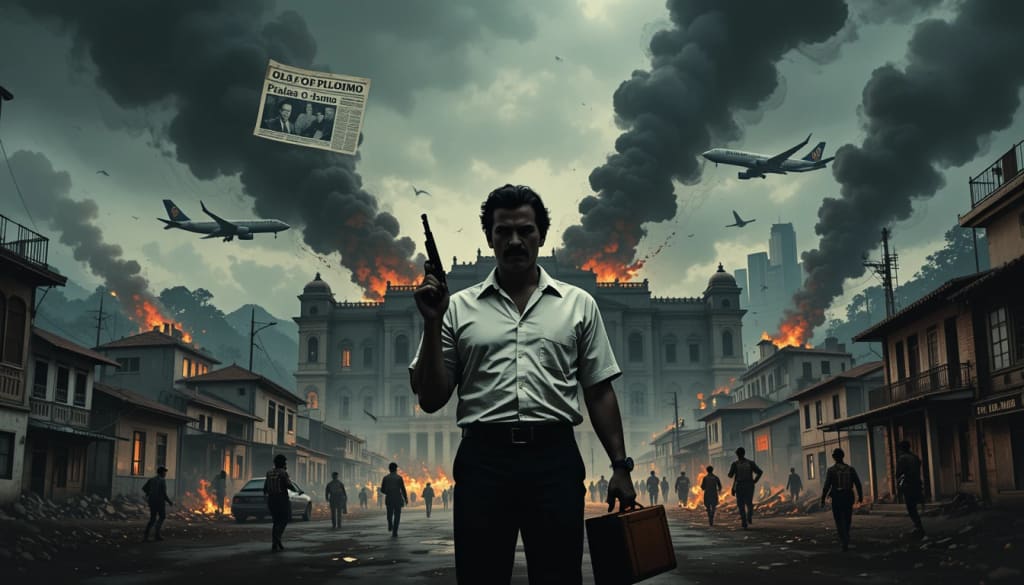
Pablo Emilio Escobar Gaviria, the infamous Colombian drug lord and leader of the Medellín Cartel, was once one of the most powerful and feared men in the world. His reign of terror in Colombia, which peaked during the 1980s and early 1990s, left an indelible mark on the nation’s history. Escobar's rise was not only defined by unprecedented wealth and influence but also by an era of brutal violence, rampant corruption, and deep social disruption. His story is both a cautionary tale and a chilling example of how organized crime can infiltrate and destabilize an entire nation.
The Rise of a Drug Kingpin
Escobar was born in 1949 in Rionegro, Antioquia, Colombia, and raised in Medellín. He began his criminal career in petty crimes, including smuggling and car theft, but quickly moved into the booming cocaine trade in the 1970s. By founding the Medellín Cartel, Escobar seized control of the majority of the cocaine entering the United States, turning the drug into one of Colombia’s most profitable exports.
At the height of his power, Escobar controlled up to 80% of the global cocaine market. Forbes magazine even listed him as one of the world’s richest men, with an estimated fortune of over $30 billion (equivalent to over $70 billion today when adjusted for inflation). But his wealth came at a catastrophic price for Colombia.
The Cartel’s Grip on Colombia
Escobar’s power extended beyond the drug trade. He created a parallel state within Colombia, where his money could buy anything — politicians, judges, police, and even entire communities. His strategy was simple but effective: "plata o plomo" — silver or lead. Officials could accept his bribes or face assassination.
Escobar’s Medellín Cartel operated with military precision and was responsible for thousands of deaths. He waged war not only against rival cartels but also against the Colombian state, journalists, police officers, and civilians. No one was safe from the reach of his violence.
Political Ambitions and Populism
Despite his criminality, Escobar attempted to enter legitimate politics in the early 1980s. He was elected as an alternate member of Colombia’s Congress in 1982, exploiting his image as a generous benefactor to the poor. In Medellín, he funded housing projects, sports fields, and schools, cultivating loyalty among the disenfranchised population.
However, his political career was short-lived. Journalists like Guillermo Cano and politicians like Minister of Justice Rodrigo Lara Bonilla exposed his ties to drug trafficking. This led to public condemnation and political isolation. In retaliation, Escobar orchestrated the assassination of Lara Bonilla in 1984, marking a significant escalation in his war against the state.
The Era of Terror
Following his fall from political grace, Escobar unleashed a campaign of terror that paralyzed Colombia. From the mid-1980s to the early 1990s, the Medellín Cartel used violence as a tool of intimidation and control.
One of Escobar’s most infamous tactics was the use of car bombs and targeted assassinations. Major cities like Bogotá and Medellín witnessed daily acts of violence. Judges, journalists, police officers, and politicians were among the thousands of victims. In 1989 alone, over 300 police officers were killed in Medellín.
Perhaps the most egregious act was the bombing of Avianca Flight 203 in November 1989, which killed all 107 people on board. Escobar ordered the bombing in an attempt to kill a presidential candidate, César Gaviria, who ultimately survived. This terrorist act shocked the nation and the international community, solidifying Escobar’s status as a global menace.
In another act of defiance, Escobar ordered the storming of Colombia’s Palace of Justice in 1985 by the M-19 guerrilla group, allegedly financed by the Medellín Cartel. The siege resulted in the deaths of 94 people, including 11 Supreme Court justices. The incident was not only a national tragedy but also a blow to Colombia’s judiciary, which was perceived as under siege by narcoterrorism.
The Government’s Response
The Colombian government, with increasing support from the United States, initiated an aggressive counter-narcotics campaign. Elite police and military units were trained to capture or kill Escobar. Extradition to the U.S. became a key issue, and Escobar's fear of facing justice abroad led to further escalation of violence.
In a surprising turn in 1991, Escobar negotiated a deal with the Colombian government to surrender in exchange for avoiding extradition. He was allowed to build his own luxury prison, dubbed "La Catedral," complete with a soccer field, waterfall, and bar. The prison was more of a fortress than a penitentiary, and Escobar continued to run his cartel from within.
However, international and domestic pressure forced the Colombian government to reconsider the deal. When authorities attempted to move Escobar to a standard prison in 1992, he escaped, triggering a massive manhunt.
The Manhunt and Escobar’s Death
The manhunt for Escobar was one of the largest in history. The Colombian government, with intelligence and support from the U.S. DEA and CIA, launched a nationwide search. Simultaneously, a vigilante group known as Los Pepes ("People Persecuted by Pablo Escobar"), composed of rival cartel members and former allies, began targeting Escobar’s associates and assets.
On December 2, 1993, Escobar was located in a middle-class neighborhood in Medellín. He was killed in a rooftop shootout with the police, though some believe he may have taken his own life to avoid capture.
His death marked the end of the Medellín Cartel and a turning point in Colombia’s drug war. However, the vacuum left behind was quickly filled by other cartels, and drug trafficking continued in different forms.
Legacy and Lessons
Pablo Escobar’s reign of terror left Colombia scarred but also more resilient. The 1980s and early 1990s were a dark chapter defined by fear, corruption, and violence. However, Escobar’s death and the dismantling of the Medellín Cartel allowed the Colombian state to begin reclaiming control.
Colombia has since made significant strides in rebuilding its institutions, reducing crime, and fostering economic growth. Still, the legacy of Escobar continues to loom large. He is both reviled for his brutality and romanticized in popular culture as a symbol of defiance and charisma. This duality reflects the complex relationship Colombians have with a man who embodied both the worst and, paradoxically, a distorted image of populist heroism.
Ultimately, Escobar’s story is a grim reminder of how unchecked power, wealth, and corruption can devastate a society. It underscores the need for strong institutions, international cooperation, and the rule of law in combating organized crime and safeguarding democracy.
About the Creator
Ken Childs and the Shadow Network Behind Celebrity Surveillance
Hollywood is no stranger to intrigue. Behind the red carpets, blockbuster premieres, and glamorous headlines lies a parallel world where privacy is fragile and information can be extremely valuable. Over the years, celebrities have faced stalkers, hackers, and fraud schemes designed to exploit their wealth and visibility. Recently, reports circulating online have drawn attention to a controversial narrative involving private investigator Ken Childs and allegations that place him near the center of a disturbing story about celebrity surveillance.
By Shane Smith4 days ago in Criminal
Murdering the love of Sarah Maguire
January 2022, it was a cold winter in Tulsa, Oklahoma, one that felt colder than most for some of us in the city. If one were to be out in the evening air of the cold, it was bone chilling to the soul. On an evening like this one who wouldn’t enjoy a good home cooked meal by someone who seemed to care about them? Right, Folks?
By Cassie Moorea day ago in Criminal


Comments
There are no comments for this story
Be the first to respond and start the conversation.