
AI in Law and Ethics: The Future of Courts, Judgments, and Justice
Can AI Deliver Justice Without Bias?

Exploring the rise of AI as judge, jury, or legislative advisor - and its implications for fairness, morality, and the law.
Imagine a near-future courtroom where artificial intelligence (AI) helps sift through evidence and even proposes verdicts. Technologies like machine learning and natural language processing are already being integrated into legal practice. Predictive analytics tools can forecast litigation outcomes; AI-driven research assistants scour statutes and case law; and data-driven case-evaluation systems flag legal issues.
As Thomson Reuters notes, AI is now "transforming how we work" in courts - generating text, analyzing documents, and assisting at every step of the justice process. These innovations promise faster, more data-driven outcomes. But they also raise profound questions about fairness, accountability, and human values in justice.
In a justice system built on trust, how can an algorithm serve as a judge or a jury?
AI as Judge
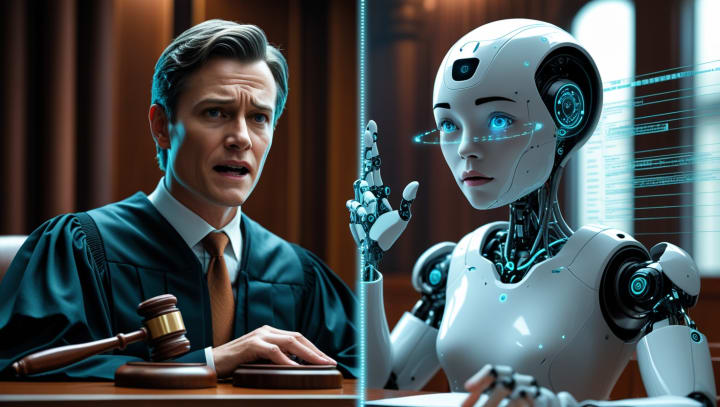
In theory, an AI judge would combine vast legal data with machine learning to evaluate evidence, apply statutes, and suggest rulings. A system might be trained on millions of past cases and legal texts, using natural language models to interpret facts. Such a system could, for example, predict sentencing ranges or find precedents by pattern-matching thousands of rulings. Supporters argue that AI judges would be efficient and consistent: they never tire or get distracted, and unlike humans they do not need breaks or vacations.
AI has no appetite or emotion to cloud its logic, so similar cases could yield more uniform sentences. A University of Chicago study found that an AI model (GPT-4o) adhered to legal precedent over 90% of the time, whereas human judges often departed from the letter of the law under emotional pressure. This suggests AI could reduce arbitrary bias or corruption: with no personal gain to protect, an AI judge would not succumb to bribery or nepotism. In short, AI might deliver faster verdicts and more predictable, rule-based outcomes.
However, this vision raises sharp concerns. First, data bias is a serious risk: if the AI is trained on historical court records, it may absorb past prejudices. Algorithmic decisions tend to reflect the patterns in their data. As one analysis warns, "algorithmic bias may be amplified" because AI tends to replicate whatever the data treats as normal. Second, empathy and context are missing. A human judge can consider nuances: a defendant's remorse, a family's plight, cultural circumstances.
An AI judges only by statistics, not by feelings. In one study, researchers noted that AI judges strictly followed precedent "unaffected by the defendant's likability," whereas human judges often let sympathy sway their judgments. This reflects the classic divide: AI embodies legal formalism, while human judges sometimes practice legal realism with compassion. Third, accountability is elusive.
When a human judge errs, an appeals process or disciplinary body can intervene. But if an AI's reasoning is opaque, we cannot review its "thought process." As one commentator notes, AI's decisions are essentially black boxes that we may never fully understand. We would be unable to know why it chose a particular sentence, or which factor carried the most weight.
There is also a philosophical objection: by design, AI judges lack a normative legal rationale. Legal scholar Ebrahimi Afrouzi argues that even a highly accurate AI "prediction" is only a statistical correlation, not a reasoned justification. He concludes that AI systems "are incapable of providing valid legal decisions" because they cannot supply the moral and normative reasoning that underpins justice. In other words, an AI might tell you what the law calls for on paper, but it can never weigh that demand against deeper moral or societal values.
Benefits:
- Efficiency and consistency: AI can process evidence and precedent rapidly, applying rules uniformly.
- Reduced human error/bias: By standardizing analysis, AI can avoid some cognitive biases and corruption (its recommendations are uniform and traceable).
- Anti-corruption potential: AI could detect irregularities or bribery patterns (as it does in financial data) and remove personal discretion from rulings.
Risks:
- Embedded bias: Flawed or biased training data can lead AI to replicate or even amplify systemic prejudices.
- Lack of empathy: An AI cannot grasp victims' suffering or defendants' remorse, and so may apply the law without mercy or human understanding.
- Opacity and accountability: AI reasoning is inscrutable; courts would struggle to explain or challenge algorithmic judgments.
- No moral judgment: AI lacks a conscience or normative sense - it follows rules, but cannot judge why those rules exist.
- Responsibility: If an AI judge makes a mistake, who is accountable - the programmers, the judges who deployed it, or the machine itself?
In summary, AI judges promise consistency and speed, but at the cost of empathy, transparency, and moral reasoning. Most proposals agree that AI must assist rather than replace human judges: it can suggest options, flag issues, or handle routine matters, but a person should have the final say.
AI as Jury
In theory, an AI jury (or jury adviser) would play a similar role, using data to weigh evidence and render verdicts. For instance, AI could be used to simulate jury deliberations in trivial cases, or assist jurors by summarizing technical evidence. Because juries are meant to be impartial fact-finders, one might imagine AI's cold logic eliminating human bias.
Indeed, an AI jury would treat all evidence purely on its merits and apply the law uniformly, unaffected by attorneys' charisma or jury prejudices. It could also process vast information (financial records, forensics) far quicker than human jurors. Some argue that AI-driven verdicts would be more predictable and systematic than human ones.
However, human juries serve functions beyond calculation. Juries are often called the "conscience of the community," bringing a collective moral compass to justice. Jurors consider not only raw evidence but also context - the victim's humanity, the community's values, and ethical intuitions. As one commentary notes, juries "are not mere processors of evidence; they represent the conscience of society".
They embody empathy, morality, and cultural nuance. An AI, by contrast, cannot truly understand suffering or social values. It cannot place itself in the shoes of the accused or victims. Nor can it interpret silent cues - a defendant's trembling voice, a spouse's tearful testimony - that often sway human judgment. In short, AI lacks the emotional intelligence and ethical sensibility that jurors (and judges) often rely on.
There are also practical concerns. Will people accept a verdict delivered by code? Public trust is critical to justice, and opaque algorithms may seem unaccountable. An AI jury's reasoning would be inscrutable - citizens could not scrutinize its deliberations. If an AI reaches a conclusion, we might only know the statistical reasons, not the moral reasoning. That challenges the legal tradition of transparent, reasoned judgments.
Finally, consider moral luck: jurors sometimes acquit or convict based on factors of human judgment that AI can't capture. For example, jury nullification (acquitting a technically guilty defendant because a law seems unjust) is part of many legal systems. An AI jury would never exercise such conscience-driven discretion.
Pros of an AI Jury:
- Impartiality in evidence: An AI can be programmed to ignore irrelevant biases (race, wealth, etc.) and focus strictly on facts.
- Data-driven consistency: AI could ensure similar cases yield similar verdicts, potentially enhancing uniformity of justice.
- Efficiency for trivial cases: For minor disputes, an AI "jury" could decide quickly, reserving human jurors for complex trials.
Cons of an AI Jury:
- Lack of empathy: AI cannot understand emotions or ethical nuances in testimony.
- Transparency issues: People may distrust an algorithmic verdict they cannot inspect or question.
- No moral judgment: AI can compute probabilities, but it cannot contemplate justice and mercy in human terms.
- Public trust and legitimacy: The legitimacy of verdicts rests on human juries (or judges); bypassing them risks undermining faith in the legal system.
In practice, most experts suggest using AI to support jurors rather than replace them. For example, an AI might highlight legal precedents or flag inconsistencies in evidence during deliberations. This "human-AI partnership" approach draws on AI's analytical power while keeping a human conscience at the heart of the decision. Such collaborative models aim to boost juror information and speed without sacrificing empathy or accountability.
AI as Legislative Advisor
Beyond courts, AI is poised to reshape lawmaking itself. Legislators could use AI tools to simulate policy outcomes and draft complex statutes. For example, advanced "agent-based" models can mimic entire economies or societies. By encoding how individuals or companies respond to rules, AI simulations can explore thousands of "what-if" scenarios in minutes.
Researchers in Europe have built an innovation-policy simulator for the Irish economy: it uses patent data and investor behavior to model how different tax incentives or funding schemes might spur new businesses. In principle, legislators could run similar simulations for healthcare, crime, or climate policy. Imagine drafting a bill and then having AI predict its impact on unemployment, budgets, and social outcomes in real time.
Indeed, one proposal envisions AI tools that let lawmakers "simulate a new law and determine whether or not it would be effective, or what the side effects would be." Lawmakers on modernization committees have urged Congress to develop such AI analysis tools.
AI can also sort through mountains of legal text. An AI legislative assistant might summarize lengthy bills, highlight conflicts with existing laws, or even suggest draft language. Vendors are already marketing AI legislative-analysis platforms. These tools can flag loopholes or unintended consequences (or, worryingly, create them): just as human lobbyists exploit legislative text, AI algorithms could be used to scan a draft law and craft precise loopholes to benefit particular interests. At the same time, AI's strength lies in data-driven policy insights.
For example, algorithms could scan social data to identify systemic inequities - say, which communities lack access to education or healthcare - and suggest reforms targeted to those gaps. By processing real-time data (economic indicators, health outcomes, crime stats), AI models could help legislators fine-tune laws to current conditions, rather than rely on outdated reports.
But these possibilities carry risks. A major pitfall is overfitting: AI might optimize laws for predicted scenarios that never materialize. As one cautionary account puts it, "AI-written law trying to optimize for certain policy outcomes may get it wrong". If lawmakers let AI tune every variable, they might pass brittle laws that crumble under real-world complexity. Moreover, AI-driven policymaking risks detachment from values. Simulations and data feeds cannot capture ethical priorities or political judgment. The Deloitte report notes: "AI simulations can help uncover drivers of problems and test interventions," but they "can't make value judgments." They can only evaluate options based on the human-defined values they're given.
In other words, AI can show what might happen under various policies, but it cannot tell us which outcome is desirable. Finally, there is a democratic concern: reliance on AI could shield lawmakers from blame (or understanding). If an AI tool writes a bill or predicts its impacts, who is responsible for that law? Transparency and oversight become crucial.
Strengths:
- Policy simulation: AI can model complex systems (economy, health, environment) to forecast policy effects.
- Data-driven reform: It can highlight systemic issues or inequities in existing laws, guiding targeted legislation.
- Drafting assistance: AI can summarize bills and even propose legal text, speeding the legislative process.
Risks:
- Overreliance on predictions: AI may craft laws tuned to its models, which could fail if reality changes or models are flawed.
- Ethical detachment: AI lacks moral judgment; policy choices involve values that no algorithm can decide.
- Manipulation: Powerful AI tools might be used by special interests to craft deceptive legislation or loopholes.
- Complexity and legibility: If bills become written by AI, they might become even more complicated and opaque to laypeople or oversight bodies.
In sum, AI could become a powerful advisor to legislatures - a kind of "automated think tank." It might help us see the consequences of laws before enacting them. But its role should be carefully constrained to analysis and support, not final say.
Bridging the Gap: Ethical Guidelines for AI in Law
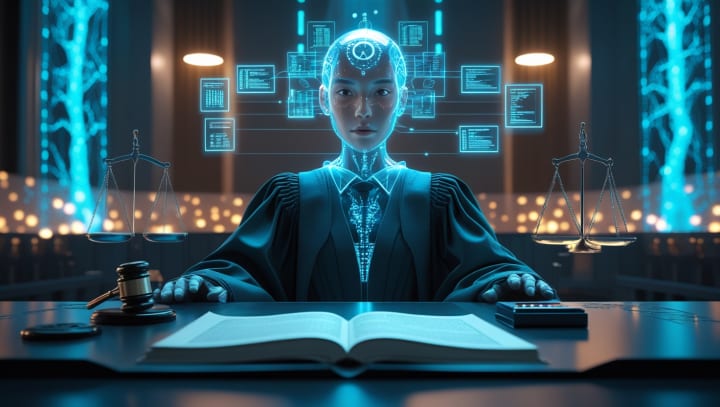
Given these possibilities and perils, experts emphasize the need for strong guardrails and collaboration. A number of principles for responsible AI in courts and government have already been proposed by legal bodies. Common themes include fairness, transparency, human oversight, and accountability. For example, the Victorian Law Reform Commission stresses that AI systems "should be fair and equitable, and not discriminate against individuals or groups," with clear accountability for their use.
Likewise, a U.S. court policy consortium advises that AI must never be the final arbiter: court staff and judges must retain ultimate responsibility and carefully review all AI outputs. Any high-risk AI use (e.g. sentencing or verdict recommendation) should have a "human-in-the-loop" to verify results. Verification and audit are crucial: outputs from AI tools must be checked for factual accuracy and bias before relying on them.
Transparency is also paramount. Courts should disclose when AI is used, so that parties know if an algorithm influenced a decision. For instance, guidelines state that "courts must maintain open and clear communication about their use of high-risk AI tools," including explaining to the public how the AI works. Detailed records should be kept on what tasks AI performed. Such openness builds trust and ensures accountability. Similarly, laws like the EU AI Act will soon impose transparency and safety requirements on any "high-risk" AI system, including those used in justice.
Another key principle is bias auditing. Legal AI must be regularly tested to ensure it doesn't perpetuate injustice. This means proactively identifying and correcting biased outcomes, and not using sensitive data (race, gender, etc.) inappropriately. Third, human rights and dignity must guide all AI use. AI tools should be deployed only with strong procedural safeguards, ensuring that people retain the right to a fair hearing by a human judge or jury when it matters most.
Finally, there must be public and democratic oversight. The community needs a voice in setting limits on AI in justice. Policymakers and citizens should engage in dialogue about acceptable uses of AI - for instance, agreeing that routine administrative tasks might be automated, but life-and-death or liberty decisions remain strictly human. International frameworks (from the UN to professional associations) are emerging to guide ethical AI governance, and national regulations (like the proposed EU AI Act) will impose baseline safeguards.
In practice, many advocates favor augmentative AI rather than autonomy: AI as a "co-judge" or aide that provides insights, while humans do the judgment. This hybrid model - AI assisting human lawyers, judges, and legislators - can harness AI's power without handing over moral authority. Throughout, clear rules on training, deployment, and accountability will be essential.
Conclusion
AI is poised to bring both big gains and serious limits to the justice system. On the plus side, AI could greatly reduce human error, corruption, and delay. By relying on data, it can enforce consistency: similar cases would no longer hinge on which judge or jury you get. It can crunch legal texts at lightning speed, freeing human court staff to focus on people. It can also expose fraud or bias hidden in complex data. For example, algorithmic tools could flag when judicial rulings deviate suspiciously from norms, or help identify discriminatory patterns in past cases.
Yet the limits are profound. An AI cannot feel and cannot understand the depths of human life. It cannot grasp why a victim's trauma or a defendant's history should soften a sentence. As one pithy summary puts it: "Human judges follow their hearts, while AI follows the law.".
AI might always treat every case by the book, but justice in practice often requires mercy, cultural understanding, and moral wisdom. When a judge hears a victim cry in court and rules more harshly out of shared outrage, that is a human moment AI will never share.
In the end, the soul of justice belongs to us. AI can be a powerful ally in courts - a tool to check corruption, reduce routine bias, and speed up decisions - but it cannot replace human conscience and compassion. We must ensure that these technologies serve justice rather than undermine it. Careful design, strict ethical guidelines, and a continued commitment to human values will be essential.
As justice scholars remind us, public confidence in the legal system rests on transparency, fairness, and humanity.
AI should strengthen those foundations, not erode them.
Sources: Recent legal scholarship and expert reports on AI in courts and governance provide the basis for this analysis. (For example, a 2025 study from the University of Chicago Law School showed AI judges sticking strictly to precedent, whereas human judges often let empathy sway them.) Guidelines from judicial bodies (Victorian Law Reform Commission; U.S. courts) emphasize fairness, oversight, and transparency. Historical examples and commentary (e.g. on Estonia's canceled AI judge project) highlight the practical limits. In sum, while AI offers powerful new tools for law, the ultimate responsibility for justice - and the embodiment of human values - must remain human.

About the Creator
Dishmi M
I’m Dishmi, a Dubai-based designer, writer & AI artist. I talk about mental health, tech, and how we survive modern life.
Subscribe for healing advice, human stories & future thoughts!
Reader insights
Outstanding
Excellent work. Looking forward to reading more!
Top insights
Easy to read and follow
Well-structured & engaging content
Excellent storytelling
Original narrative & well developed characters
Expert insights and opinions
Arguments were carefully researched and presented
Eye opening
Niche topic & fresh perspectives
Heartfelt and relatable
The story invoked strong personal emotions
On-point and relevant
Writing reflected the title & theme
Two Teens, One Bus, and a Nation Watching
Hello, and welcome to “The True Crime Reader,” where we dig beneath the headlines to unravel the stories that shape our understanding of crime, justice, and society. Today’s episode takes us to Oakland, California, for the story behind Dashka Slater’s powerful nonfiction book, “The 57 Bus”—a case that stunned the Bay Area and reverberated across the country.
By Kristen Barenthaler4 days ago in Criminal
Robert William Fisher: The Unresolved Mystery Behind One of America’s Most Notorious Fugitives
Few criminal cases in the United States have remained as haunting and unresolved as that of Robert William Fisher. More than two decades after his disappearance, Fisher’s name continues to appear on the FBI’s Most Wanted list, symbolizing both a tragic family crime and one of the longest-running manhunts in modern American history. His case blends elements of domestic violence, psychological profiling, forensic investigation, and unanswered questions that still trouble law enforcement and the public alike.
By Salaar Jamaliabout 16 hours ago in Criminal




Comments
There are no comments for this story
Be the first to respond and start the conversation.