

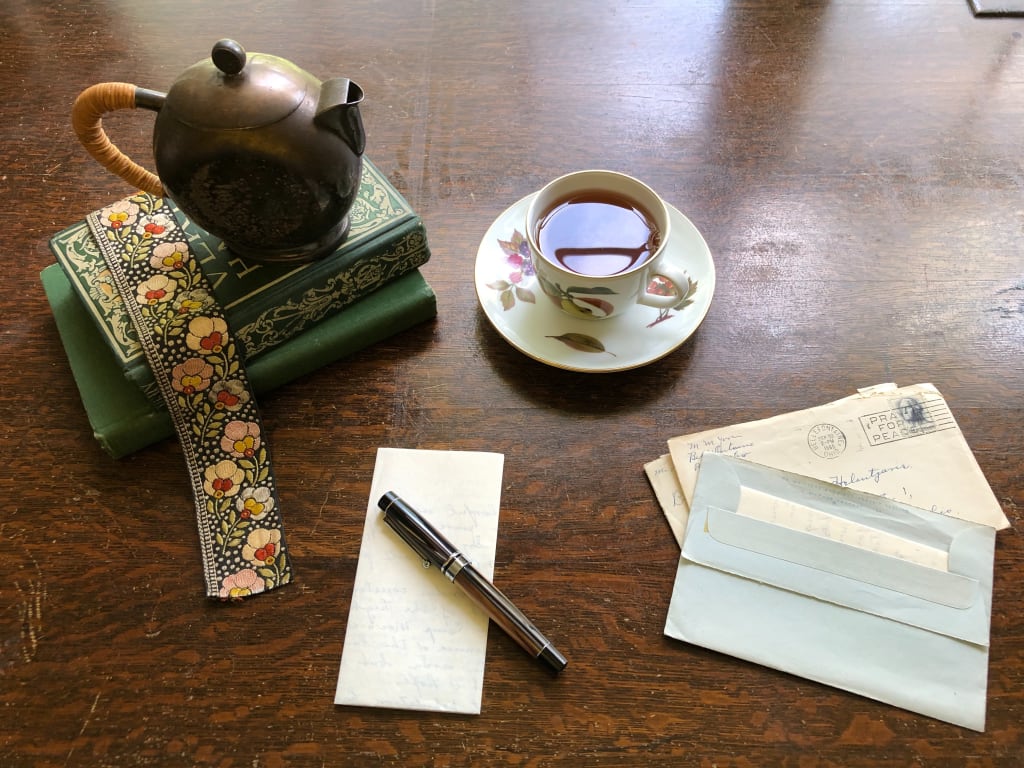
The tea tasted bitter, with strange hints of anise or fennel masking something foul. The result of careless steeping by Catherine’s girl no doubt, or perhaps a failure to properly wash the kettle after a previous brew of oolong or darjeeling.
And these ridiculous white gloves Catherine insisted they wear, as though this collection of housewives were a gaggle of wealthy debutants making their debut at some fiendishly antebellum cotillion. Joan could barely contain her contempt for the entire thing, the frivolity and contrivance of it all.
This wasn’t the Old South and these women weren’t gathered at Tara. It was simply a garden club, comprised of women with full social calendars, brought together on a beautiful Thursday afternoon to mark the end of the last frost and celebrate the completion of Catherine Briggs’s raised flower beds.
Catherine Briggs, parvenu extraordinare, so desperate to elevate herself to the upper echelon of Main Line society. An heiress to a fortune whose origins were murky, awash as it was in barrels of illegality. She tried so hard to shower these women with kindness and hospitality but could never suppress the urge to remind them of its transactional motivation. Her largesse obviously came with conditions.
The flower beds—two large wooden troughs measuring 3 feet by 8 feet—were professional quality, the work of a skilled carpenter who had raised them off the ground to waist height. They each rested on no fewer than 15 stout legs and had already been filled to the brim with a rich, nearly black soil.
They were centered out on the lawn, just past the large windows of the sunroom. Eight women, tea cups and saucers in hands, making idle chitchat with each other, waiting to be invited out to dig through the soil and complement Catherine on her ability to engage the services of a carpenter.
Absurd as this all was, Joan played along. She wore her gloves and sipped her tea and sat very still and ladylike, making idle chitchat with the others, fulfilling the role of the dutiful friend, just as she had all her life. Daughter, friend, fiancé, wife…different roles but always dutiful. Never going against the grain.
Catherine joined Joan on the settee. Joan forced a toothless smile.
“I’m so glad you could make it,” Catherine said. She placed a white-gloved hand on Joan’s. “How many of the others have you met?”
Catherine asked as though Joan were the outsider, an ignorant assumption. “Everyone, of course. I know Dorothy from tennis. Ruth and I are active in D.A.R. I know Margaret from the club. She and her husband—”
“Oh! Tom is such a wonderful man…and so good to her!” Catherine detailed a list of gifts Tom had bought Margaret in the last year, gifts Joan had already seen and gushed over. But…she merely smiled and nodded, ever dutiful. “Yes, I’m sure.”
Catherine caught herself, misunderstanding the reason behind Joan’s aloofness, assuming the gaffe was a comparison of the husbands. “Oh, but so is your Palmer," Catherine said, adding "how are things at home?”
“Uh…good,” Joan answered with very little conviction. “Palmer was just promoted you know—Vice President of Regional Sales. That company, they’ve been so good to us.”
“Not working him too hard, I hope?”
“Well…” Joan trailed off. She thought for a moment of the many overnight trips and the business dinners and the weekends he spent drunk and asleep in a hammock under the elm in the back yard. “He provides. And you and Edgar?”
Catherine waved her hand dismissively, then laughed. “Around, I suppose. Haven’t seen much of Old Edgar these last few days come to think of it.”
Joan felt sad for poor Edgar.
That pitiable man, fifteen years Catherine’s senior. Edgar Briggs worked harder than any of the other husbands represented here. But despite his herculean efforts to provide for her, he appeared to Joan to lack their strength and vitality. Even at his best, his rumpled clothes hung from his tired frame and made his pale, anemic face always seem something more than just tired.
Despite his hangdog appearance, he’d give Catherine the moon if she asked him to. And she asked. But for all that, the most she could manage was a haughty wave. It reinforced Joan’s already low opinion of the host who, since marrying Edgar, had moved mountains to ingratiate herself among the Main Line crowd.
The other women moved away from the settee toward a piano at the other end of the room.
A bit more isolated now, a grim seriousness overtook them both. Catherine broke the silence.
“Actually, um…I’ve been meaning to talk to you. For awhile now…actually.”
Joan cocked her head to the side. “Oh? About…about what, exactly?”
“Palmer,” she said, letting the name hang in the air a minute. Joan’s gaze locked onto Catherine’s a moment before her host averted her eyes.
“How should I put this? Oh goodness, how embarrassing this is….” A single tear formed in the corner of Catherine’s eye before being quickly dabbed away on a knuckle.
Joan’s face burned—either with either anger or dread at whatever was to come in the next few moments. She sipped her tea again and winced at the taste, noticing also an acrid smell she hadn’t detected when the tea was hot. It gave her a headache.
“Your husband…do you trust him?”
“I don’t understand. He’s my husband. Of course I do,” she added, suddenly unsure.
Catherine leaned closer. “There are rumors he’s been unfaithful.”
Joan's now-shaking hand rattled the teacup on its saucer, and the little spoon fell softly to the carpet, narrowly avoiding her shoes. She picked up the spoon and replaced it on the saucer, setting all of it on the glass top table in front of them. The clatter from this drew the attention of a few of the women now browsing through sheet music spread across the baby grand.
“Are you sure?” she whispered.
The imminent disaster of her life was suddenly but plainly visible before her. Nausea overwhelmed her. She thought she might vomit or pass out where she sat.
“At least you won’t have to worry about money,” Catherine said coldly.
Joan’s attention was elsewhere, searching her handbag for an embroidered mouchoir with which to dab her now leaking eyes, but the mention of money from this nouveau riche poseur, with her bitter awful tea and her insipid white gloves, snapped her clean back into the present. This…woman! Who dares to traffic in gossip about her darling Palmer! Except, it wasn’t idle gossip, she knew. In a place not so deep down, she knew it was true. That he’d been unfaithful.
And now, twenty minutes into this wretched garden party—in this hideous, sun blasted pastel room filled with the choking scent of tuberoses—she knew what she needed now was a good lawyer.
Palmer’s family, while not remotely as rich as her Hubert family pedigree, was a few generations removed from poverty. They understood money—how to grow it, how to keep it, and how to acquire it, unencumbered by the burdens of common things like decency, fairness, or honesty. The Hubert family fortune was placed within Palmer's reach the morning she'd said "I do." She'd be damned if she was going to let him make a fool of her and walk off with a dime of that money. Her short-lived sadness quickly curdled into rage.
Sitting on this tacky knockoff Second Empire settee, she wondered how she’d ever fallen in love with such an empty shell of a man. Football star, college graduate, war hero…all meaningless baubles hung on a person without a warm heart or a kind soul.
She thought hard, trying to remember even a single moment of kindness he might have evinced in their 13 years together. But she could think of nothing.
“My ring,” she whispered to herself.
The women on the other side of the room had chosen a song. Sandra Long played while the others sang loudly together, to the visible irritation of Catherine. But the distraction was only momentary.
“What ring is that?” Catherine said loudly, in order to be heard above the music.
Joan was still partially in a daze, but responded.
“My sapphire. A wedding gift from my mother.”
“You don’t wear it?”
“No. I never have. It’s…irreplaceable. And somewhat famous. It has a name: the Star of Kanya. It’s been in my family for four hundred years, passed down from mother to daughter on the Hubert side.”
Catherine’s eyes simply widened. Her jaw slackened, her mouth left slightly agape. Just the notion of such an item was titillating. “My goodness. Where do you keep such a treasure?”
“Oh, I’ll never tell. Even Palmer doesn’t know.”
Catherine nodded. “My my…what a precious secret. Why wouldn't you want him to know?"
Joan thought a minute. "I guess…" she began, trailing off.
"There should be no secrets between a husband and his wife. I know all there is to know about Old Edgar. No secrets between us."
What might have escalated was interrupted by Dorothy Sayer, who called over from the piano to Catherine. “Catherine! How about we take this party outside?”
“Wonderful idea Dorothy! By all means. Some fresh air might do us all some good."
Catherine stood and walked toward the french doors that opened onto a narrow brick patio and the larger expanse of the south lawn.
Joan moved to stand and felt a wave of dizziness overtake her. She steadied herself on the settee, took a deep breath and forced herself to her feet. It took considerable effort. She held a hand to her head and a few of the other women walked over to see if she was ok. She politely waved them off. Shakily, she made her way toward the doors and the party beyond.
Out on the lawn, the white gloves came off, tucked away in handbags and traded for gardening gloves or, in Dorothy's case, bare hands.. The group wandered past the raised beds, complemented Catherine on their sturdy construction, and sifted through its loam soil.
“You must have clay soil on this property, is that why the raised beds?”
Catherine agreed, hands nervously clasped in front of her.
“My goodness Catherine, you’ve got sprouts already. How are you fertilizing this soil?”
“That’s my secret Eunice,” said Catherine with a smile.
Joan’s left foot began dragging slightly. She stood still, not just feeling the sun but hearing it. As she looked into the sky and stared directly into its brilliant fire, she heard sizzling. Or perhaps a roar from flames. No, she thought. It was a more like rushing in her ears. Rushing like water. Angry water. Fast-moving angry water.
The colors of the world—green and blue mostly, though also the white sides of the house, the deep rust red of the shutters—suddenly took on an odor colors shouldn't have, each one unique. Green became molasses, blue a crisp citrus, rust red an iron rich blood scent so strong she could taste it.
No, it wasn't a smell. It was taste, actual blood she was tasting.
Her blood.
And her final cogent thought was that she’d bitten her tongue.
Her jaw, she felt, had become fused shut. Terror rose in her throat. Terror and the need to scream. But her mouth would not yield and the scream rumbled forth as a muffled gurgle.
A tingle began in her right hand and radiated quickly up her arm, past her shoulder, all across her scalp. A sharp tingle like electrocution. Then, with her skin on fire, the loud squelch of a radio buzzing screamed in the center of her head, right between her ears. Her skull vibrated with the static of a radio broadcast, like a wireless had been jammed into her gray matter, its volume knob turned all the way to the right.
She grabbed her head and shrieked.
Then nothing but total blackness.
The others rushed to Joan’s side, who’d fallen where she stood and began convulsing. Her eyes rolled into the back of her head and blood trickled from her lips. Flecks of pink foam formed in the corners of her mouth and the women jumped to their feet.
“Is it rabies?!” someone screamed.
“Call an ambulance!” Dorothy shouted.
Doris Martin and Ruth Baxter ran inside, presumably to do so.
Dorothy got on her knees behind Joan’s head and held it, her garden-gloved hands pressed against Joan’s ears.
To those remaining she said: “Keep your fingers away from her mouth. She’s already bitten her tongue. Nothing we can do about that now. This’ll pass in a few minutes.”
Everyone—even Catherine—stood horrified watching Joan. But when two minutes turned to three and then four, they backed slowly away from the heinousness of it all.
A uniformed patrolman walked into the yard followed closely behind by Doris and Ruth.
“An ambulance is on its way, ladies. It should be just a minute now.”
Dorothy stood, brushing grass from the front of her frock. “That’s a minute too long, buster.” She was weeping a bit as she dropped her gloves to the ground.
“I beg pardon, ma’am?”
“She’s dead, officer.” Gasps and cries filled the still spring afternoon. “She died in my arms. Epileptic seizure. Grand mal, I think it’s called. From the French, meaning 'real bad.' Boy, I’ll say.”
“What is her name?” the cop asked, pointing at Joan’s body, notebook at the ready.
“Her name WAS Joan Krendall.”
The cop wrote the name down on his note pad.
“Is the homeowner here?”
Catherine raised her hand. “I am she.”
“Is your husband home, ma’am? I’d like to talk to him.”
“No.”
He made a note. “OK. Ladies I’m going to have to ask that everyone have a seat and not leave the premises. I need to go call this in. I’ll be right back. Ambulance crew should be here any minute.”
Nobody moved or even breathed. Catherine’s face was haggard. She looked and felt as though she’d aged a year in the last ten minutes.
“Got anything stronger than tea?” Dorothy asked.
Once Joan’s body had been removed and the party attendees questioned, all but one left quietly, leaving Catherine alone in the house with Dorothy, whose third brandy prevented her from immediately getting behind the wheel of a car.
They sat across from one another in wingback leather arm chairs in Edgar’s study, holding brandy snifters. The last light of the day glowed on the horizon, casting deep shadows in the room, which was lit only by a single bronze floor lamp and the glow from a flaming gas fireplace, silent but for the hiss of the gas.
Dorothy drained the last of her glass and set it on the small table next to her. “I noticed you haven’t weeded your garden yet,” she said.
Catherine met her eyes. “Excuse me?”
“You’ve yet to weed. I noticed.”
“I haven’t had a chance to get it all done. You really want to talk about weeds at a time like this?”
“You’ve got jimsonweed out there. Ugly little thing, all spiky leaves. That hideous little mad apple on the end. It’s got a purple flower on it, shaped like a little cone.”
Catherine stared at her but said nothing.
“It’s poisonous, you know. Stinks to high heaven but the leaves make a hell of a lethal tea.”
Dorothy pushed herself out of the chair, unsteady on her feet.
“Where are you going? You’re in no condition to drive.”
Dorothy waved a hand dismissively. “I’m going to walk down to the Bakers and call myself a cab.”
"Call from here."
"If it's all the same to you, I'd rather not."
She made her way to the door, steadying herself on the frame when she reached it. She cast a glance behind her to see Catherine poised on the edge of her chair, hands clenched around the snifter, eyes locked on nothing but a point somewhere on the floor near her feet. Dorothy shook her head and left.
When Catherine heard the front door close, she jumped up from her seat and hurried over to the desk, frantically grabbing the phone from its cradle.
“Campbell-6567,” she said and waited for the call to connect. “It’s me.”
In a clipped and irritated voice, Palmer Krendall asked her a single question. “Did she tell you where the ring is?”
But Catherine didn’t immediately answer because she was thinking about a different, more important question: what happened to the tea cup Joan drank from?
About the Creator
Wesley Ratko
I'm a designer with a background in cartography and data visualization. On the side, I scribble fiction.
Keep reading
More stories from Wesley Ratko and writers in Criminal and other communities.
The Line Was Thinner Than I Thought
They tell you that the difference between a "good man" and a "cautionary tale" is a wide, sturdy canyon. They tell you there are signs—warning lights, sirens, a gut feeling that screams stop. But as I stood in the rain outside the Miller estate, feeling the cold weight of the key in my pocket, I realized the truth.
By Jhon smith3 days ago in Criminal
Autonomy Is The Real Privilege
Good morning, freedom-seekers! Today we’re gonna be looking at autonomy. A strange word, I know; one many would probably look at blankly and run away from on sight. We’re gonna figure out what it actually means, consider how it’s achieved, and decipher just how deeply most of us are tangled up in dependence without realising it.
By That ‘Freedom’ Guy5 days ago in Humans




Comments
There are no comments for this story
Be the first to respond and start the conversation.