
Void
The McNallys were the kind of family no one knew but everybody talked about.

The year the McNally boy died, Ray Warner bought a little black notebook.
Hardcover, with lined, cream-colored pages and a fancy ribbon to mark your place. Most people—including me—thought it an odd coping strategy after such a devastating tragedy.
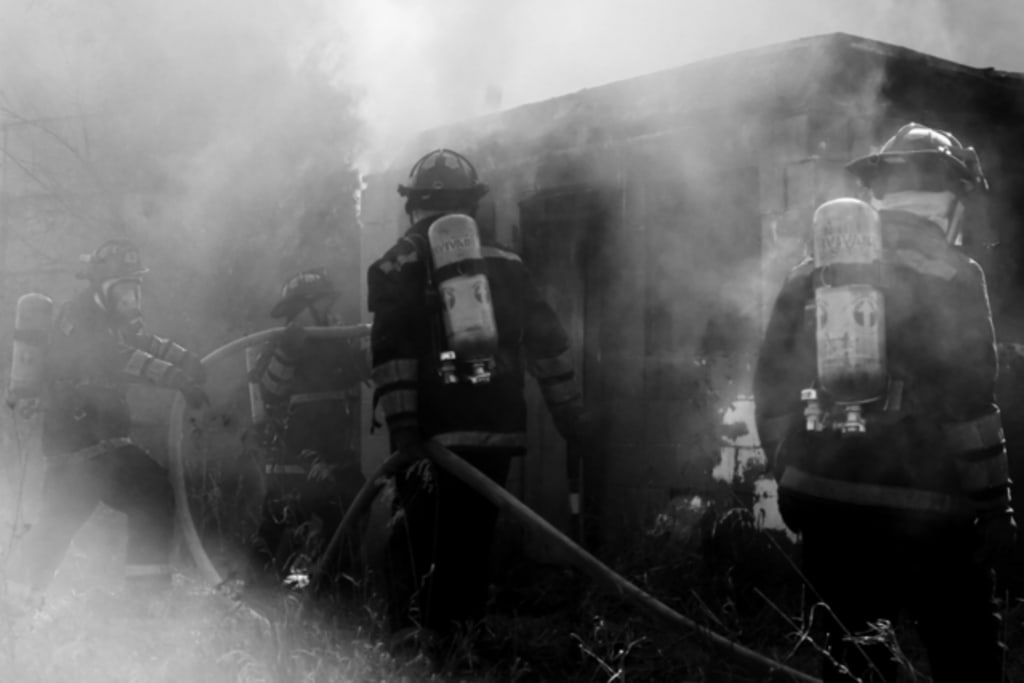
All firefighters fear that at some point we may not be able to save everyone. Some fires prove just too vicious. Too hungry. Too evil. And the bravest of us, like Ray, who run into the danger but fail, usually turn to the bottle (or something harsher) to cope with the guilt that we survived while someone helpless did not.
But not Ray. Ray had his book.
How it helped him manage was a mystery. His wife said the book never moved off his basement work bench. He took no steps to hide it and never told her not to open it. But Mary Warner proudly told anyone who would listen that she respected her husband’s privacy. In all the time they were married, she never snooped.
“I figured it was where he kept his girlfriends’ phone numbers,” she said with a wry but rueful smirk. “Marriage don’t work without trust.”
As far as Mary (or anyone else) knew, no one other than Ray had ever looked inside it. No one until the day she asked me to visit.
The Warners lived in a small, well-maintained two-bedroom house on a corner lot on Deacon Street, concrete from the basement to the roofline. The only wood in the place was the furniture in the rooms, the doors between them, and the rafters that held up the roof.
A hothead ladder jockey I only knew as Tommy once asked Ray why he built his house out of concrete. It was a stupid question and everyone knew it, including Tommy. But he asked anyway because he thought he was funny, a quality he prized more than courtesy.
“Concrete don’t burn,” Ray grumbled. Tommy was gone before the year was out and that may have been the only three words Ray ever said to him.
I was with the company for that incident, but the McNally fire was before my time. A few of the guys filled me in on the details, the most important of which was to never ask Ray about it. And as curious as I was, I respected his right to silence. So I never asked.
As captain of Engine Company 1, Ray commanded respect among his men. But he was naturally a quiet man, reserved, content with his own company, and not inclined toward idle chitchat. A year after McNally, I transferred in as a driver engineer and Ray took me under his wing. He knew I had a brother who’d died in the line and, however unspoken our shared pain, he stepped into a mentor role for me at a time when I needed one. Perhaps because he needed to be one.
It was that admiration that kept me from asking Ray about the fire, but it didn’t stop me from talking to everyone else at the station.
Our lieutenant once told me when the crew first arrived on the scene that night they couldn’t find the parents, Ed and LuAnn, who only turned up later at the hospital to fetch their five surviving kids who were being treated for smoke inhalation. Lieu said the five were found huddled under blankets in the front yard well away from the house, past a big elm tree from which a flaming tire swing burned on its rope. Two big dogs sat panting at their feet, all watching the flames lick the tops of nearby trees. They didn’t even start screaming about the little one until Ray asked if there was anyone else inside.
In spite of the inferno that had all-but-consumed the house, Ray ran straight at the A-side and through the front door. He emerged only a minute later, unsteady on his feet. He was dragged away from the front porch seconds before the roof collapsed. The guys thought the smoke and heat had gotten to him, but the effects he suffered inside were psychic, not physical. Whatever he saw in that house changed him, hollowed him out. And an already introverted man curled inward, into a newly created void.
The McNallys were the kind of family no one knew but everybody talked about. Their old clapboard house was set back from the road, surrounded by trees and nestled along Dickson Creek at the bottom of Flynt Street.
It probably predated indoor plumbing. Some speculated it might not have ever had it. The house, dark brown and mostly peeling, had somehow escaped the destruction wrought by multiple floods over the years, though it was visibly stained by evidence of water damage right up to the top of the first floor windows.
Visitors to the home (mostly state officials and law enforcement) were invariably greeted by the sight of at least two of the younger McNally children staring back from behind a threadbare sofa left out on the front porch. LuAnn McNally was usually screaming at someone from inside, either in anger or so she’d be heard over the incessant barking of one or more large dogs.
The older children were a rowdy bunch. The oldest, Hank, was well-known by the police, yet virtually unseen in the classrooms of the high school. The youngest however was, by all accounts, a shy and curious child who would frequently wander up to the library on Sanderson to look through the picture books and encyclopedias and stay until closing.
That boy—the dead one—was widely mourned by all after the fire. Teachers, librarians, Reverend Reynolds from First Presbyterian, they were all deeply saddened by his loss. Many noted in one-on-one conversations that he was likely the only McNally who might have ever amounted to anything. His death was dishearteningly tragic, a death most people in town blamed on Ed and LuAnn, myself included.
Ray thought otherwise. Whatever the cause of the fire, Ray insisted the McNallys were out working that night—Ed a night watchman at the Slocum Lace Factory and LuAnn a waitress at Hep’s Diner on Route 9. Didn’t matter to most folks though—to most folks the kids were neglected, and that neglect was worthy of people’s scorn.
Lieu said he was standing outside the hospital watching the McNallys pile in to an ancient rust bucket of an old Ford having a smoke when Ray muttered “I’m gonna do right by those people” to no one in particular.
I’d never been to Ray’s house when he was alive. He’d mentioned a wife, but until she introduced herself on the phone and again at the door, I didn’t know her first name was Mary.
“Come in,” she said, her eyes visibly puffy from crying. “I was about to put some coffee on, would you like some?” I told her I would and stepped into the living room. She returned a minute later and stood there, searching the room for something to say. I stood still, afraid too much movement might disrupt the spirit of a man whose eternal rest required silence. “Thank you for coming,” she said.
“It’s the least I could do, ma’am.”
“Odd thing, this, Ray leaving you that book. You, specifically. By name, no less! Any idea what might be inside?”
I shook my head. To say anything felt like a betrayal of the confidence Ray had in me. I sincerely didn’t know, but he’d made me its steward and that came with discretion.
“Well…it’s this way. In the basement.” She led me through the kitchen to a door on the far end of the room, opened it and stood aside. I thanked her. She held my gaze.
“He worked himself to death you know. Shifts at the station. Odd jobs for cash. Little things. But the time added up. He’d always been funny, my Ray, in his own way. Last few years though….” Her lip quivered. Whatever the thought it would remain unspoken. “I just wish I knew what drove the man so hard.”
Again I said nothing, unsure how anything could help. I descended.
The basement steps, a metal pre-fab structure, were narrow and steep, and they creaked and groaned with every footfall. Mary watched me go about halfway down before vanishing into another part of the house. Widows, I’ve found, walk soft as cats.
The concrete ceiling was low, crisscrossed by pipes and wire conduits. A few bare bulbs lit the room, screwed into socket boxes positioned centrally throughout. In spite of them, darkness and shadows dominated. The air was damp and smelled of mildew. At points along the wall, traces of water darkened the gritty, rough concrete and drew amorphous paths toward a drain in the center of the floor.
I produced a pen light from my jacket pocket and clicked it on, shining it around the room. A trail of paw prints made by some long-dead creature, a cat most likely, had been memorialized the day the foundation was poured, preserved forever in the slab and still visible all these years later.
A masonry column extending up through the center of the house occupied a significant portion of the room just beyond the stairs. Along the north wall, a work bench of bolted-together four-by-four posts framed with two-by-four studs and topped by a formica countertop stood at rib height below a wall-mounted pegboard from which hung hammers and wrenches, pliers and screwdrivers.
On the ceiling above that was a shop light, suspended from chains affixed to eye hook bolts secured into the concrete. I flicked a switch beside the pegboard and two fluorescent tube lights buzzed to life, casting this corner of the basement in bright, artificial light.
The counter was nearly bare, its surface scuffed and dented from decades of use. On it were an oversized Hills Brothers coffee can stuffed overflowing with rags and a battered old black notebook, four inches by six. The book was centered on the table, not stored but displayed. I picked it up, half-expecting to see its outline drawn or etched onto the tabletop to mark its sacred space.
I held it gently with something like reverence and my first thought was of hymnals in church or the bibles of my youth.
On the first page, written in shaky block letters, Ray had inscribed it with a Bible verse:
“And he shall make full restitution for his wrong, adding a fifth to it and giving it to him to whom he did the wrong. Numbers 5:7”
The rest of the book was simply a ledger, an eight year accounting of funds earned and saved, neatly printed in columns noting the date, the amount, and a running total. Some of the entries were for twenty dollars, some hundreds, still others only two or three.
Three pages from the end, the entries stopped. The last, dated a month prior to Ray’s death, noted a five dollar deposit and a total: $20,012.
In the pocket affixed to the inside back cover was a folded and yellowing newspaper clipping with a simple headline: “Boy, 6, dies in house fire.”
I set the book down, sure now he’d left me more than just this ledger. Below the bench were a few stacked paint cans, three nearly empty tool bags, and several boxes with assorted power tools. I squatted and searched them all but found nothing. The money was here, I was sure of it.
I looked again at the coffee can and whipped off the top rag. It was filled nearly to the top with eighteen rolls of tightly wrapped bills, dirty and tattered.
Twenty thousand dollars worth of Ray’s absolution.
Twenty thousand dollars…set aside for the McNallys.
Twenty thousand dollars repayment for the loss of the only good child to come out of that wretched family.
Twenty thousand dollars…left in my care.
To do with as I pleased.
About the Creator
Wesley Ratko
I'm a designer with a background in cartography and data visualization. On the side, I scribble fiction.
Keep reading
More stories from Wesley Ratko and writers in Families and other communities.
Wise~Guys
— Look Behind what's in Front of You ~ Make Good Choices — Hey, So how you Doin'..! Made~Men — Mobster Movies romanticise a distinctive, elegant appearance, impeccable attire style, along with the 'Families' expressive lingo. Making their 'Bones' gave them Panache — with vintage fedoras, tailored pin-striped suits, mirror-polished wing-tip shoes adorned with tassels; with their 'Gun Moll' gorgeous dates on their arms.
By Jay Kantor24 days ago in Families
Lies Have No Feet
One afternoon, Wahab Sahib went to the school grounds to pick up his son, Abuzar. He saw Abuzar chatting happily with his classmate and friend, Tauseef. Tauseef, speaking casually, asked, “Hey Abuzar! Why didn’t you come to school yesterday? We missed you.”
By Sudais Zakwana day ago in Families



Comments
There are no comments for this story
Be the first to respond and start the conversation.