
I was fourteen years old when my mother lied to me.
At the time, I didn’t think it was a lie. I thought I had finally won.
For months, my mom and I had been at war. I was hanging with the wrong crowd—guys who skipped school, stole things for fun, and smoked in alleyways like they were grown men. My mother begged me to stop. She cried. She yelled. She threatened. Nothing worked.
One day, after another call from school about my behavior, she sat me down at the kitchen table. Her eyes were tired, her voice was calm—too calm.
“What do you want?” she asked.
I scoffed. “What do you mean?”
“If I could give you anything, what would make you happy?”
I folded my arms. This had to be a trick. But then I saw something in her face—defeat. Like she was done fighting. I felt a strange kind of power.
“I want a car.”
I expected her to laugh. Maybe slap me.
Instead, she nodded. “Okay.”
I blinked. “Okay?”
“Yes.” She leaned forward. “But first, we need to go home.”
Home? I frowned. “We are home.”
She shook her head. “No. We’re going to Nigeria. Your Uncle Friday has passed away. We have to attend his burial.”
A funeral? That wasn’t part of the deal.
But if sitting through some long, boring event meant I’d get a car when we got back, then fine. No problem.
A Funeral Without a Dead Man
A few weeks later, we landed in Nigeria. The air was hot, thick, and smelled like smoke and sweat. From the airport in Owerri, we drove for hours down bumpy, red-dirt roads until we arrived at my mother’s village.
That’s when I saw him.
Uncle Friday.
Alive.
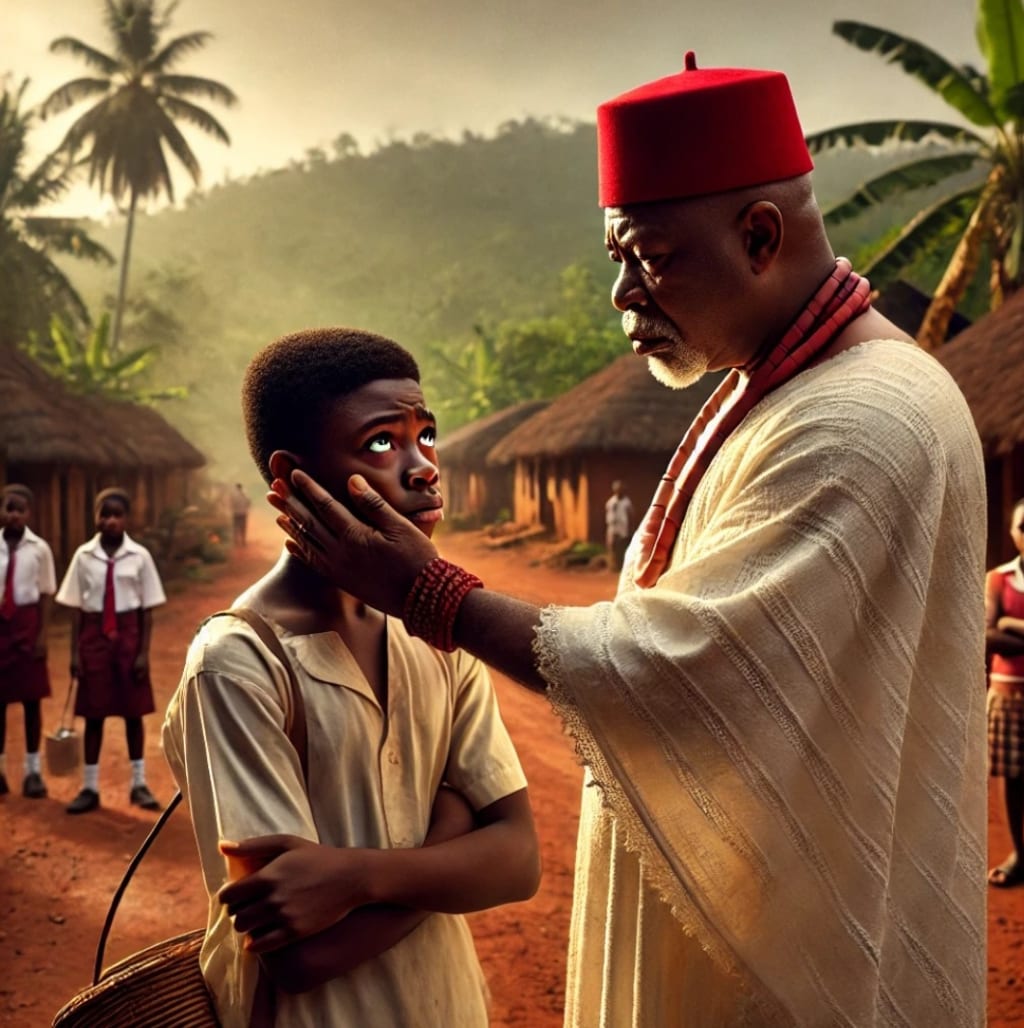
I thought I was seeing a ghost. The man was supposed to be dead. Instead, he was standing in front of the house, arms crossed, watching me like he had been expecting me.
Before I could say a word—SLAP!
My vision blurred. My ears rang. My face burned.
“That is for being a trouble to your mother,” he said.
I staggered back. What the hell was happening?
I turned to my mom, eyes wide, betrayed.
She nodded. “You’ll be staying here.”
I froze. “What?”
She placed a hand on my cheek—the same one Uncle Friday had just slapped—and smiled. “You want a car? Earn it.”
Then she got in the car and drove away.
I had no passport. No money. No way back.
Welcome to Hell
At 5 AM the next morning, I was yanked out of bed by my uncle’s booming voice.
“Get up! You have work to do.”
Work? What work?
He shoved a plastic bucket into my hands. “Go and fetch water.”
I stared at him, confused. “Fetch water? From where?”
“The stream.”
The what?
I followed some local boys as we walked—no, trekked—miles down a narrow dirt path to a murky, slow-moving stream. They filled their buckets easily. I struggled to lift mine. By the time I got back, my arms were shaking, my legs were weak, and I felt like throwing up.
But that was just Day One.
Day Two? Farm work.
Day Three? Clearing the bush with a machete.
Day Four? Public school.
I thought American school was bad. But this? This was a war zone.
The classrooms had no air conditioning. The teachers carried canes. One kid got flogged for getting a math problem wrong.
And lunch? If you didn’t bring food, you didn’t eat.
I hated it.
I tried to fight back. I refused to go to school. I refused to fetch water. I refused to work on the farm. I skipped class and started hanging with some of the village boys under the mango tree.
Then one night, Uncle Friday sat me down and looked me dead in the eye.
“You want to be a thug?” he asked.
I folded my arms, refusing to answer.
“Good. Go and join the boys under the mango tree. Let me see how far you will go.”
I didn’t move.
Because I had seen what happened to those boys.
Some ended up stealing. Some got beaten by the villagers. Some… disappeared.
Uncle Friday leaned closer. “You think you’re a man?” His voice was calm, too calm—just like my mother’s had been that day in the kitchen. “Then go. Prove it.”
I didn’t go.
I stayed.
And I changed.
Three years passed. By the time I turned seventeen, I was no longer the same boy my mother had dropped off. I had muscles. I had discipline. I had respect.
When my mother finally returned, she barely recognized me.
She hugged me tight. “You’re ready.”
Then she took me back to the U.S.
Uncle Friday’s Burial… Again
I never got the car.
I didn’t need it.
I had learned something more valuable—how to be a man.
Now, years later, I have my own family.
And my eldest son? He’s acting up. Bad friends. Bad attitude. Just like me back then.
Last night, my wife sat me down at the kitchen table—the same way my mother once did.
“What are we going to do?” she asked.
I looked at my son.
Then I smiled.
“Uncle Friday’s burial is happening again.”
About the Creator
Keep reading
More stories from writers in Confessions and other communities.
Thoughts on Vocal and the way the world is
"Death cannot stop true love, only delay it." – Wesley in The Princess Bride. I decided to come back to Vocal on a very cold and dark night at the end of December. I had been, and still am, convalescing from a horrible staph infection that had gone misdiagnosed for months. This, paired with the increasing challenges of being healthy, making the best choices for my co-parented child, being a wife, and being a director at a new job, was a lot to manage.
By Jazzy 9 days ago in Confessions
UAE Abruptly Cuts Aid to Vital Hospitals After Withdrawing From Yemen
The United Arab Emirates’ abrupt decision to cut aid to several vital hospitals in Yemen following its withdrawal from the country has sparked serious concern among humanitarian groups, medical workers, and international observers. The move comes at a time when Yemen’s healthcare system—already weakened by nearly a decade of conflict—remains heavily dependent on external assistance to function. For many Yemenis, the loss of Emirati-funded medical support could have immediate and life-threatening consequences.
By Salaar Jamali3 days ago in Confessions



Comments
There are no comments for this story
Be the first to respond and start the conversation.