
The Joy of Missing Out: Why Saying No Creates Space for a Better Yes
Choosing rest, reflection, and intentional living over endless obligations
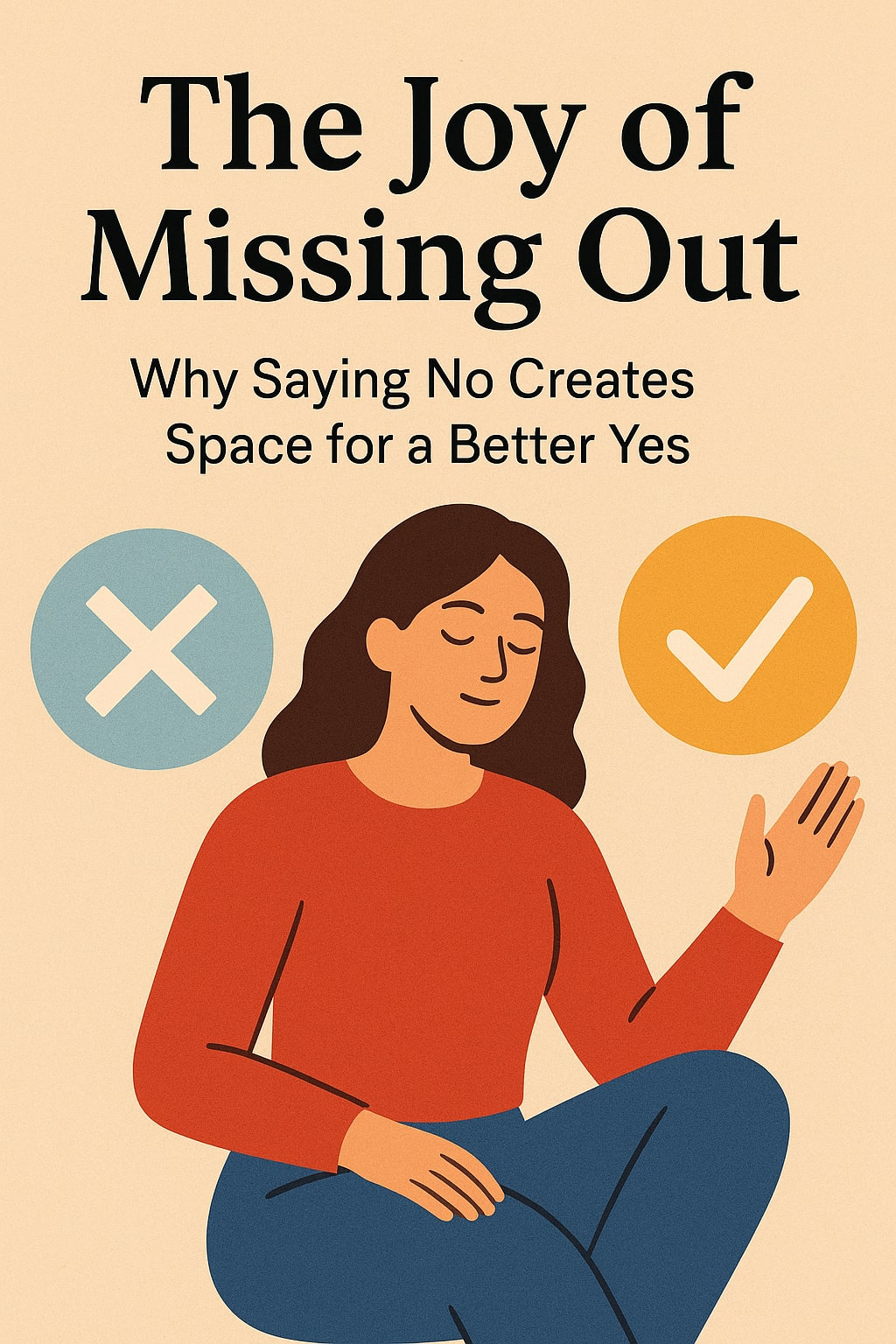
Choosing rest, reflection, and intentional living over endless obligations
In today’s fast-paced, hyperconnected world, the fear of missing out—often abbreviated as FOMO—has become a near-universal experience. Social media feeds overflow with curated snapshots of people seemingly living their best lives: vacations in tropical destinations, gourmet meals, professional milestones, and endless social gatherings. In response, many of us feel an invisible pressure to keep up, to do more, and to say yes even when our energy and time are already stretched thin.
Yet beneath the surface of this constant striving lies a quieter, more liberating truth: the Joy of Missing Out, or JOMO. Far from being a resignation or defeat, JOMO represents the freedom of saying “no” when necessary and embracing a lifestyle rooted in mindfulness, presence, and intentional choices. It’s about realizing that missing out on certain things is not only okay—it’s often essential to living a meaningful and fulfilling life.
This article explores what JOMO really means, why it’s so powerful, and how learning to say no can open the door to deeper yeses that truly matter.
The Roots of FOMO and Why It Drains Us
The term FOMO entered mainstream culture in the age of smartphones and social media. The more access we had to other people’s lives, the more opportunities we had to compare ourselves—and feel like we were falling behind.
But FOMO isn’t just about envy. It’s rooted in three deeper fears:
Fear of not belonging – Humans are wired for connection. Missing an event, conversation, or opportunity can trigger the worry that we’ll be excluded or forgotten.
Fear of lost opportunities – We fear that by saying no today, we’re closing doors on something bigger tomorrow.
Fear of inadequacy – When others seem to be “doing more,” we feel like we’re not doing enough.
Ironically, constantly saying yes to avoid missing out only increases stress, weakens focus, and leaves us feeling emptier. Overcommitted schedules can rob us of downtime, reflection, and the ability to fully enjoy the activities we actually value.
JOMO: A Radical Shift in Perspective
JOMO flips the script. Instead of being driven by fear, it’s grounded in contentment. At its core, JOMO is the intentional choice to prioritize quality over quantity—presence over distraction.
Think of it as the joy of:
Missing out on noise so you can hear your own thoughts.
Missing out on meaningless busyness so you can rest deeply.
Missing out on comparison so you can appreciate what you already have.
It’s not about rejecting experiences altogether but about curating which ones align with your values, goals, and emotional capacity.
The Power of Saying No
For many of us, saying “no” feels uncomfortable. We worry it will disappoint others, close opportunities, or make us seem selfish. But every “no” is also a “yes” to something else:
Saying no to another late-night work email may be a yes to a peaceful evening with family.
Saying no to a social gathering may be a yes to much-needed rest.
Saying no to overcommitting may be a yes to deeper focus on what truly matters.
When we say no strategically, we reclaim our time, energy, and mental clarity. This creates space for better yeses—the ones aligned with our passions, values, and long-term growth.
JOMO and Mental Health
Research increasingly shows that overstimulation and constant busyness contribute to anxiety, burnout, and reduced well-being. JOMO offers an antidote. By letting go of unnecessary obligations, we allow ourselves:
More rest – Our brains and bodies need downtime to function optimally.
Deeper focus – Fewer distractions mean more meaningful engagement with tasks and people.
Stronger self-worth – Instead of measuring ourselves by external activities, we anchor our identity in internal values.
Reduced comparison – Missing out on endless scrolling helps us remember that what we don’t see online is just as important as what we do.
In this way, JOMO isn’t just a lifestyle trend—it’s a tool for protecting mental health.
Practical Ways to Embrace JOMO
Shifting from FOMO to JOMO doesn’t happen overnight. It’s a practice of rewiring habits and rethinking priorities. Here are practical steps to help:
1. Redefine Success
Ask yourself: what does success truly mean to me? Is it about being everywhere and doing everything, or about living authentically in alignment with your values?
2. Set Boundaries
Practice saying no kindly but firmly. You don’t owe long explanations—sometimes a simple “I can’t commit to that right now” is enough.
3. Unplug Regularly
Take intentional breaks from social media and digital devices. Even short daily detoxes help reduce comparison and overstimulation.
4. Prioritize Deep Connections
Choose fewer but more meaningful relationships and activities. Invest in the people and projects that truly energize you.
5. Celebrate Rest
View rest not as laziness but as fuel for creativity, resilience, and joy. Missing out on constant busyness often means gaining peace of mind.
6. Reflect Often
Journaling or quiet reflection helps you identify what matters most and what can be released.
The Better Yes
When we learn to say no, we discover that not every opportunity is meant for us. Some doors are distractions, while others are paths to growth. JOMO helps us filter the noise and recognize the invitations that are worth our energy.
The “better yes” may look different for each of us:
For one person, it’s more time with family.
For another, it’s pursuing a creative passion.
For someone else, it’s focusing on health and well-being.
What unites all these better yeses is that they’re intentional. They’re not chosen out of fear or obligation, but out of clarity and joy.
The Paradox of Freedom
It may seem counterintuitive, but missing out actually expands our freedom. When we stop chasing everything, we create room for what matters most. In this way, JOMO is not about scarcity—it’s about abundance.
Instead of thinking “I’m missing out on something,” JOMO reframes the thought as: “I’m gaining peace, clarity, and alignment.” This shift allows us to approach life from a place of fullness rather than lack.
Living with JOMO in a FOMO-Driven World
Of course, society doesn’t slow down just because we choose to. Social media will continue to showcase highlight reels, and invitations will keep arriving. Practicing JOMO requires courage to stand apart from the cultural norm of busyness and endless availability.
But every act of intentional “missing out” becomes a statement: that your worth isn’t measured by how much you do, but by how authentically you live. That joy isn’t found in comparison, but in contentment. That the best yeses often arrive when we have the courage to say no.
Conclusion: The Joy of Missing Out as a Path to a Fuller Life
At first, JOMO may feel uncomfortable. It challenges deeply ingrained habits of comparison, overcommitment, and constant striving. Yet with practice, it becomes liberating. By saying no to the noise, we say yes to what truly matters.
The Joy of Missing Out is not about retreating from life—it’s about living it more fully. It reminds us that we don’t have to be everywhere to live meaningfully. We don’t have to do everything to be enough. And we don’t have to chase every yes when the right yes is waiting for us.
So the next time you feel the pull of FOMO, pause. Ask yourself: what am I really missing out on—and what am I gaining instead? Chances are, the joy of missing out will lead you closer to the life you truly want.
About the Creator
Keep reading
More stories from Aiman Shahid and writers in Confessions and other communities.
The Power of Pausing: Why Stillness Can Be the Most Productive Choice
Introduction In a world where productivity is often measured by speed, output, and constant motion, pausing may seem like the opposite of success. We live in a culture that glorifies hustle, celebrates multitasking, and idolizes busyness as a badge of honor. Yet, this obsession with constant activity often leads to burnout, stress, and a loss of clarity. What if true productivity isn’t about always moving, but about knowing when to stop?
By Aiman Shahid4 months ago in Confessions
Raising my standards
I am raising my standards. Now, I just don't want a boy whose isn't clear about his feelings for me and says that I am just like his sister or someone who often shows up like a "Surprise, I exist" and act like they care about me, love me but doesn't give a damn about me and ignore me for weeks.
By Samairaa 4 days ago in Confessions



Comments
There are no comments for this story
Be the first to respond and start the conversation.