
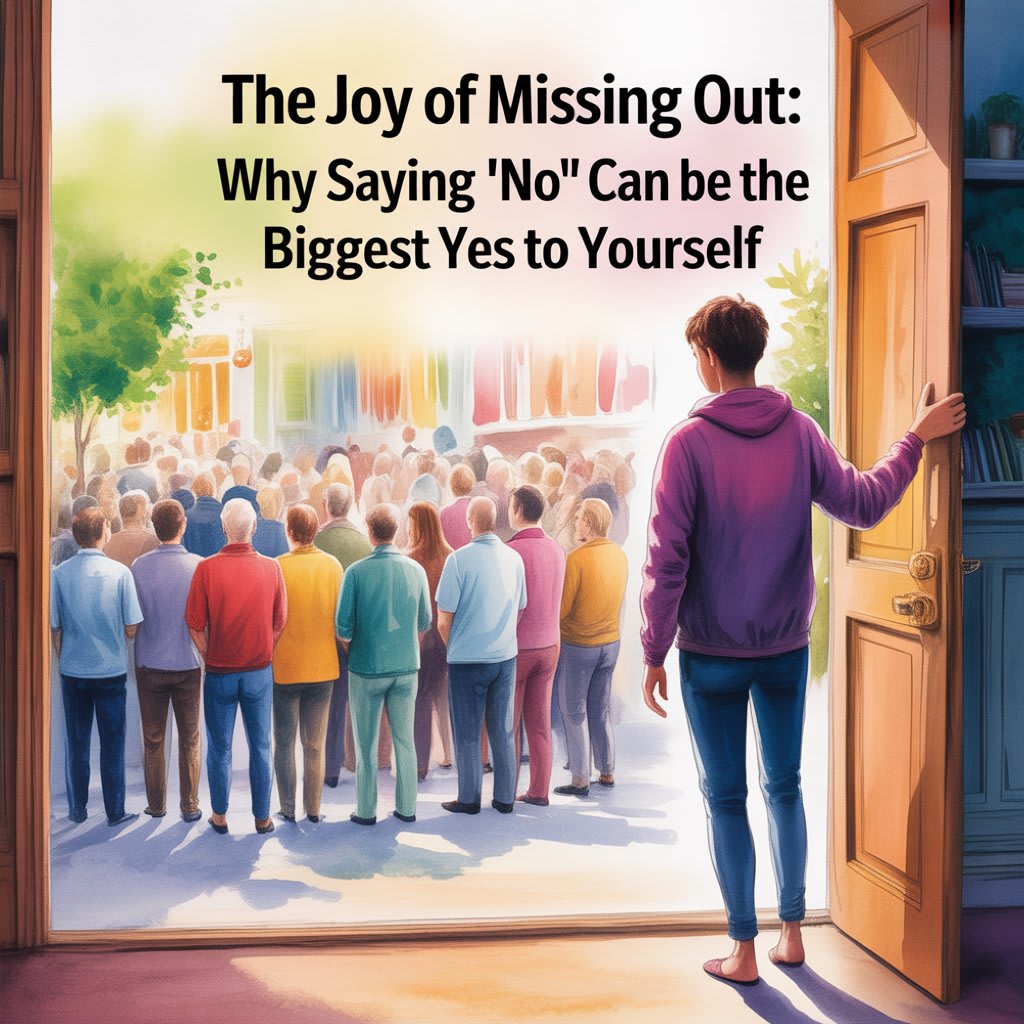
The Joy of Missing Out: Why Saying ‘No’ Can Be the Biggest Yes to Yourself
Exploring how setting boundaries, turning down invitations, and embracing solitude can actually lead to a richer, more fulfilling life.
Introduction – Redefining “Missing Out”
For years, the term FOMO—the “fear of missing out”—has driven people to say yes to everything. Every invitation, every opportunity, every social gathering feels like an obligation. What if you’re left out of an important moment? What if people think you’re not fun, ambitious, or involved enough?
But there’s a quieter, more powerful movement happening: JOMO—the joy of missing out. It’s about reclaiming your time, energy, and mental space. It’s about choosing you over constant busyness. And it’s about realizing that every time you say “no” to something that doesn’t serve you, you’re actually saying a bigger “yes” to something that truly matters.
1. The Problem with Always Saying “Yes”
The Burnout Trap
Constantly saying yes can lead to exhaustion—physical, mental, and emotional. The more we overcommit, the less time we have for rest and self-reflection. Over time, this leads to burnout, resentment, and even health issues.
The Illusion of Connection
We often say yes because we want to stay connected. But being physically present in every event doesn’t necessarily mean we’re emotionally connected. True connection comes from meaningful engagement, not endless appearances.
The Cost to Your Priorities
Every time we say yes to something that doesn’t align with our values, we’re saying no to something that does. Time is finite—spending it on obligations means less for passions, loved ones, and personal growth.
2. Understanding the Power of “No”
No is a Boundary, Not a Rejection
Many people avoid saying no because they fear it will hurt someone’s feelings. But a respectful no isn’t about rejecting a person—it’s about respecting your limits. Boundaries protect relationships by preventing resentment from building up.
No Creates Space for Yes
By saying no to activities, people, or commitments that drain you, you open space for things that nourish you—rest, creativity, health, deep relationships.
No is an Act of Self-Respect
When you say no, you affirm that your time, energy, and well-being matter. This self-respect often inspires others to treat you with greater respect as well.
3. What JOMO Actually Looks Like
Choosing Quality Over Quantity
Instead of attending every party, maybe you choose one gathering a week where you can be fully present. Instead of joining every project at work, you pick the one that excites you the most.
Embracing Solitude Without Guilt
JOMO often means enjoying your own company—reading a book on a Friday night instead of going out, or taking a solo walk instead of filling your schedule with back-to-back coffee dates.
Mindful Presence in the Moment
When you embrace JOMO, you don’t just skip events—you savor the alternative. If you’re home, you’re really home—unhurried, undistracted, present with yourself or your loved ones.
4. Overcoming the Fear of Missing Out
Recognizing That You Can’t Do It All
Life is full of wonderful possibilities, but no one can experience all of them. JOMO begins with accepting that saying no to some things doesn’t make your life less—it makes it more focused.
Trusting That What’s Meant for You Will Find You
When you skip something, it doesn’t mean you’re losing opportunities forever. The right opportunities will align with your timing and priorities.
Shifting from External Validation to Internal Fulfillment
FOMO thrives on external validation—likes, tags, invitations. JOMO thrives on internal fulfillment—peace, contentment, and meaning, even if no one else is watching.
5. Practical Ways to Embrace JOMO
A. Audit Your Commitments
Make a list of your current obligations. Ask yourself: Does this align with my values? Does it energize or drain me? If it’s the latter, consider stepping back.
B. Create a “No” Template
Saying no is easier with a script:
“Thank you so much for thinking of me! I can’t make it this time, but I hope it’s wonderful.”
“I appreciate the invite, but I’m focusing on other priorities right now.”
C. Schedule Downtime Like an Appointment
Block out rest time in your calendar just like you would a meeting. Treat it as non-negotiable.
D. Curate Your Social Media
If scrolling fuels FOMO, unfollow or mute accounts that make you feel you’re always missing out. Replace them with creators who inspire balance and authenticity.
E. Celebrate Your “No” Wins
Every time you say no and feel relief afterward, acknowledge it as a victory.
6. The Ripple Effect of JOMO
Better Relationships
When you choose fewer but more meaningful interactions, you show up with more energy and genuine interest. This deepens bonds.
Improved Mental Health
JOMO reduces stress, anxiety, and the pressure to perform socially. It fosters a calmer, more grounded mindset.
Greater Productivity and Creativity
With fewer distractions, your mind has space for deep work, creative thinking, and personal projects you’ve been postponing.
A Stronger Sense of Self
When you’re not constantly adapting to others’ schedules and expectations, you rediscover who you are and what you truly enjoy.
7. JOMO in Different Life Stages
In Your 20s
The pressure to network, attend events, and “not miss a thing” is intense. JOMO here means trusting that saying no won’t derail your future—it might even fast-track it by giving you clarity and focus.
In Your 30s and 40s
Life gets busier with career, family, and responsibilities. JOMO becomes essential for maintaining mental and physical health.
In Later Life
JOMO often comes naturally with age—you realize that peace and presence are worth more than constant activity. But it’s still a conscious choice.
Conclusion – The Yes Inside Every No
The joy of missing out isn’t about rejecting life—it’s about embracing it on your own terms. It’s about realizing that when you say no to something that doesn’t align with your priorities, you’re actually saying a big, beautiful yes to something that does: your health, your peace, your passions, and the people who matter most.
Every “no” is a doorway to a more intentional, fulfilling life. And the more you walk through those doorways, the more you’ll discover that you’re not missing out—you’re exactly where you need to be.
I can also create a shorter, more catchy version of this article for a Vocal audience that’s optimized for reader engagement and shareability. That version would keep the same message but make it more conversational and snappy for online reading.
About the Creator
Keep reading
More stories from Aiman Shahid and writers in Confessions and other communities.
The Art of Starting Small: Why Tiny Steps Matter More Than Giant Leaps
For most of my life, I thought real change had to be big. It had to look like dramatic before-and-after photos, quitting jobs overnight, or completely reinventing myself in the span of a month. If it wasn’t radical, it didn’t feel real. And because I couldn’t always summon the energy for those sweeping transformations, I stayed stuck—forever waiting for the “perfect moment” to become who I wanted to be.
By Aiman Shahid6 months ago in Confessions
A Room where I Finally Met Myself
By Fatima Sami The door clicked shut, and for the first time in three decades, there was nowhere left to run. It was a modest room—four walls painted a shade of eggshell that seemed to bruise in the twilight, a single window facing an oak tree, and a silence so heavy it felt like a physical weight on my chest. I had spent my entire life avoiding this specific brand of quiet. I had filled my hours with the frantic hum of career goals, the static of social media, and the constant, exhausting performance of being "fine."
By Fatima Sami 6 days ago in Confessions


Comments
There are no comments for this story
Be the first to respond and start the conversation.