
The Girl Who Only Spoke in Movie Quotes
She never said a word of her own—until life wrote a script she couldn’t quote from.

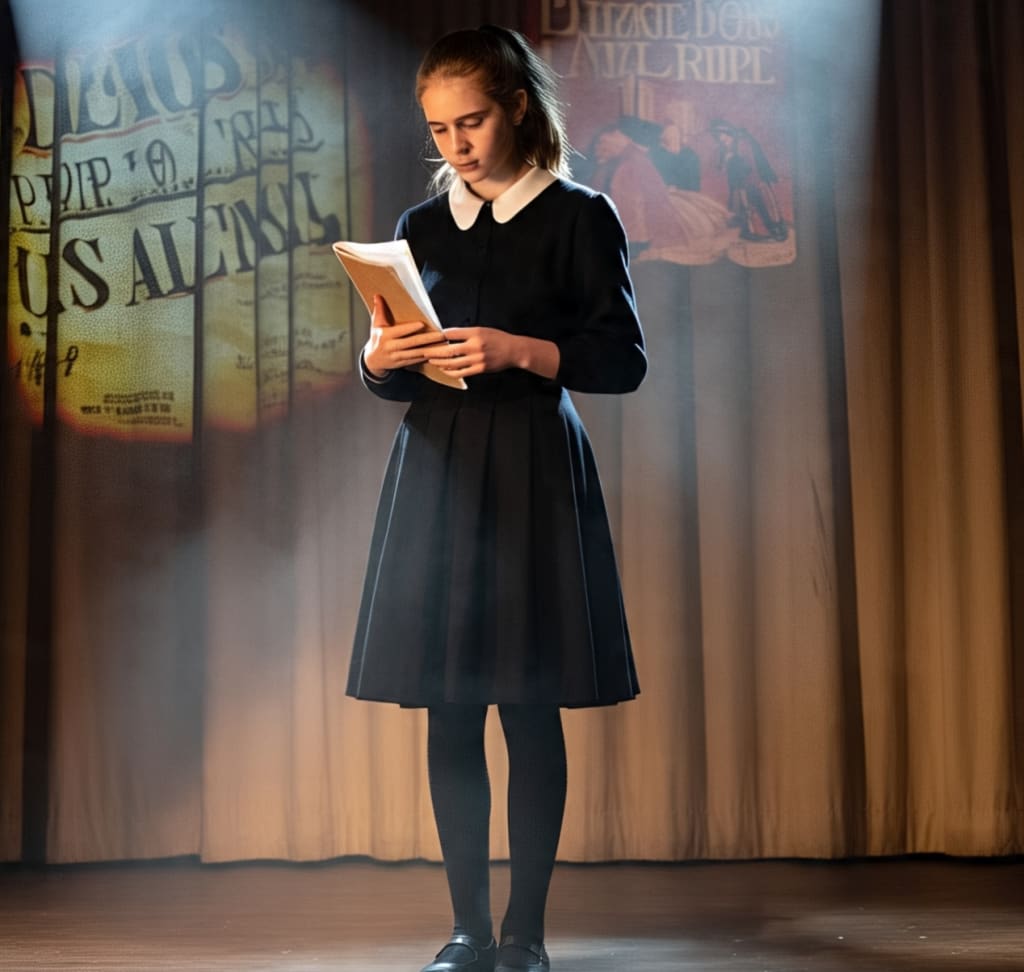
Everyone in the small town of Ashbury knew Mia Langston. Not because she was loud or rebellious, but because she had a peculiar way of speaking: Mia only communicated in movie quotes.
Ask her how she was doing, and you'd hear, "I'm just one stomach flu away from my goal weight," delivered in Meryl Streep’s clipped tone from The Devil Wears Prada. Ask her what she wanted for lunch, and she’d smirk and say, "I'll have what she's having," like in When Harry Met Sally. People would laugh. It was quirky. It was charming. But behind the lines, there was always a silence no one questioned.
Mia had mastered her craft. She had memorized hundreds of films—from timeless classics to obscure indie gems—and carefully catalogued the quotes in her mind. Her conversations were stitched together like scenes from a screenplay, carefully edited, always in control.
To her teachers, she was an enigma. Her classmates thought she was hilarious. But to those who watched closely, Mia was hiding behind a script—never revealing her true thoughts, never saying a single word of her own.
She hadn’t always been this way.
Before the quotes, before the act, there was a girl who used to sing out loud in class, who made up ridiculous rhymes and jokes that no one understood. That girl vanished the day her father died. One moment, they were watching The Princess Bride together. The next, he was gone—suddenly, tragically, and without warning. The last words he ever said to her were, "As you wish."
Grief doesn’t speak in complete sentences. It chokes. It twists. Mia found comfort in the language of movies—predictable, rhythmic, structured. Movies didn’t leave. They didn’t die. They played on repeat.
So she stopped speaking her own words and started quoting instead.
At first, her mother thought it was a phase. Then a coping mechanism. Then a problem too fragile to fix. Therapists came and went. Teachers tried writing prompts. But Mia stayed in character.
Until Theo Carter entered her life.
Theo was the new kid, fresh from the city, with an annoying habit of asking deep questions and not taking “funny answers” for replies. He was tall, lanky, and always had a pencil tucked behind his ear. While others laughed at Mia’s one-liners, Theo listened like there was something underneath them.
One rainy afternoon in the school library, Theo sat across from Mia, flipping through a copy of Dead Poets Society.
“You really never say anything that’s not from a movie?” he asked, raising an eyebrow.
Mia tilted her head. “Frankly, my dear, I don’t give a damn.”
Theo grinned. “That’s Gone with the Wind. But you do give a damn. I think you just don’t know how to say it.”
She glanced down. Her hand subconsciously reached for her journal—a black notebook where she scribbled quotes, not thoughts.
“I think,” Theo continued, “you’re writing your own story. You just don’t know how to read it yet.”
For the first time, Mia didn’t respond with a quote. She stared at him, words dancing on the tip of her tongue, but none borrowed, none rehearsed.
They became unlikely friends. He introduced her to poetry. She showed him her collection of scripts. Slowly, a friendship bloomed between the lines of their shared silences. They started writing together—short scripts, scenes, character studies. Theo would write the dialogue, and Mia would “translate” it into famous lines.
But then came the school’s talent show. Theo, always the bold one, signed them up for a short performance—an original piece. Their piece.
“I can’t,” Mia whispered backstage, her voice barely audible. Her palms were sweating, her mind racing.
Theo looked her in the eyes and said gently, “Carpe diem. Seize the day, Mia.”
That line would have usually made her smile.
But this time, something shifted. She shook her head and said softly, “I don’t want to borrow words anymore.”
And just like that, the curtain rose.
Mia stepped forward under the spotlight. For a moment, she froze. The crowd waited. She took a breath—not the kind you take before a performance, but the kind you take before becoming someone new.
Then, for the first time in years, she spoke in her own voice.
“This is a story about silence,” she began, “and how sometimes, the only way to survive is to speak through someone else’s voice. But I’m done surviving. I want to speak for me now.”
A hush fell over the auditorium.
She didn’t quote a single film that night. Her performance was raw, real, and unpolished. But it was hers.
After the final line, there was a beat of silence. Then came the applause—thunderous, standing, endless.
Mia Langston, the girl who only spoke in movie quotes, had finally found her own script.
And it was beautiful.
About the Creator
Mati Henry
Storyteller. Dream weaver. Truth seeker. I write to explore worlds both real and imagined—capturing emotion, sparking thought, and inspiring change. Follow me for stories that stay with you long after the last word.
Keep reading
More stories from Mati Henry and writers in Confessions and other communities.
When the Moon Forgot How to Shine
No one could explain when it happened or how—but one night, the moon simply stopped glowing. The stars blinked uneasily in the sky, unsure whether they should keep twinkling without their luminous leader. The oceans, confused by the absence of the moon’s pull, became restless. High tides crashed against once peaceful shores. Night animals stirred too early or too late. And the people, well… the people noticed.
By Mati Henry 7 months ago in Poets
Thoughts on Vocal and the way the world is
"Death cannot stop true love, only delay it." – Wesley in The Princess Bride. I decided to come back to Vocal on a very cold and dark night at the end of December. I had been, and still am, convalescing from a horrible staph infection that had gone misdiagnosed for months. This, paired with the increasing challenges of being healthy, making the best choices for my co-parented child, being a wife, and being a director at a new job, was a lot to manage.
By Jazzy 2 days ago in Confessions
Word of the Day: 推し
I am not putting any more time on my timer right now. I am just trying to get by here. There is almost no point to school because, like 35% of the time is technical difficulties and the rest of the time is things that actually aren't really useful.
By Kayla McIntosh7 days ago in Confessions


Comments (1)
oh Fine ,, Hi support me.