
The Collector
Every souvenir holds a story its owner never intended to tell

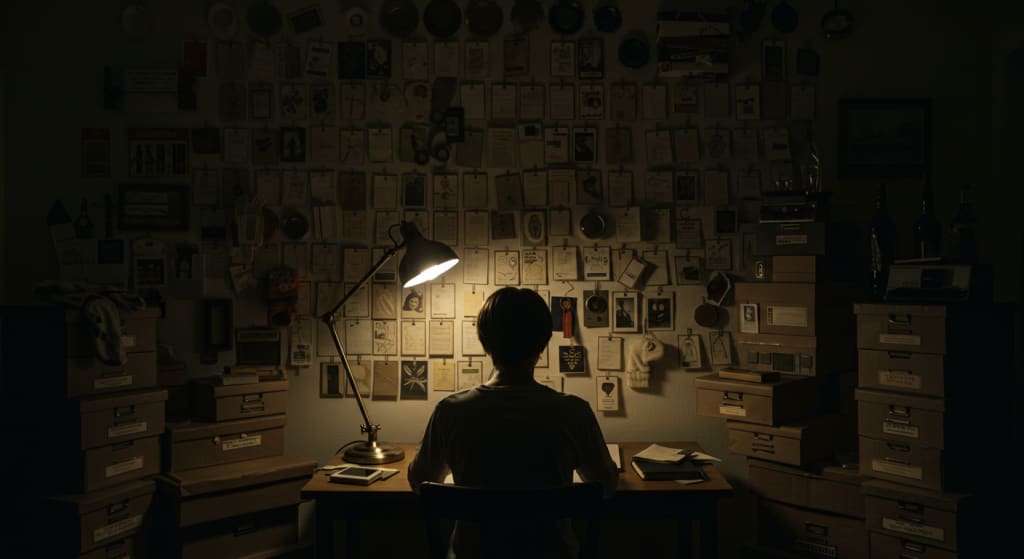
I collect things that don't belong to me. Not valuable things—I'm not a thief in the traditional sense. I take objects most would consider worthless: a grocery list abandoned in a shopping cart, a child's mitten left on a park bench, a bookmark forgotten in a library book, a hairband from the gym locker room floor.
My apartment contains seventeen carefully cataloged boxes, each item labeled with the date and location of acquisition. The half-finished crossword puzzle from the downtown diner (March 17, 2021). The prescription receipt from the pharmacy counter (September 4, 2022). The tear-stained birthday card never delivered (January 30, 2020).
I tell myself I'm preserving moments that would otherwise be lost—capturing evidence that these strangers existed, that their mundane Tuesday afternoons mattered somehow. But that's not entirely true. What began as a child's quirky habit became an adult's compulsion, a way to possess fragments of lives more authentic than my own.
Each object becomes the seed of a story I nurture and grow. The worn guitar pick becomes evidence of a struggling musician's last open mic night before giving up his dream. The sonogram picture abandoned at a bus stop becomes the beginning of a young mother's difficult choice. The dog-eared self-help book becomes a desperate attempt to save a marriage already beyond repair.
My therapist (who doesn't know about the collection) says I have trouble connecting with people. She's wrong. I connect deeply—just with versions of strangers I've created rather than the ones who actually exist. Real people are messy and disappointing. My collection allows me to know others perfectly, to construct their lives in ways that satisfy my need for narrative closure.
Yesterday, I found a leather-bound journal in a hospital waiting room. Unlike my other acquisitions, this one actually contains someone's story—page after page of raw pain, hope, and fear as they navigate a terminal diagnosis. For the first time, I'm holding something that genuinely matters to someone, something whose absence will be keenly felt.
The journal sits on my kitchen table, my cataloging materials untouched beside it. I've spent my life collecting other people's discarded moments, but this is different. This isn't garbage—it's someone's lifeline. Tomorrow I'll return it to the hospital lost and found. And maybe the box labeled "2025" will remain empty as I learn to live my own story instead of collecting fragments of others'.
My collecting began after my mother disappeared when I was nine. She didn't die or abandon us intentionally—she simply went to work one Tuesday and never came home. The police found her car in the train station parking lot, her purse still on the passenger seat, coffee still warm in the cupholder. For months, they investigated possible abduction, suicide, amnesia. Eventually, she became just another missing person statistic.
What remained were her things—lipstick with her tooth mark on the tube, half-read novels with dog-eared pages, grocery lists in her slanted handwriting. I began sleeping with her scarf, carrying her keychain, wearing her watch despite it being too large for my wrist. When my father eventually packed her belongings for donation, I secretly rescued items from the boxes—not the valuable jewelry or expensive clothes, but the insignificant detritus that proved she existed: expired coupons from her wallet, the movie ticket stubs in her coat pocket, the shopping list magnetized to the refrigerator.
These objects told me more about her daily life than the carefully curated photo albums or the stories relatives shared at her memorial service. They were authentic glimpses into her ordinary moments—the mundane reality that disappeared along with her. When I held her handwritten reminder to "buy more coffee filters," I felt connected to the woman who existed when no one was watching.
I began collecting other abandoned objects at twelve. The first was a math worksheet left on a playground bench, covered with frustrated eraser marks and doodles in the margins. I imagined the student—struggling, distracted, eventually giving up. I labeled it carefully and stored it in a shoebox beneath my bed. Soon I added more: a grocery receipt showing someone's exact purchases, a torn concert ticket, a birthday card signed only with a first initial.
By high school, my collection required a cataloging system. I organized by date, location, and category (personal correspondence, utilitarian items, creative expressions). I developed rules: I would never take anything of monetary value; I would never collect something someone was actively searching for; I would never remove items from inside buildings except public spaces.
College roommates found my hobby bizarre but harmless. "Everyone needs a weird thing," my sophomore roommate said when she discovered my boxes. "Some people collect stamps; you collect garbage." She didn't understand that I wasn't collecting garbage but rather moments—fragments of lives interrupted, evidence of human existence temporarily forgotten.
My most valuable acquisition came from a campus library study carrel—a spiral notebook containing a student's detailed observations of people in the campus coffee shop. For three months, they'd documented conversations, clothing choices, study habits of complete strangers. It was a collector observing others, just as I did. Reading it felt like finding a kindred spirit, someone else who paid attention to the details others overlooked. I spent weeks trying to identify the author before realizing the irony—I'd turned the observer into the observed, creating stories about someone who created stories about others.
My therapist, Dr. Winters, suggests my collection represents an inability to form "real connections." She doesn't know that I've cataloged items from our sessions: a paper clip she bent while listening to a particularly difficult story, a tissue she unconsciously shredded during our discussion of my father's declining health, a pen cap she accidentally dropped that rolled under my chair. These small objects tell me more about her authentic reactions than her carefully maintained professional demeanor.
The journal I found yesterday is different. Written by someone named Michael, it documents his diagnosis with stage four pancreatic cancer, his decision to decline treatment, his process of saying goodbye. Unlike my other acquisitions, this wasn't casually discarded—it was accidentally left behind by someone who will surely return searching for it. For the first time, I feel the weight of possession—not just of an object, but of someone's most intimate thoughts during their darkest moments.
Tomorrow I'll return it to the hospital. And perhaps it's time to return other items as well—to acknowledge that these fragments belonged to real people with complete stories I've never truly known. The objects I've collected aren't mine to possess any more than my mother's life was mine to keep.
About the Creator
Edmund Oduro
My life has been rough. I lived in ghettos with a story to tell, a story to motivate you and inspire you. Join me in this journey. I post on Saturday evening, Tuesday evening and Thursday evening.
Keep reading
More stories from Edmund Oduro and writers in Confessions and other communities.
The Perfect Daughter
I've spent twenty-seven years being the daughter my mother wanted instead of the one she had. My real sister died before I was born—a golden child named Catherine who drowned at age seven. I arrived eleven months later, a replacement my mother never acknowledged as such.
By Edmund Oduro9 months ago in Confessions
Thoughts on Vocal and the way the world is
"Death cannot stop true love, only delay it." – Wesley in The Princess Bride. I decided to come back to Vocal on a very cold and dark night at the end of December. I had been, and still am, convalescing from a horrible staph infection that had gone misdiagnosed for months. This, paired with the increasing challenges of being healthy, making the best choices for my co-parented child, being a wife, and being a director at a new job, was a lot to manage.
By Jazzy 5 days ago in Confessions
Word of the Day: 近眼
I am sort of happy about some really random things. Like I might know something about something but, I mean I feel... god yea it is just gossip isn't it? I usually avoid that kind of stuff but it is social currency. I guess I am used to playing a more passive role in things but I think it is more in response of being overlooked.
By Kayla McIntoshabout 18 hours ago in Confessions
The Path to Salvation
The late autumn evening air filled the monk's lungs, but it wasn't the season that chilled his bones. The heavy-handed presence of evil he had sensed upon entering the woods surrounding this mountain village had not bothered to conceal itself from him.
By Made in DNAa day ago in Fiction


Comments
There are no comments for this story
Be the first to respond and start the conversation.