
The Perfect Daughter
Behind every flawless facade lies a carefully constructed lie

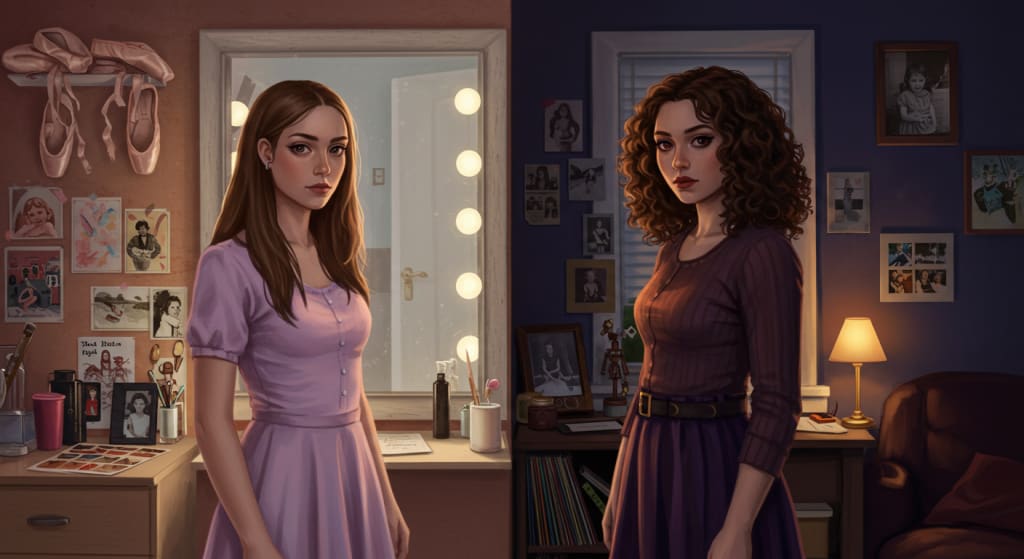
I've spent twenty-seven years being the daughter my mother wanted instead of the one she had. My real sister died before I was born—a golden child named Catherine who drowned at age seven. I arrived eleven months later, a replacement my mother never acknowledged as such.
Catherine's bedroom remained untouched—a shrine to ballet trophies, watercolor paintings, and a perfectly made bed that would never again be slept in. My mother enrolled me in dance classes despite my natural clumsiness. She hung my mediocre artwork beside Catherine's genuinely promising pieces. She called me "Cat" despite my birth certificate reading "Eleanor."
By twelve, I understood the assignment. I learned to dance passably. I practiced painting until my fingers cramped. I straightened my naturally curly hair to match the photos of Catherine's sleek bob. I studied her childish handwriting and adopted it as my own. When Mother's friends mentioned how much I resembled my sister, I smiled gratefully instead of screaming that they never actually saw me.
The college acceptance letter addressed to Eleanor Parker sits in my desk drawer, never shown to my mother. Instead, I attend the local community college, living at home to care for her advancing Parkinson's. The neighbors call me a saint. They don't know about the second bedroom in my apartment across town—filled with black clothes my mother would hate, curly hair dye, mystery novels instead of poetry, and jazz records instead of classical compositions. One night each week, I become Eleanor while my mother believes I'm at a study group.
Yesterday, while helping Mother to bed, she stroked my cheek and whispered, "Catherine would have been so proud of you." Twenty-seven years of performance, and she's never seen me at all. The perfect daughter doesn't exist—not Catherine, frozen in idealized childhood, nor the Eleanor-performing-as-Catherine puppet I've become.
Tomorrow I'm bringing my lease renewal papers for Mother to sign as my "academic scholarship renewal." Next week, Eleanor moves into her apartment full-time. The perfect daughter is finally drowning, just like her sister did. I can almost feel the water filling my lungs, and strangely, it feels like freedom.
I never knew Catherine personally, but I've lived with her ghost every day of my life. I know her through the stories my mother tells endlessly—how Catherine mastered a difficult piano piece at six, how she could recite poetry from memory, how her ballet instructor believed she had professional potential. Photos of her—always smiling, always perfect—occupy every surface of our home. In most, she wears the pale blue dress she drowned in, a detail my mother mentions often, as if the tragedy's specifics might somehow make her loss more significant than others'.
The drowning happened during a family vacation to Lake Geneva. My father—who left when I was three—was supposed to be watching her while my mother napped. His momentary distraction became the defining failure of his life. My mother never forgave him, though I suspect the separation had been brewing long before. She speaks of him only in the context of Catherine's death; his existence reduced to that single, catastrophic moment of negligence.
My earliest memories involve visits to Catherine's grave, where my mother would tell me to "say hello to your sister" as if we'd ever occupied the same space. On my birthdays, we brought cupcakes and sang to both of us, though Catherine's name always came first. When I started school, Mother warned my teachers not to cut my hair during craft projects because "we're growing it out like Catherine's." She enrolled me in the same activities Catherine had enjoyed, registered me with the same pediatrician, even arranged playdates with Catherine's now-adolescent friends who clearly found it uncomfortable to entertain a much younger child they barely remembered.
At night, Mother would read me Catherine's favorite books, showing me which pages had her fingerprints, which corners she had dog-eared. Sometimes she'd pause mid-sentence, overcome by memory, and I'd have to prompt her to continue. On those occasions, she'd look at me with momentary surprise, as if she'd forgotten I was there—as if she'd been reading to someone else entirely.
By middle school, I'd developed the unsettling ability to anticipate what Catherine would do in any situation. Before making decisions, I'd unconsciously consider: Would Catherine choose chocolate or vanilla? Would Catherine speak up in class or remain silent? Would Catherine befriend the new student or stick with her established social circle? These weren't questions about a real person's preferences but about the amalgamation of perfectionism my mother had constructed. Still, they guided my every choice.
My father's child support checks funded my secret apartment—a technical violation of the agreement specifying the money be used for my education. During our infrequent phone calls, I've never told him about my double life. He remarried and had two more daughters who have never met me. Sometimes I stalk their social media accounts, wondering if they're allowed to be themselves or if they too live under the shadow of a perfect ghost.
The small acts of rebellion began in high school—a hidden tattoo here, a secretly pierced cartilage there. I maintained Catherine's expected 4.0 GPA while developing Eleanor's taste for horror movies and punk rock. While "Cat" performed in the school's production of Swan Lake, Eleanor was teaching herself guitar in her locked bedroom. While "Cat" applied to Catherine's dream college (which I deliberately sabotaged by submitting an incomplete application), Eleanor was researching art therapy programs across the country.
Last week, I found Mother looking through a box of Catherine's belongings—baby teeth, hair clippings, hospital bracelets. "You know," she said without looking up, "she would have been thirty-four this year. Probably married with children of her own." She never acknowledges that I am twenty-seven, that I might have wanted those things too.
The permission slip for my apartment—disguised as a scholarship renewal—sits in my bag. After tomorrow, Eleanor will finally have more days than Catherine's replacement. Perhaps eventually, I'll even learn who Eleanor actually is, beyond simply being everything Catherine wasn't allowed to become.
About the Creator
Edmund Oduro
My life has been rough. I lived in ghettos with a story to tell, a story to motivate you and inspire you. Join me in this journey. I post on Saturday evening, Tuesday evening and Thursday evening.
Keep reading
More stories from Edmund Oduro and writers in Confessions and other communities.
Thoughts on Vocal and the way the world is
"Death cannot stop true love, only delay it." – Wesley in The Princess Bride. I decided to come back to Vocal on a very cold and dark night at the end of December. I had been, and still am, convalescing from a horrible staph infection that had gone misdiagnosed for months. This, paired with the increasing challenges of being healthy, making the best choices for my co-parented child, being a wife, and being a director at a new job, was a lot to manage.
By Jazzy 5 days ago in Confessions
Word of the Day: 実習
Well my teacher did an impromptu zoom meeting with me which I really appreciated. Basically wrang me a new one very nicely about how I need to get my homework in. I am pretty sure I can actually do it now that I see what her methods are and the 3 channels she mostly uses so, that will make navigating things a lot easier as I wasn't sure where to look most of the time.
By Kayla McIntosh3 days ago in Confessions


Comments
There are no comments for this story
Be the first to respond and start the conversation.