
Greetings to all war correspondents
A British photographer who had just returned from Ukraine told me how he spent more than two weeks there in great concern between his personal safety and following up on the conditions of his wife
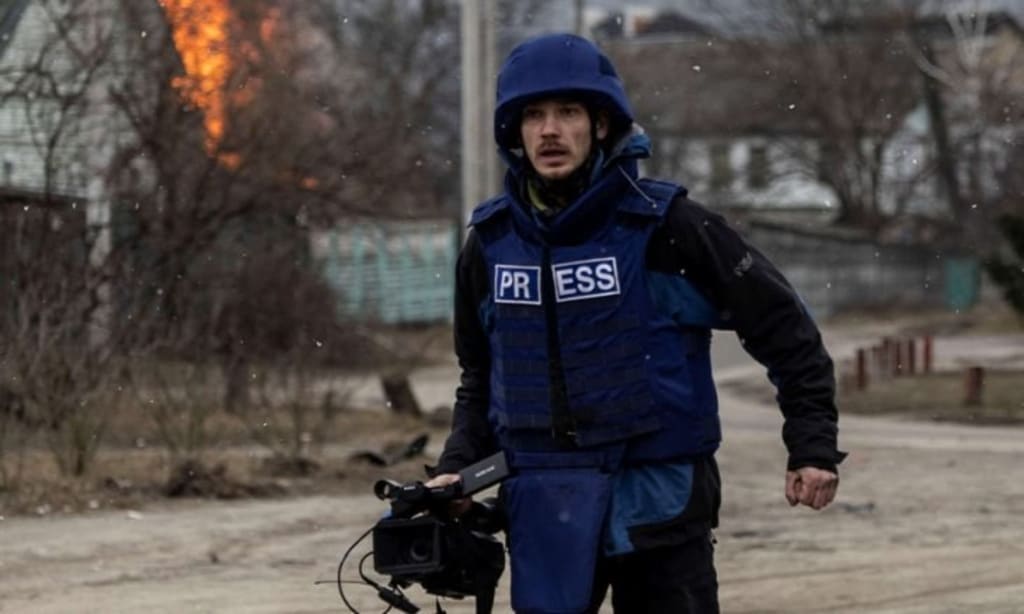
A British photographer who had just returned from Ukraine told me how he spent more than two weeks there in great concern between his personal safety and following up on the conditions of his wife, who had left her alone with their infant son, and then she contracted Corona. Nevertheless, he is a lucky photographer, not only because he was working in the regions of western Ukraine that are less militarily hot, but because he did not stay there for a long time after which he returned safely to his family, and this is not always the amount of those who go to cover wars.
I will never forget what the famous British journalist Robert Fisk told me. We met by chance at Baghdad airport in 2003, just two days before the beginning of the US invasion of Iraq, when he said that journalists are the only ones in the world that you see heading to places where their people flee. They do this even though they know very well that they may pay a price with their lives and they also know that no journalistic story is worth that price, but they are not always the ones who kill themselves, as one of them may be injured by a stray bullet or be targeted by an armed person despite his full knowledge of his capacity as a journalist, which is clear to all.
“Difficult, poignant, and painful,” this is how the Committee to Protect Journalists in New York described the atmosphere of journalistic work these weeks in the Russian war on Ukraine, which has so far claimed the lives of the American journalist Brent Reno, who worked for the New York Times, while another was wounded with him. The car of the American "Fox News" channel was attacked, killing Irish photographer Pierre Zarzewski and his colleague from the same team, Ukrainian reporter Oleksandra Kovchinova, while British reporter Benjamin Hall was seriously injured, after which he was taken to hospital before being evacuated abroad for further treatment. The Al-Araby TV team was also trapped in the Erbin region, north of the Ukrainian capital, Kyiv, for four days, during which reporter Adnan Jan and cameraman Habib Demirji remained in mortal danger, after the team came under direct fire from the Russian forces.
All this happened and the war was in its first month, which warns that more difficult days await the correspondents who are there, especially if we enter the stage of a tight siege of the capital, Kyiv, and an attempt to bring it down. All of this, and what happened in several previous wars, proves once again the heavy price that many journalists have paid and paid, especially those who transmit it live in audio and video.
Perhaps the first Arab television experience in covering wars differently from the normal coverage or even the propaganda that Arab public opinion has experienced in previous wars, through radio stations in particular, is the experience of “MBC” when it covered the war of secession in Yemen in 1994 between its north and south after four years. Only years of their unification under the late President Ali Abdullah Saleh. However, with the launch of Al-Jazeera as the first news channel in 1996, such coverage entered a new phase after the world had been fascinated by CNN's coverage of the second Gulf War and the liberation of Kuwait in 1991.
Al-Jazeera’s first experience was in Operation Desert Fox in December 1998, a process in which Iraq was subjected to American aggression for four days with intense raids, which it was able to brilliantly convey to the Arab public and the late Palestinian journalist Muhammad Khair Al-Buraini, then wars continued to prove The correspondents of this channel were able to convey the most brutal facts, from the second intifada in 2000 and the Palestine team consisting of Walid Al-Omari, Sherine Abu Aqleh and Guevara Al-Budairi, to the war in Afghanistan and its famous star, Tayseer Alouni, who paid the price for that coverage dearly, between imprisonment and house arrest in his home after an unfair trial In Spain, then came the invasion of Iraq in 2003, in which the station was distinguished by its team, who killed Tariq Ayoub from the roof of its office in Baghdad. Abu Dhabi Channel also excelled in those events with Shaker Hamed and his colleagues. Then the Israeli wars continued on Lebanon and Gaza, and in both of them, Al Jazeera’s war correspondents did well, and the Arab public kept memorizing their names such as Abbas Nasser, Ghassan bin Jeddo, Mazen Ibrahim, Tamer Al-Mishal, Wael Al-Dahdouh, Heba Aqila and others. Even during the revolutions of the Arab Spring, the various correspondents of the “Al-Jazeera” network did not hesitate to report the facts of the scourge that took place in Syria, for which they paid the price with their lives, such as Muhammad al-Masalma, Mahran al-Diri, Hussein Abbas, Muhammad al-Qasim, Muhammad al-Asfar, Zakaria Ibrahim and Ibrahim al-Omar. Qatari photographer Ali Jaber was also killed in Libya. After the station's team car was hit by an intentional shooting.
Greetings of appreciation and gratitude to all of these, and may God protect him who is still struggling there to convey the facts of wars so that no one will say one day that he did not know.
About the Creator
Keep reading
More stories from Zernouh.abdo and writers in Confessions and other communities.
What will the Arab countries do with the food crisis imposed by the Ukraine war?
. Everyone is now warning of a global food crisis that will hit many regions of this world due to the Russian war on Ukraine and the dependence on grain supplies coming mainly from both sides, and even started talking about a famine that will occur in certain regions, the most important of which is Africa. The latest of these shouts came from the Director-General of the International Monetary Fund, Kristalina Georgieva, when she said unequivocally that “the war in Ukraine means hunger in Africa,” but not only Africa is threatened with severe repercussions, but many other regions even in Europe, as it is a major country like France. Its president declares that "we are about to enter into an unprecedented food crisis" at a time when Europeans are currently facing a significant increase in the prices of various agricultural products, but it is certain that the repercussions will be more severe and catastrophic for Africa and the Middle East. The warnings did not stop at people's livelihood in these areas, but extended to the United Nations Secretary-General saying that "the world will witness a storm of famine and a collapse of the global food system." Such talk was accompanied by a worrying warning that this would inevitably lead not only to difficult humanitarian conditions there, but would certainly be accompanied by unrest and political turmoil whose extent no one knows from now. If Europe is currently searching with all effort for specific exits for such a possibility, as the French President called at the recent G7 summit of the need to go to search for the best and fastest ways to develop a collective plan that seeks to raise agricultural production in Europe, then we are in Africa and in our countries Arab countries are affected more than others. We have seen nothing but an expression of fear without moving a finger, even though the food threat came to it, accompanied by the rise in energy prices, so two calamities met with it, not just one. The paradox here is that agricultural and food experts in the European Union are currently complaining about the absence of a clear and solid European agricultural vision before this crisis, and they point out that Europe does not possess a reliable strategic reserve of grain (Germany is almost the only one with such reserves) at a time when countries were Like China or India, it is working strongly in this direction, and the result is that China has a 9-month stockpile, while the European Union has only a 36-day stockpile. And if this is the situation of an organized bloc like the European Union, then what will the situation be in some Arab countries?! In the list of the top 10 importers of wheat in the world, we find two Arab countries, Egypt and Algeria, where Egypt is the largest importer and consumer of wheat in the world, as it imports annually more than 13 million tons, or more than two-thirds of its needs of this strategic commodity. Russia and Ukraine constitute the source of about 85 percent percent of the imported quantities. Although a country such as Algeria, which is considered among the largest importers of soft wheat in the world, has France as a major supplier of this material, and deals to provide the required quantities of wheat with about 20 countries, it is also concerned about the possible disruption of Russian wheat that returned to its markets after A break of about five years. As for Morocco, which is the third consumer of wheat in Africa, after Egypt and Algeria, and is among the ten countries in the world that import the most grain, it is no less disturbed than others, as Ukraine and Russia come in second and third, after France, among the exporters of soft wheat to the Kingdom, while Canada ranks The first place among its suppliers of durum wheat. Perhaps Tunisia is among the most affected, especially as it is already experiencing a severe financial crisis with delays in the payment of salaries and a shortage of basic foodstuffs such as grain, sugar, oil and some medicines. What makes the situation worse is the deep political crisis there and the state of denial of its president, who believes that many of the country’s problems are due to conspiracy against him, to the extent that the shortage of foodstuffs brought him back to monopoly, although he does not explain everything, especially since some ships loaded with grain have turned back. From Tunisian ports because the state did not have the ability to pay, in a dangerous precedent that carries very frightening omens about the future. The political cost of all of the above is currently unknown, especially in both Egypt and Tunisia, with rising prices and more suffocation of people in their livelihood. Do not forget that both of them lived in the eighties of the last century major popular uprisings called the bread uprisings after the increase in their prices. As for reminding most Arab countries that a country like Sudan would have been the safe food basket for all of them, if there was vision and insight, there is no point in talking about it..
By Zernouh.abdo4 years ago in Confessions
Thoughts on Vocal and the way the world is
"Death cannot stop true love, only delay it." – Wesley in The Princess Bride. I decided to come back to Vocal on a very cold and dark night at the end of December. I had been, and still am, convalescing from a horrible staph infection that had gone misdiagnosed for months. This, paired with the increasing challenges of being healthy, making the best choices for my co-parented child, being a wife, and being a director at a new job, was a lot to manage.
By Jazzy 4 days ago in Confessions
Finding Herself Between Subway Stops
Manthatan Story The morning sun glinted off the glass towers of Manhattan even before Anika stepped off the subway. The city was already humming with life and noise and possibility. Every block felt like a promise waiting to be fulfilled. She had moved here from a small town in Texas with a suitcase full of clothes and an even bigger bag of dreams. Today was her first day at her new job at the publishing house just off Fifth Avenue.
By Ibskins7 days ago in Confessions


Comments
There are no comments for this story
Be the first to respond and start the conversation.