
Catharsis. The process of releasing, and thereby providing relief from, strong or repressed feelings. Many things can cause catharsis in one's life, music, art, skydiving. Catharsis is the closest humanity can get to scraping our brain clean and free of ‘ropes of nerve and bone’ that can cause us to feel suffocated. As if you’re loading a Sims game, and the refreshing character screen pops up, allowing you to synthesise any persona you wish, and drop them in a new world. A blank canvas. They become ready to do whatever you command them to, and you get a rush of adrenaline when you realise you are playing the role of God. Before I get off track here, catharsis is an important part of human living and prevents us from becoming mind-numbing zombies.
The first time I experienced a sense of catharsis was the first time I was introduced to Shakespeare and his works. There was something about the language he used that seemed so eloquent and descriptive, flavourful and had a sense of depth. So many words were used to describe simple sentences and it stunned me that our way of greeting each other's presence became a slurred ‘Wassup?’ when it could be "Prithee good sir, doth thou smile greet the stars?". I mean it speaks for itself. After perusing his sonnets and sublime rhyming couplets
“But soft, what light through yonder window breaks? It is the east and Juliet is the sun, arise fair sun and kill the envious moon.”
I felt a rise inside me, like I'd been pumped up with helium and had started to float to the moon. I felt my pupils dilate and read over the same words. The world suddenly looked different, everything around me had a brighter aura. The world around me looked like a Hallmark postcard. And when I realised that we had to study Shakespeare in class? My mind was further blown completely out of the water. How could anyone not like his works? There is absolutely no one in the world that wouldn't like to study Shakespeare.
...
So turns out many people don't like Shakespeare. Believe me, I’m as baffled as you are. The majority of my class hated Shakespeare! Completely! His books hadn’t turned them inside out, altered their view on reality in any way, instead it seemed to cause them stress. Reading Shakespeare in class was always fun, and I had made it my mission to secure a role each and every time. Here was my plan:
1) Read the character descriptions beforehand to decide which had the most lines in the scene
2) Bring your own copy in to read
3) Sit nearer to the front to catch the attention of the teacher
4) Listen attentively to the pauses in the teacher’s talking — this may signify the inevitable ‘Alright so we need a Malvolio?’
5) Put your hand straight up and say ‘Me please!’ Or alternatively, before she starts casting roles, place your hand up and say ‘May I please take the role of Macbeth?’ Your politeness will aid in getting the part.
6) If you don't get the role you wanted, continuously put your hand up for each role, so reduce the risk of having no role at all!
You might think I’m a bit insane, but hear me out for a while longer. Shakespeare’s plays did to me what water would do to a person trapped in the desert. His words and rhymes slid down my mental throat and quenched my literary thirst.
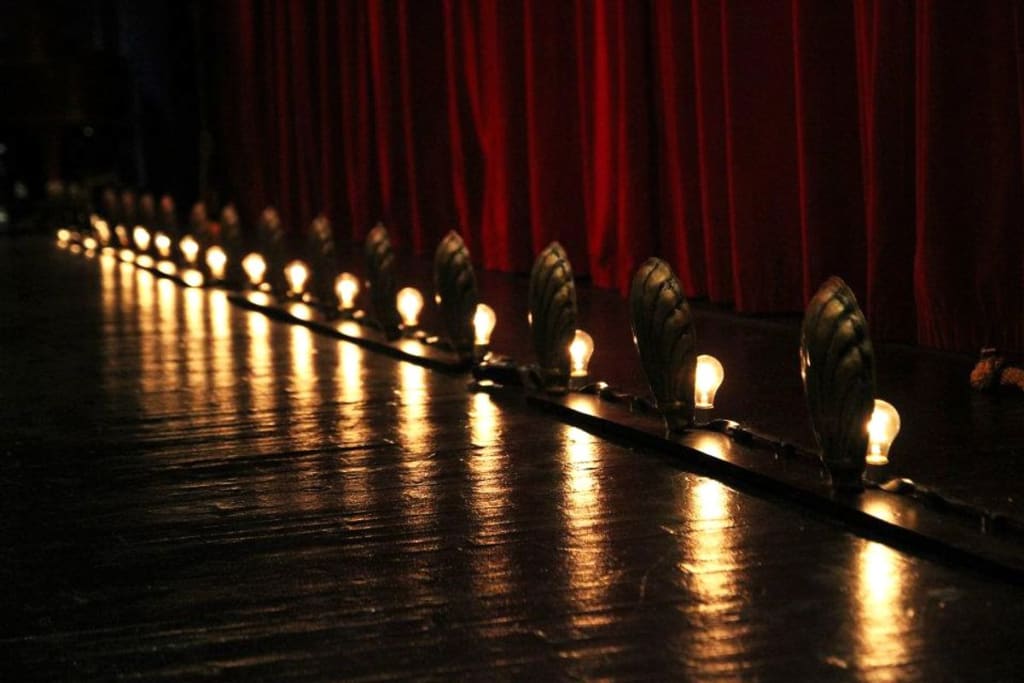
Then came my biggest role yet, Richard in Shakespeare’s Richard The Third. The main character, centre stage, the spotlight was on me for the next three weeks in English class. The role had thrust me onto new ground, challenging my eloquence with soliloquies, dramatic monologues, and my favourite, bouts of witty stichomythia. Bantering back and forth and in my mind, I was frolicking about a mahogany stage, dressed in Elizabethan attire and performing for an audience of thousands, a standing ovation after every verse. In reality though, I was half standing in my seat, dressed in an itchy school dress and performing for about fifteen tired highschool girls, to the beat of a ticking clock minutes away from the end of the lesson.
I had always been that one person who enjoyed the prescribed text that everyone else loathed, Wuthering Heights, Metropolis, Othello. People sometimes questioned whether or not I was just pretending to be That One Quirky Girl (trademarked). But the eloquence of the language gave me a sense of catharsis like no other, making my world different for as long as I occupied time and space.
“This above all, To thine own self be true.”
About the Creator
Keep reading
More stories from Gaia Fahed and writers in Confessions and other communities.
Here Again
Sweating, my hand gripped the rail as I dragged each foot up another step. I didn't realise how many I would have to climb; regardless, a mild calmness seeped through me as I knew what was awaiting me at the top. Slamming my hands on the door handles, I pulled them open to breathe the crisp morning air. My mind was caught up in the serenity of the dawn, the enchanting purple streaks across the waking sky, the peek of the sun’s glowing face over the horizon. My eyes closed, taking it all in, arms outstretched to welcome the new day, content that it would be my last. A flock of birds flew past, screeching and disrupting my morning welcome. I opened my eyes and sighed in mild annoyance, only then acknowledging the figure peering over the roof’s ledge.
By Gaia Fahed4 years ago in Psyche
Thoughts on Vocal and the way the world is
"Death cannot stop true love, only delay it." – Wesley in The Princess Bride. I decided to come back to Vocal on a very cold and dark night at the end of December. I had been, and still am, convalescing from a horrible staph infection that had gone misdiagnosed for months. This, paired with the increasing challenges of being healthy, making the best choices for my co-parented child, being a wife, and being a director at a new job, was a lot to manage.
By Jazzy 2 days ago in Confessions
When Science Changed Our Future
Science is more than formulas, laboratories, and textbooks. It is the invisible force that shapes our world, quietly transforming how we live, think, and dream. From the moment humans first struck two stones together to create fire, science has guided our journey forward. But there are moments in history when a single discovery doesn’t just change knowledge—it changes everything. This is the story of how science altered our future, not once, but again and again, redefining what it means to be human.
By Aiman Shahidabout 9 hours ago in Confessions



Comments
There are no comments for this story
Be the first to respond and start the conversation.