
Borrowed Glory
The spotlight shines brightest on the stories we steal

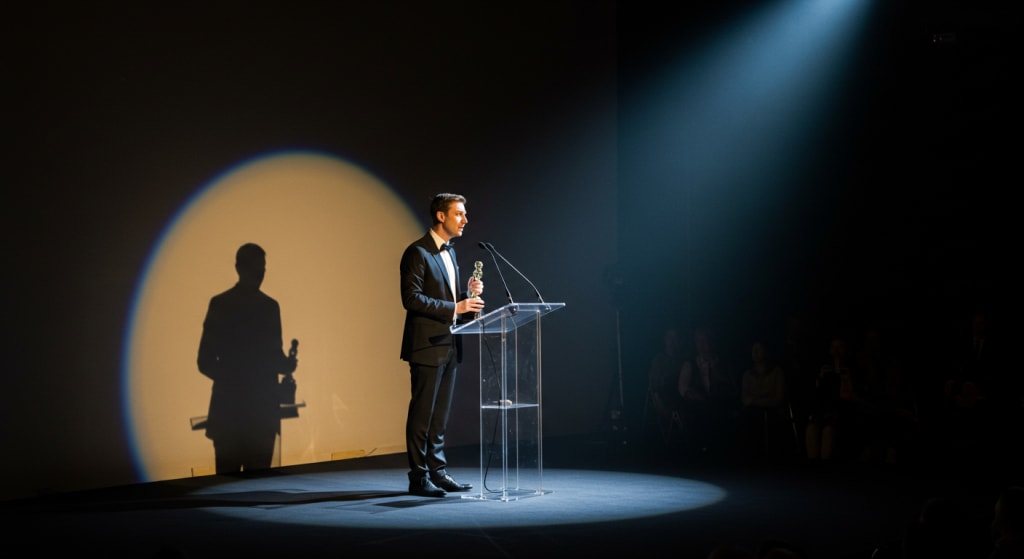
The keynote speech that launched my career wasn't mine. The words that moved the audience to tears, that secured my promotion to creative director, that still appear in industry textbooks—I stole them from a dying man.
Daniel was my mentor, diagnosed with stage four pancreatic cancer three months before the advertising industry's biggest conference. "I've been working on this speech for forty years," he told me from his hospital bed, handing me a worn leather journal. "Make sure they hear it." I promised to deliver his message.
The night before the conference, I transcribed his handwritten notes, intending to credit him fully. But standing at the podium, facing executives who could change my life, something broke inside me. I presented his revolutionary approach to authentic storytelling as my own groundbreaking research.
The standing ovation was deafening. Three job offers landed before I left the stage. Daniel died the following week, never knowing what I'd done. At his sparsely attended funeral, his widow thanked me for "carrying on his legacy," mistakenly believing I'd properly attributed his work.
My career skyrocketed. I've published two books expanding on "my" theories. I fund a scholarship in Daniel's name at our alma mater—a pathetic attempt at atonement. Each award, each recognition drives the knife deeper. I've constructed elaborate rationales: I've developed his ideas further than he could have; I've reached audiences he never would have; I've become worthy of the initial theft.
But late at night, staring at industry accolades, I hear applause meant for another man. My greatest fear isn't exposure—it's that I've become so comfortable in my deception that I can no longer distinguish between Daniel's brilliance and my mediocrity. The words that changed my life weren't mine, and neither is the person I've become because of them.
I met Daniel fifteen years ago when I was a struggling copywriter with more ambition than talent. He was already a legend—the creative mind behind campaigns that defined generations, the professor whose courses had year-long waiting lists, the mentor everyone wanted but few accessed. When he selected me for his prestigious workshop, colleagues assumed family connections or bribery. The truth was more mundane: I'd written him a letter directly addressing the flaws in his recent campaign, offering alternative approaches. He later told me my audacity had impressed him—my ideas were derivative, but my courage was not.
Under his guidance, I improved dramatically. Where others saw advertising as manipulation, Daniel saw it as empathy translated into action. "Great advertising," he often said, "is simply truth recognized." He pushed me to find authentic connections between products and human needs, to identify the genuine value proposition beneath marketing fluff. His methods were revolutionary but grounded in decades of observation and experience.
When his diagnosis came, the industry began its premature eulogies. Daniel responded by pouring his remaining energy into a comprehensive framework that would transform how authenticity functioned in advertising—a swan song that would cement his legacy. As his health deteriorated, he invited me to his home studio weekly, sharing glimpses of his developing masterwork. "This isn't just about selling products," he explained during one particularly lucid evening. "It's about respecting the intelligence of consumers while still moving them to action."
The leather journal he eventually handed me contained more than theories—it held his life's philosophy, carefully distilled into actionable principles. His handwriting grew shakier toward the final pages, testament to his deteriorating condition. The last entry simply read: "Truth always finds its audience. Make sure they hear it through you."
The conference was in Chicago, a thousand miles from Daniel's hospital bed. I rehearsed my introduction meticulously: "These revolutionary ideas come not from me, but from my mentor Daniel Marshall, who couldn't be with us today." I practiced saying his name clearly, proudly. But when I reached the podium and saw the sea of influential faces—the agency heads, the brand directors, the publishers—something collapsed inside me.
"Today, I present a new framework for authentic engagement," I began, Daniel's name suddenly absent from my lips. With each slide, each principle explained, each example cited, I felt simultaneous elation and disgust. The audience leaned forward, captivated by insights that weren't mine. Questions followed that I could answer only because I'd heard Daniel explain these concepts repeatedly. My responses earned admiring nods, business cards thrust in my direction, invitations to exclusive after-parties.
When news of Daniel's death reached me at the conference hotel, I vomited in my bathroom. Three prominent agencies had already contacted me with six-figure offers. His widow called, thanking me through tears for "honoring Daniel" with my presentation. I realized she assumed I'd given him credit and couldn't bear to correct her. That first lie birthed countless others.
Fifteen years later, I'm a respected industry leader, sought-after speaker, and published author. My office walls display awards for campaigns built on Daniel's principles. Each morning I pass the university building bearing his name—funded largely by "my" book royalties. The deception that began in a moment of weakness has become the foundation of my entire professional identity. And still, in unguarded moments, I hear his voice: "Truth always finds its audience." I fear that one day, it will.
About the Creator
Edmund Oduro
My life has been rough. I lived in ghettos with a story to tell, a story to motivate you and inspire you. Join me in this journey. I post on Saturday evening, Tuesday evening and Thursday evening.
Keep reading
More stories from Edmund Oduro and writers in Confessions and other communities.
The Silent Observer
In the dusty corner of a local coffee shop, I've watched life unfold for seven years. Not as a barista or regular customer, but as someone paid to observe. My job title is "market researcher," but I'm really a professional spy—documenting patterns, reporting conversations, tracking regulars. The coffee shop owner hired me to understand his customers better, but it evolved into something darker.
By Edmund Oduro9 months ago in Confessions
Thoughts on Vocal and the way the world is
"Death cannot stop true love, only delay it." – Wesley in The Princess Bride. I decided to come back to Vocal on a very cold and dark night at the end of December. I had been, and still am, convalescing from a horrible staph infection that had gone misdiagnosed for months. This, paired with the increasing challenges of being healthy, making the best choices for my co-parented child, being a wife, and being a director at a new job, was a lot to manage.
By Jazzy 5 days ago in Confessions
They Said Girls Don’t Do That. Turns Out We Always Have
There was a moment on my social media feed recently that felt small and huge at the same time. A woman on video leaned in and said, half joking, half reverent, “When the enemies finally become lovers and no one’s home.” There was a soft buzzing sound underneath the audio. Anyone who understood it understood it immediately. Anyone who didn’t was about to learn. The comment section exploded. Women laughing, women nodding, women confessing, women admitting, women asking, “Wait… we’re allowed to do that?” Like they needed permission. Like someone had to sign it off. Like there had ever been a rulebook handed out in the first place.
By No One’s Daughter7 days ago in Confessions


Comments
There are no comments for this story
Be the first to respond and start the conversation.