
"The Vanishing Isle of Virelia: A Tale of Time, Memory, and the Sea"
Every hundred years, the sea gives rise to a forgotten land—an island where time warps, memories vanish, and those who enter must choose between truth and oblivion. This is the story of the last expedition to Virelia, and the woman who refused to forget.

Chapter One: Whispers of the Deep
For centuries, the legend of Virelia haunted the northern coasts of Europe. Old sailors, drunk on rum and dread, told stories of an island that surfaced once every hundred years—perfectly formed, eerily silent, and unbound by the laws of nature. Most dismissed it as a myth, a maritime fable told to frighten young deckhands.
But not Dr. Mireille Anson, a historian and linguist whose obsession with the obscure had ruined more than one academic career. She'd spent twenty years gathering fragments—journal entries, tattoos on preserved corpses, and a single map drawn in faded ink and blood. They all pointed to the same date: July 16, 2124. That was when Virelia would rise again.
She assembled a small team of skeptics and believers alike—an expedition funded in secret and launched from a forgotten Norwegian harbor. Their destination: a set of coordinates in the North Atlantic where nothing had ever officially existed.
Chapter Two: The Breach
The first sign was the silence.
Forty hours at sea, and even the gulls were gone. No birds, no whales, no wind—just an expanse of grey ocean and the oppressive weight of stillness. Then the compass spun wildly. Instruments failed. The air grew warmer, though no sun pierced the fog.
And then, at precisely 12:00 a.m., the mists parted.
Virelia rose from the ocean like a sigh from the deep.
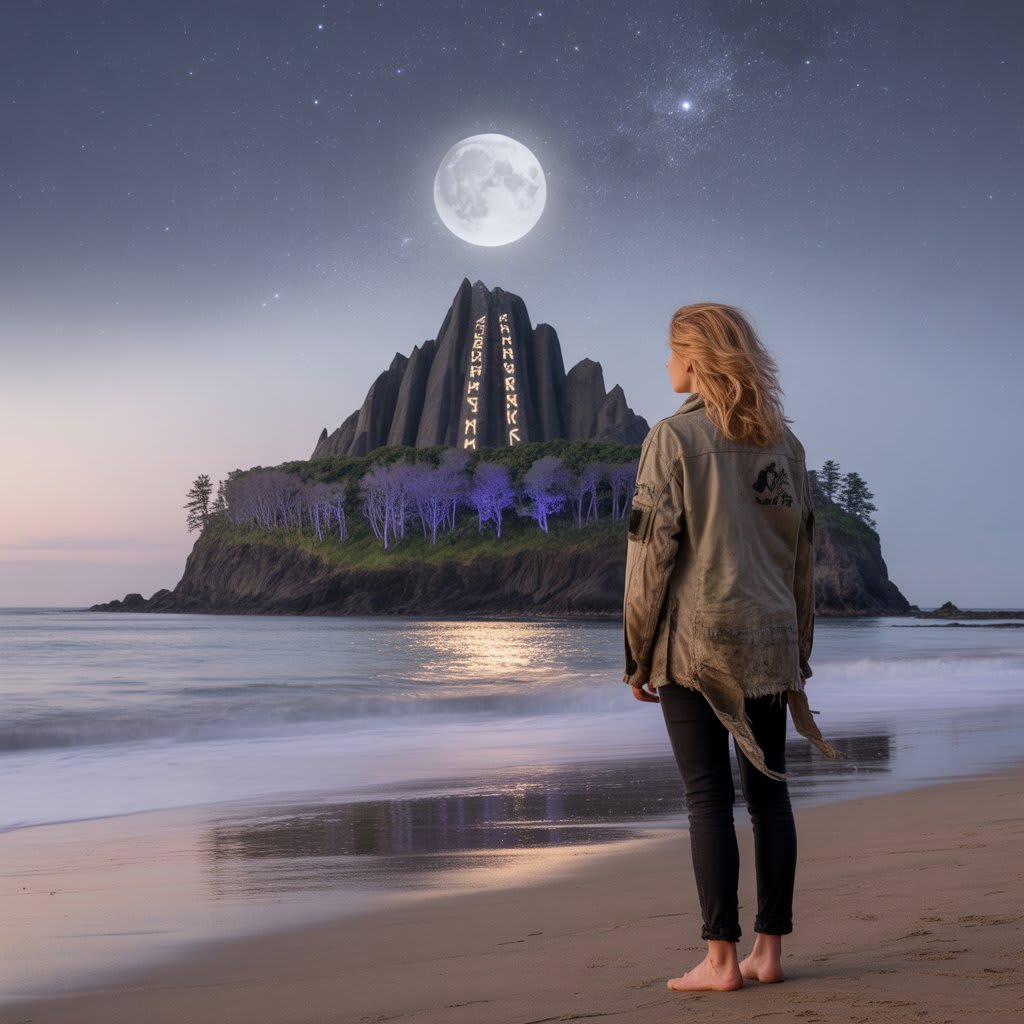
It was breathtaking: golden beaches wrapped in obsidian cliffs, a canopy of violet trees, rivers that shimmered with colors no eye could name. But strangest of all—it was not aged or weathered. Virelia looked as though it had been waiting.
The expedition team disembarked with drones, scanners, and geo-trackers. Everything shorted out within minutes. Only analog tools remained functional. But Mireille didn’t care. She stepped onto the shore barefoot, feeling the warmth of the sand beneath her feet, and whispered, “We found it.”
Chapter Three: Echoes
The island was alive.
Not in the way a rainforest pulses with insects and birds, but in the way a cathedral echoes with memory. Footsteps in the sand vanished seconds after they were made. Carved stone archways led to empty cities that hummed with a frequency no one could hear but all could feel.
And time… time was broken.
On their second day, the team encountered a man named Elias, claiming to be a cartographer from the year 1824. He looked 35. He had been on an English ship, searching for new trade routes when the island appeared before them out of nowhere. He remembered stepping ashore, then darkness. Then waking up here.
“I’ve been on this island for a week,” he said. “Or maybe a hundred years. I don’t know anymore.”
Chapter Four: The Heart of the Island
They followed an overgrown path that led to the island’s center—an ancient ziggurat-like structure of glistening black stone. Mireille deciphered some of the markings: "Memory is the gate. Time is the key. Will is the lock."
Inside the temple, they found an orb floating above an altar, pulsing with light that seemed to react to thought. One of the crew, Simone, reached out and vanished. Another, caught in panic, screamed—but no sound came. Her mouth opened, but her voice had been swallowed by the walls.
The temple was more than a monument. It was a machine—or perhaps a being. Mireille realized it wasn’t just that the island appeared once every hundred years. It was that time passed differently on it. Virelia existed in slivers of overlapping centuries, a pocket folded within the fabric of time.
Those who entered were caught in its rhythms—looping, aging backward, vanishing altogether.
Chapter Five: The Choice
By the fourth day, memory itself began to degrade.
Crew members couldn’t recall why they were there. One wrote a journal entry in a language no one recognized—including herself. Mireille woke up with new memories—of a life lived centuries ago, of cities that no longer existed.
And each night, the same dream: a woman cloaked in coral and shadow standing beside a sea of stars, whispering, “To know us is to join us. To leave is to forget.”
Mireille understood the island was offering a choice: stay and become part of its eternal memory—or leave and forget it ever existed.
She refused both.
Instead, she carved the truth into obsidian. She etched her mind’s unraveling onto the walls of the temple, using a fusion of ancient and modern scripts. She buried records in sealed stone chambers at the shoreline, hoping they would survive the next rise. She tattooed coordinates onto her own arm.
And when the ocean began to reclaim Virelia, she bound herself to a life raft with nothing but her notes and her blood-marked skin.
Chapter Six: Aftermath
She was found drifting off the coast of Greenland by a fishing vessel. Dehydrated, incoherent, and missing two toes from frostbite.
The crew saw only a madwoman. Her stories were dismissed. Her journal was blank. Her tattoos were dismissed as hallucinations of a deranged academic. She spent the rest of her life in an institution, painting murals of places no one had ever seen.
But she had planted a seed.
One of her paintings—an exact replica of the Virelia ziggurat—was acquired by an art historian named Keiji Murakami in 2184. It would inspire a new wave of researchers who noticed the repeating pattern: ship disappearances, strange weather, recovered journals written in dead languages—every hundred years.
Chapter Seven: The Next Cycle
On July 16, 2224, a research crew set sail under secret funding from a coalition of historical societies and technological corporations.
They didn’t know Mireille’s name. But they carried one of her paintings in the ship’s cabin, and someone had copied the tattooed coordinates from a century-old photo.
And far beneath the waves, the pulse began again.
About the Creator
AFTAB KHAN
SUBSCRIBE ME AND READ STORY
Storyteller at heart, writing to inspire, inform, and spark conversation. Exploring ideas one word at a time.
Writing truths, weaving dreams — one story at a time.
From imagination to reality
Keep reading
More stories from AFTAB KHAN and writers in Chapters and other communities.
The Town That Wouldn’t Quit
There was a small town tucked into the hills of Montana called Willow Creek. It wasn’t famous, it wasn’t rich, and it didn’t show up on most maps. But to the people who lived there, it was everything. A place where neighbors helped neighbors, where Fourth of July parades marched proudly down Main Street, and where the stars seemed to shine just a little brighter at night.
By AFTAB KHAN6 months ago in Chapters
Fair Exchange, No Robberies
Dark Memoirs - Index There are at least two kinds of people in the world: those who write this half-arsed kind of intro to a story that looks to separate the rare and the norm, and those who realise it's an overused framing device and don't.
By Paul Stewart14 days ago in Chapters
Sacrifices For The Balance Chapter 8: The Investigations Get Serious
Lady Astor parked her electric SUV just outside the dog rescue. She had decided to start with Maddy Tennyson; even if she couldn't get her to commit to her cause, she could be useful in gauging the political environment. She had decided to go with the jeans and boots look; she was as ready to work as she was to talk.
By Jamais Jochim2 days ago in Chapters
Silver Screen Magic with Mae West
American actress and singer Mae West became a popular film actress during the Great Depression. She started entertaining in vaudeville, then performed on Broadway, and finally went to Hollywood. She signed up with Paramount Pictures and made her debut in the 1932 film “Night After Night.” She also starred in musicals, comedies, and crime dramas. The American Film Institute named her one of the best classic Hollywood actresses.
By Rasma Raisters6 days ago in Geeks


Comments
There are no comments for this story
Be the first to respond and start the conversation.