
The Death of the Queen - Epilogue
Comments reference the history & writing a play


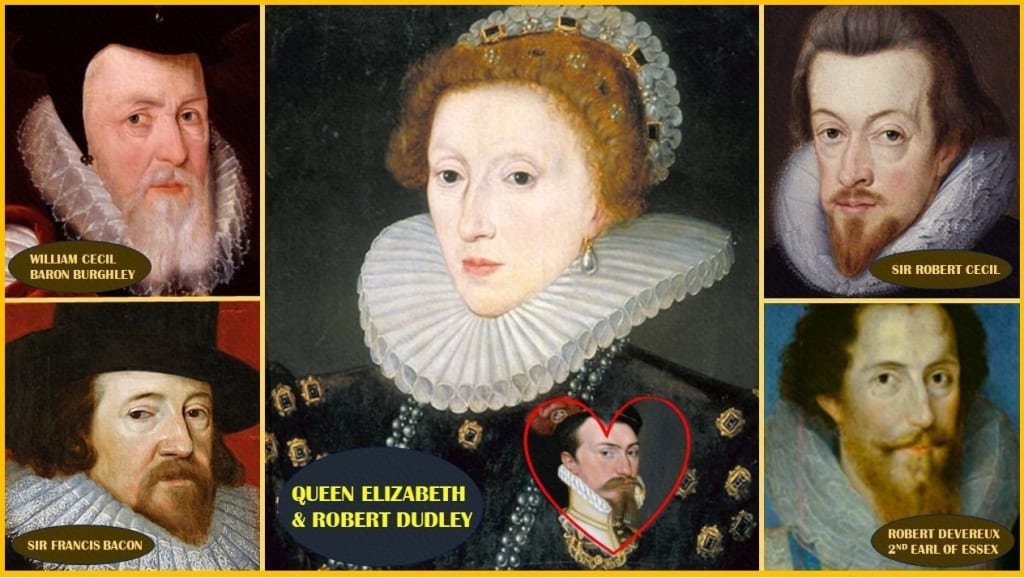
William Shakespeare wrote plays tracing the histories of seven of England's kings, some celebrated and others maligned. But during Elizabeth I's long reign, he did not pen a single play about any Tudor monarch. He wrote his only Tudor play - Henry VIII - ten years after her death and three years before his own.
In John Ford's play, Perkin Warbeck, Jacobean era audiences witnessed the first Tudor king - Henry VII - upon London stages. But no plays celebrating Elizabeth were penned during that great dramatic age, which seems to me a tragic loss.
I am confident that Hilary Mantel will eventually give Elizabeth her royal due, but in the interim, I thought it might be fun to anonymously write a short play of my own in the manner of the Elizabethan and Jacobean period.
But what of my Bonafide's, you ask? I'm afraid I don't really have any. Having never written a play before, I was not even a neophyte dramatist. It's true I have read and taught a few of Shakespeare's plays, but that does not make me an expert in Elizabethan and Jacobean literary arts.
So why attempt such a ridiculous thing? Because I knew before I started it would be fun!
And now having completed this fool's errand, I am absolutely gob smacked by the responses of readers and Vocal!
How it began or the Big Fib:
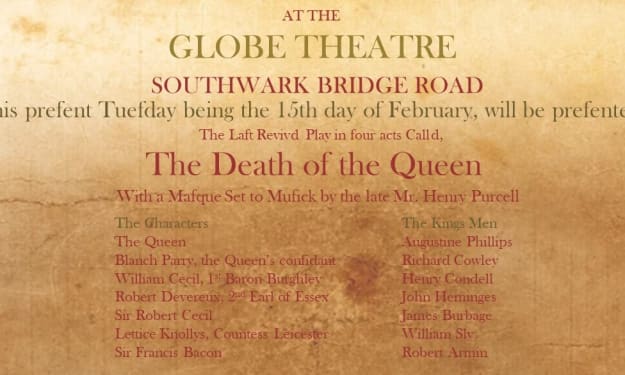
The introduction that I wrote to establish provenance of The Death of the Queen as an anonymous play was mostly true save for the professor’s discovery of the play and the play bill since I naughtily invented both. With this slim thread I structured a simple plot: the Queen grieves love lost, She loves again, She executes her new love for treason and then She dies. Long Live the Queen!
Since the idea of me channeling the great playwrights of the Elizabethan and Jacobean era was perfectly ridiculous, naturally I assumed that my regular readers would quickly unmask the big fib and recognize the tongue in cheek nature of the first Act's opening dialogues.
Imagine my horror at discovering that almost all of the readers took it seriously. But what followed was stranger still. After completing the first act, I took even greater leave of my senses and began to take the play seriously as well!
When Hannah Moore helpfully suggested in her comments to Act II, Scene I, Time for a monologue, I think? I responded by writing Act II, Scene II and giving up the stage to a solo performance by the Baron Burghley - William Cecil. Thanks to Hannah's inspiration, Vocal gave that new and wholly unplanned scene a Top Story.
Later Vocal kindly did the same for the Prologue/Scene I as well. Not only did the new scene garner additional readers and subscribers (good grief!), it radically altered my conception of the psychological drama within the play giving it depths it could not have achieved without the serendipitous suggestion to write a soliloquy in the first place. Thanks, Hannah!
I heavily researched the stories that I selected for inclusion in the play and used actual quotes from Sir Francis Bacon, Queen Elizabeth, Mary Queen of Scotts, Robert Dudley (briefly quoted by Sir Francis Bacon), William and Robert Cecil and Robert Devereux. Of course, I could not cobble together a play just based on a handful of quotes.
Most of the dialogue is mine. I did on occasion borrow phrases and half quoted lines from Perkin Warbeck by John Ford, as well as Hamlet, Henry V, Macbeth, Midsummers Night's Dream, As You Like It and King Lear by Shakespeare plus a sprinkling of Shakespearian styled insults.
History versus the play - two key events:
What really happened at Robert Devereux's execution:
Standing upon the scaffold he bowed to those who had gathered and made the following confession:
My sins are more in number than the hairs on my head. I have bestowed my youth in wantonness, lust and uncleanness; I have been puffed up with pride, vanity and love of this wicked world’s pleasures. For all which, I humbly beseech my Saviour Christ to be a mediator to the eternal Majesty for my pardon, especially for this my last sin, this great, this bloody, this crying, this infectious sin, whereby so many for love of me have been drawn to offend God, to offend their sovereign, to offend the world. I beseech God to forgive it me – most wretched of all.
After praying that God would preserve the Queen and asking the crowd to join him in prayer, he begged God to forgive his enemies. He laid himself on the block, stretched out his arms and prayed,
Lord be merciful to Thy prostrate servant… Lord, into Thy hands I commend my spirit.
After repeating two verses of Psalm 51, he cried out,
Executioner, strike home!
The executioner swung his axe to behead Essex, but, unfortunately, it took three blows to sever his neck. When the deed was finally done, the executioner held the head aloft, shouting,
God save the Queen!
Robert Devereux was 35 years old.
Source: https://www.tudorsociety.com/25-february-1601-the-execution-of-robert-devereux-2nd-earl-of-essex/
Naturally his confession in Act III, Scene III of the play is quite different from the historical version above. Although the words of his fictional speech are Robert Devereux's, not mine, I borrowed them from a long poem he wrote while imprisoned in the tower - The Passion of a Discontented Mind - by selectively picking phrases I thought suited to the occasion.
As to which works better in the theater, I’ll let you be the judge.
Did the Queen really name King James of Scotland her successor?
Recent scholarship casts doubt on the traditional story of Queen Elizabeth signing to Robert Cecil on her deathbed to name King James as her successor.
The British Library’s handwritten manuscripts of the Annals (of Queen Elizabeth I's reign) contain dozens of pages with pasted-over or crossed-out text that can’t be read by the naked eye. According to a statement, Helena Rutkowska, the University of Oxford graduate student leading the research, used transmitting light technology to uncover these passages, discovering key instances when (William) Camden revised his account to present (King) James in a more flattering light.
“[Camden] presumably included [the story] to appease James, so that his succession looked more predetermined than it had actually been,” Julian Harrison, lead curator of medieval historical and literary manuscripts at the British Library, tells the Guardian. “Elizabeth was too ill to speak in her final hours, and no other historical evidence points to this deathbed scene being true.”
Source: https://www.smithsonianmag.com/smart-news/hidden-for-400-years-censored-pages-reveal-new-insights-on-elizabeth-is-reign-180982554/
Long story short: Sir Robert Cecil may have been an even bigger fibber than I am, and the history books sanctioned his fib for posterity's sake.
For this one, I chose to unmask Robert Cecil's lie in the final scene of the play in the conversation between Sir Francis Bacon and the Countess Leicester, which I thought was way more fun!
Why I included Sir Francis Bacon in the play and the role he played in ushering in the modern scientific age:
For those literary minded conspiracy theorists, Sir Francis Bacon has long been the leading candidate as the secret author of William Shakespeare's plays and sonnets with Edward de Vere, 17th Earl of Oxford, a close second. If you have not seen the 2011 film Anonymous starring Rhys Ifans, stop what you are doing and watch it now. Why are you still reading?!
I thought it a delicious bit of irony to include Sir Francis as a character given the alternate history that a few outspoken scholars have given him by declaring him the greatest secret playwright in history.
Do I believe that? Nope! I know from experience that a secret is the hardest thing in the world to keep. And that secret would not have been kept, it would have leaked rather than some pseudo scholar tease it from the writings and scholarship of another great writer.
But still, the idea of including him and using as many of his quotes and writings in the play more than proved its value by elevating its quality far above my meager talents.
The lines that excited the most comments from readers were exclusively from his pen. His quote - When a bee stings, he dies. He cannot sting and live. When men sting, their better selves die. Every sting kills a better instinct - is not only beautiful but profound as well.
Did he do anything other than write memorable quotes? I'm glad you asked:
Prior to the revolutionary writings of Sir Francis Bacon and later Rene Descartes, *Scholastic philosophy ruled all western European academic thought. And the dead genius at the center of that philosophy was the great Aristotle. Any new discoveries that challenged his ancient pronouncements were declared heretical by the church.
The practice of science before the invention of the scientific method was based solely on observation, formal logic and dogma rising from the church sanctioned interpretation of the Bible.
The concept of creating a hypothesis based on an inductive method of scientific investigation was first set down by Francis Bacon. The method involves the inference of general laws or principles from particular instances observed under controlled conditions (i.e., in experiments).
*Note: Scholasticism - the system of theology and philosophy taught in medieval European universities, based on Aristotelian logic and the writings of the early Church Fathers and having a strong emphasis on tradition and dogma.
Thank all of you for your kindness in reading this ridiculous experiment and making it far exceed my expectations!
_________________________
About the Creator
John Cox
Twisted writer of mind bending tales. I never met a myth I didn't love or a subject that I couldn't twist out of joint. I have a little something for almost everyone here. Cept AI. Ain't got none of that.
Valentine's Dates Over the Years
Colin grinned as Brooklyn slipped into the living room. “Is it all set?” he asked. The twenty-one year old grinned. She was in her last year of college and Colin knew that Lincoln was proud of her. Although she had been away at college, she’d eagerly helped Colin plan his surprise for Lincoln. “I’m so glad you’re finally doing this,” she said.
By Reb Kreyling28 days ago in Chapters
Early March 2026: 4 Goals Accomplished
It's early March and I've now accomplished my 4th writing goal for the year of 2026. Before diving into the behind-the-scenes of it... why not tell you up front what that accomplishment was? I was published in a 2nd publication for this year. Published in Helix Literary Magazine out of Central Connecticut State University. You can read it for free right now!
By Stephen Kramer Avitabile7 days ago in Writers



Comments (15)
Congratulations on your captivating TS. I appreciate it.
You know me a little I think! I love a good rogue and the hoodwinkery that started it all drew me in more! you executed this crazy endeavour masterfully! the background info makes me respect you even more and helps place everything! congrats on completing it and sharing it, oh and on the Top Story! now, the ultimate challenge!!!! knock up a copy, using appropriate ink and paper, age it, and leave it somewhere or send it somewhere to pass it off as genuine! hehe!
Pffft! I don't believe you wrote all that John, and I mean that in the nicest possible way! People believed your fib **because you made it read so authentically**! Also: embed thy links thou heathen elf-skin! https://shopping-feedback.today/writers/making-your-vocal-piece-readable-101%3C/span%3E%3C/span%3E%3C/span%3E%3C/a%3E%3C/p%3E%3C/div%3E%3C/div%3E%3C/div%3E%3Cdiv class="css-w4qknv-Replies">
Congratulations on a well-earned Top Story that exemplifies your endeavors, John. I am all too sure that writing the many pieces of your play, as well as this follow up piece, was a daunting, formidable task. You excelled in your efforts, however. So well done.
Circling back to say congratulations for a well deserved Top Story!
Back to say congratulations on your Top Story! 🎉💖🎊🎉💖🎊
In all my early years of treading the boards in theatre I was wholly unaware that Shakespeare did not pen a single play about any Tudor monarch. This entire read was extremely wonderful to read. I will say I did not take your play as an accurate historical fact. John I said this before, and I think you are aware that over all us creators enjoyed your series. Congratulations on Top Story
Such a intriguing piece! Loved it
There you go again...moving us and helping create and foster the love of history. I am so glad this got a top story!! Congratulations, John
This was a great read! You delivered the history so well. Really enjoyed reading about how you approached writing the scenes. Can’t believe you haven’t written a play before this!! An impressive feat, John! Thank you so much for sharing it with us!
Thank you for sharing this epilogue with us, it was informative and also very captivating. Thank you again for all your hard work, I am so glad Hannah suggested the monologue and this play got the attention of the Vocal team. Congratulations again for such a great achievement, and for writing this till the end 🎉🎊🎉
John, me thinks the best writers lean too heavily on the humble of which you have done with this epilogue. All silly talk aside, you did a great job creating and presenting your play and deserve all the accolades given.
Wonderful wrap-up. You really did a great job in this play. Well done.
I fell for the big fib. Now I’m going to have to go back to the beginning and read it as yours. (Bonus)
"Sir Robert Cecil may have been an even bigger fibber than I am" Hahahahahaha that made me laugh! Jokes aside, I truly appreciate you writing this epilogue!