
Journal of Mohandas K. Gandhi
Chapter 14 : The Day of Seeds

Near Bhimrad, June 14, 1930
We arrived in Bhimrad just after the sun had begun its descent, the hour when the heat loosens its grip on the land but the dust still clings to the skin. The village seemed carved from the dry earth itself — low mud huts with thatched roofs, sparse trees holding out against the sky, and narrow footpaths where goats nosed for shade. There was no fanfare, no procession. Only silence and the keen gaze of villagers who had waited.
A boy met us first — barefoot, thin, but with shoulders held square. He motioned for us to follow. Past the open square and the well — a dry ring of stone — we were led to a shaded space behind the village shrine, where mats had been spread and water had been set aside in clay pots. A gathering of about thirty people, mostly women and elders, sat waiting. Their eyes followed me not with reverence, but with expectancy. This was not a visit to inspire, but to bear witness.
The headman, a man whose sun-darkened face was lined like a field left fallow, stood and greeted me with folded palms. “We do not ask for help,” he said quietly. “We only ask that you see.”
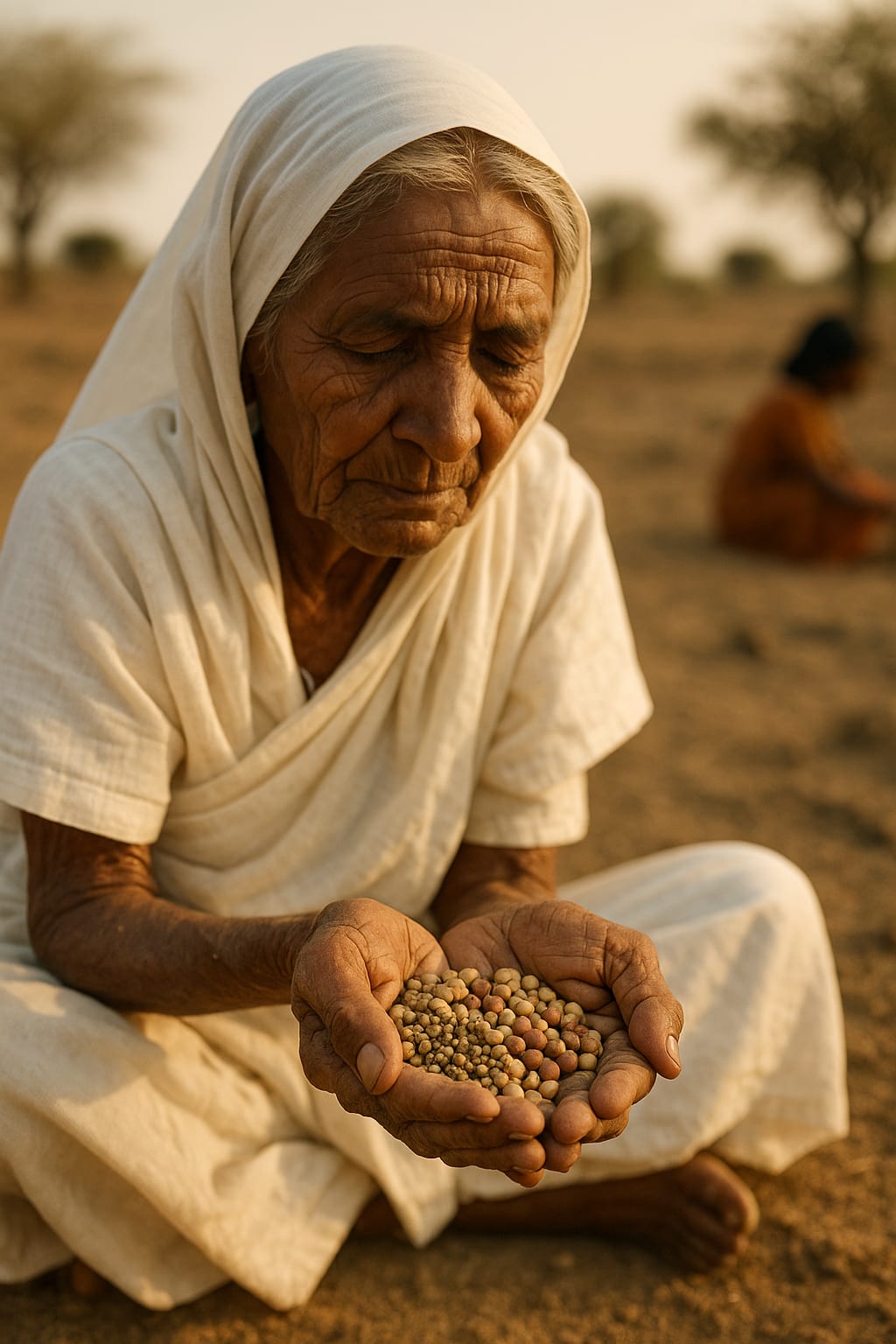
I did see. I saw the hunger, but not defeat. The calloused hands, but not idleness. The cracks in the earth, but also the careful bundles of seeds wrapped in cloth and stored with care. One woman, perhaps seventy years of age, stood and approached with a small pouch. From it, she poured into my palm a few rough, dry seeds — millets, lentils, pulses.
“These,” she said, “are not for eating.”
I looked at her in surprise. “Even now, with little food?”
She nodded. “We saved them for planting. We may go hungry, Bapu, but we will not lose the next harvest.”
Her voice was thin, but unwavering. Her words held more weight than any speech I could give. They were refusing to trade hope for survival. This — this was resistance.
After a sparse meal of bajra roti and weak tea, we sat in a circle as the sun dipped low. I noticed the children had joined us too — quiet, alert, holding onto every word spoken by their elders. A young girl asked me, “Is salt more important than food?”
I smiled gently. “Salt reminds us that even the smallest thing, when taken away unjustly, becomes precious. Food fills our bodies. But truth fills our souls.”
She seemed satisfied with this, and leaned back against her mother’s side.
Later, under a neem tree near the edge of the village, I sat with two volunteers — young men barely in their twenties. Arvind, one of them, had walked from Surat to be here. His feet were swollen, his kurta stiff with dried sweat, but his eyes were bright.
“Bapu,” he asked me, “how will we know when India is truly free?”
I paused. The fireflies had begun their slow dance in the dark, and a low hum of evening insects rose from the brush.
“When a child may drink from a village well without permission,” I said. “When a farmer may keep what he grows. When no one bows out of fear, and no woman hides her voice — that will be our freedom.”
He looked down for a moment, thoughtful. Then he said, “Then we must plant more than crops. We must plant courage in each other.”
Yes, I thought. That is the field we till now.
Before I retired to sleep, the headman came to me once more. He placed into my hands a folded cloth containing more seeds.
“Take them,” he said. “Scatter them where you go. Let them fall on open hearts. Let them grow.”
Now, by the soft glow of a clay lamp, I write these words. The air is thick with the warmth of bodies resting nearby, stretched out under thin cotton sheets. The night is warm. In the distance, a dog barks. A spinning wheel hums faintly from one of the huts — someone still working, still turning thread even as sleep pulls at them.
Today, we did not march. We did not speak to crowds. We sowed no crops.
But something far deeper took root. In the silence between words. In the simple decision to save seeds. In the refusal to eat today what could become tomorrow.
This is what they do not understand in Delhi or London: that the revolution is not made in parliaments or prisons, but in the choices of the poor, in the quiet of the fields.
We are not waiting to be free.
We are becoming it.
M.K. Gandhi
About the Creator
Alain SUPPINI
I’m Alain — a French critical care anesthesiologist who writes to keep memory alive. Between past and present, medicine and words, I search for what endures.
Keep reading
More stories from Alain SUPPINI and writers in Chapters and other communities.
Mastering French Without Losing Your Sanity: A Realistic Guide for Beginners
Learning French can feel like solving a Rubik’s Cube blindfolded. The tricky pronunciation, the never-ending grammar rules, and the surprising exceptions make it seem impossible. But don’t worry—equipping yourself with key expressions and effective strategies can turn frustration into fluency. Let’s simplify French and make learning enjoyable.
By Alain SUPPINIExclusive • 11 months ago
How Can Hobbies Make Life Better
As we live our lives and do hobbies throughout it, what comes of life through the hobbies that we do? Have you ever thought about that? Do we ever ask ourselves how hobbies can make our life better by doing them? I ask myself this question all the time. The reason for this is because hobbies are what gives life variety as we all know, and it also gives life some spice in the form of something fun. The more we put hobbies into life the more our lives get better. Life is meant to have hobbies in it, this is because the more we put into our lives in a form of relaxing the better our lives are. Doing the things that bring us joy in the form of hobbies is what makes life better. This can include any hobby that you enjoy and the most that you get out of the hobbies that you do. Doing the hobbies that you enjoy make your life better because you give the hobbies you do the most you can.
By Louise Barraco7 days ago in Chapters


Comments
There are no comments for this story
Be the first to respond and start the conversation.