
Journal of Mohandas K. Gandhi
Chapter 13 : The Day the Ashram Spoke

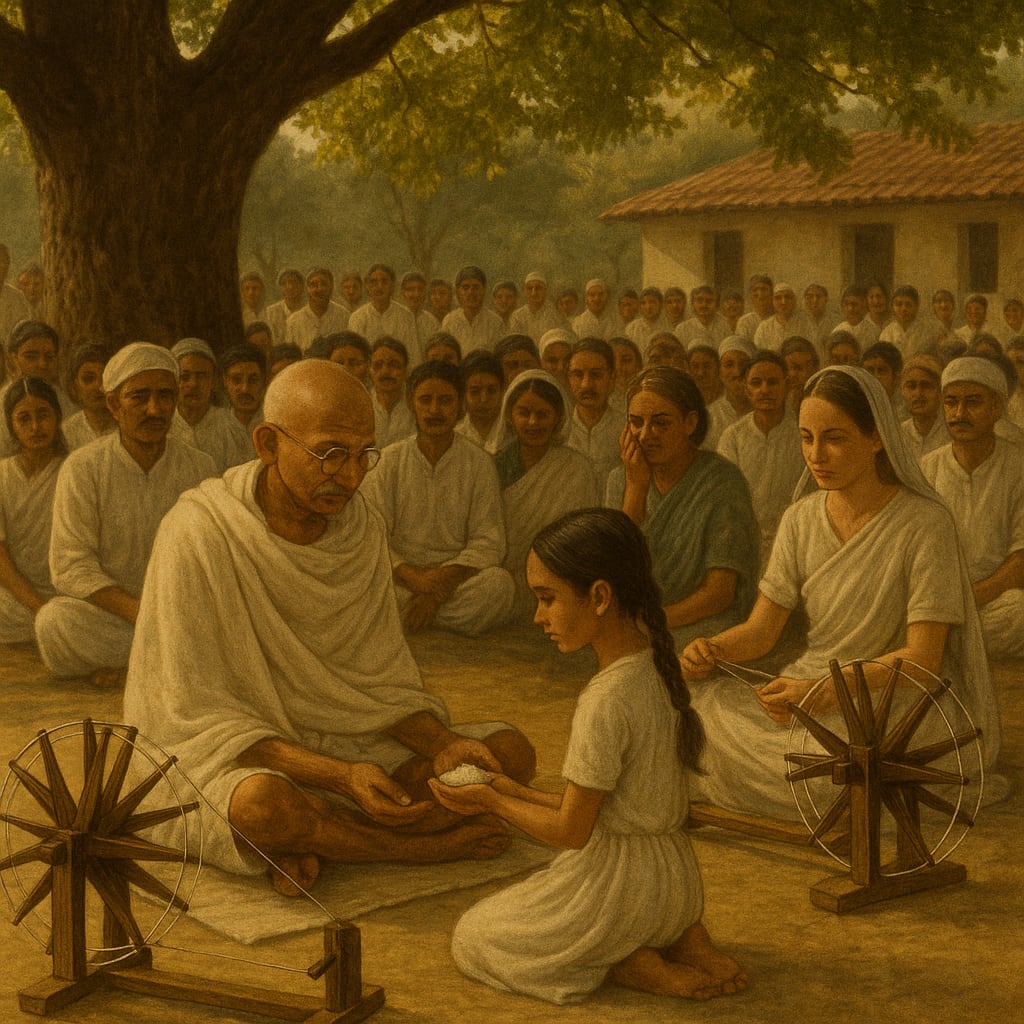
Sabarmati, June 5, 1930
Today, the sun rose heavy with unease. The wind carried a quiet tension, a stillness charged with questions. We had returned from our march, from our arrests, from the trials that sought to stifle our breath. Yet the air felt thick, as if the movement itself was listening, waiting for something unseen to begin again.
At dawn, I stepped out to the edge of the ashram and sat by the river. The water was low but steady, mirroring our spirit. As the orange light spilled across the ground, I heard a soft sweeping sound — not of brooms, but of feet, bare and sure, moving through the courtyard.
To my surprise, the children were already awake, quietly tending to the earth, as if they too sensed this was not an ordinary day. There was no bell, no command. One by one, more people arrived — not with loud proclamations, but with silence, purpose, and presence.
The whole ashram assembled, unbidden. Some brought spinning wheels; others carried baskets of coarse cotton or tools still streaked with soil. A few came with nothing but themselves — their eyes clear, their backs straight.
No one spoke.
We gathered beneath the neem tree where I had so often taught, meditated, prayed. The birds above offered their usual morning chatter, and it was they alone who filled the silence.
Then, young Manu — barely thirteen, slender as a reed — stepped forward with something wrapped in a scrap of cloth. She knelt and carefully unwrapped it: a small clump of salt. Dull, grainy, damp from the ground.
“It is ours,” she said simply. “They cannot take it away.”
That was all. No fire in her voice, no anger. Only a calm knowing.
The silence broke not into cheers, but into murmurs — low, affirming, like the first roll of a coming tide. The spinners began to turn their wheels. Someone began to sing Vaishnav Jan To. Others joined in, weaving the melody into the rhythm of the charkhas.
We did not plan it. We did not need to.
Later in the afternoon, under the harsh sun, I called a small meeting of the ashram’s elders. We sat cross-legged in the shade of the west veranda, the floor cool beneath us.
We did not speak of revenge. We did not speak of what had been taken, but of what had awakened.
“This is the pruning,” I said. “Like a tree in summer, we must now shed what is no longer rooted in truth. British courts will not deliver justice when their laws are poison. We shall not plead with poisoned tongues. Let us speak only from within.”
We resolved three things:
The Ashram would open itself to the nation. Not as a sanctuary, but as a school. Anyone may come and learn satyagraha, not as an idea, but as a discipline. We will train the heart and the hand. No one shall be turned away for caste, gender, faith, or poverty.
Every member shall adopt one village. To live, to spin, to teach, to walk among the people. Not to lead, but to listen.
We will begin the next phase of resistance without delay. But not by force. We will teach others to break unjust laws peacefully, and to endure the consequences with dignity.
When the meeting ended, no one raised their voice in approval. There were no slogans. We simply nodded, and returned to our tasks.
That is how I know this is real.
Now, the sun has fallen behind the trees. The lantern flickers beside me as I write. From the next room, I hear the hum of a single spinning wheel — perhaps Miraben, perhaps one of the girls. It soothes me.
The children are asleep. The air smells of burnt oil, wet grass, and cardamom from the evening’s tea.
I feel no triumph. Only quiet purpose.
They will come for us again. I do not doubt this. But what I witnessed today — Manu’s calm voice, the people gathering without signal, the charkha spinning like a heart — tells me that our roots are deeper than their chains.
We are becoming a people who know how to wait, how to act, and how to endure.
A revolution can be shouted from rooftops — or whispered through salt.
M.K. Gandhi
About the Creator
Alain SUPPINI
I’m Alain — a French critical care anesthesiologist who writes to keep memory alive. Between past and present, medicine and words, I search for what endures.
Keep reading
More stories from Alain SUPPINI and writers in Chapters and other communities.
Mastering French Without Losing Your Sanity: A Realistic Guide for Beginners
Learning French can feel like solving a Rubik’s Cube blindfolded. The tricky pronunciation, the never-ending grammar rules, and the surprising exceptions make it seem impossible. But don’t worry—equipping yourself with key expressions and effective strategies can turn frustration into fluency. Let’s simplify French and make learning enjoyable.
By Alain SUPPINIExclusive • 11 months ago
Bruce Lee and The God of War: Kuan Ti
It starts with love.. The Power to the God Of War and Wealth Walk into a Chinese restaurant (even in Oklahoma, USA), a Chinese police station, a kung fu martial arts studio or even a Chinese temple and you often see a red faced warrior holding a heavy quan-do (spear like weapon).
By WILD WAYNE : The Dragon King12 days ago in Chapters
The Ritual of Demand, Chapter Two
The subsequent phases of the solar cycle saw a tremendous change in Flashpower. He was a happier and more confident Mini-Flash all round. He lost his wan distracted look and his cheeks flushed with colour, the freckles on his snub nose standing out boldly. In class he could concentrate again, and his grades began to improve. Even his Flashball picked up a little, and when someone got the better of him he started taking it as any boy would, instead of getting his knickers in a twist. The adult Flashes all agreed Flashpower was finally getting the hang of being the age he was.
By Doc Sherwood6 days ago in Chapters
Wild Card Weekend Recap: What Happens Now?
I think I figured out why I love Wild Card Weekend so much. It's because it's the first playoff anything of the calendar year. The NFL season starts in the fall, and once upon a time, the champion was crowned either on or slightly before New Year's. The evolution of the NFL schedule has resulted in the playoffs starting just into the New Year, and currently, the final week of the season falls on the first weekend of the New Year, with Wild Card Weekend coming a week after that. So yes, chronologically, the NFL's Wild Card Weekend serves as the first playoff anything of the calendar year.
By Clyde E. Dawkins6 days ago in Unbalanced




Comments (1)
The description of the ashram's unity in making salt is powerful. It shows how people can come together with purpose, no matter the circumstances.