
Journal of Mohandas K. Gandhi
Chapter 15 : The Children Who Carried Light

June 16, 1930 — Dharasana
The sun was already high when I stepped out of the modest hut, my dhoti clinging damply to my legs. The air shimmered with heat rising from the parched ground. Though I had not marched at Dharasana myself — the viceroy’s order had seen to that — I could not remain still. I had come not as a leader, but as a witness. Dharasana had become the crucible in which the spirit of our movement was tested.
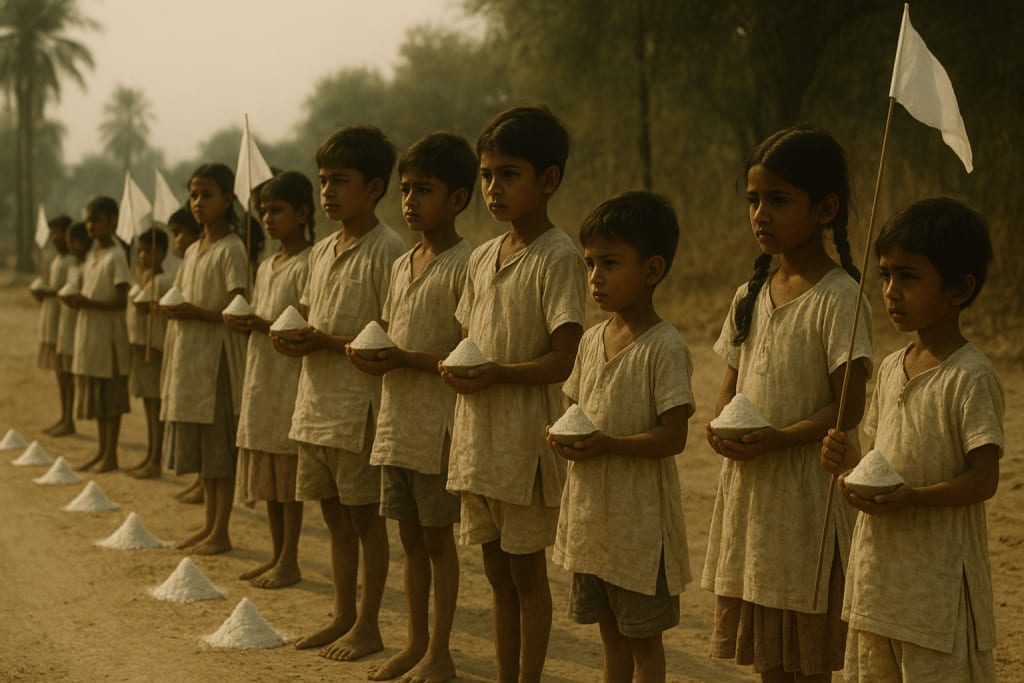
Word had reached me in the early hours: a new wave of satyagrahis had arrived. Not men of stature, nor trained workers from the Ashram. They were children. Boys and girls no older than twelve, their feet bare, their eyes open, carrying with them white flags and a handful of salt wrapped in cotton.
I reached the edge of the path that led to the Salt Works. There, lining the dusty road, stood perhaps forty of them — ragged kurtas, unruly hair, calloused feet — holding silence like it was a shield. They didn’t move as the guards walked past. They didn’t flinch. Each child held a little cone of dried salt, shaped from the waters of the Arabian Sea, and placed it at the roadside, as if to say: This is ours. This is not wrong.
One boy — no taller than my shoulder when seated — trembled slightly as a British officer approached and shouted in his face. Still, the boy did not move. I watched his throat tighten, his fingers clutch the salt closer to his chest. He bowed his head. The officer stood frozen. And then, with a grunt of something between shame and confusion, he walked away.
It was not the boy who had been humbled.
Later in the day, we sat beneath the neem tree that offered sparse but welcome shade. Some of the children, faces flushed from the heat, shared with one another what food they had — a roti torn into four, a mango pressed soft in the hand. I sat among them as an equal. One girl, with unruly curls and dirt-streaked cheeks, offered me her last piece of roti. I declined gently.
I asked, “Why have you come here, when you could be at home, at school?”
The girl shrugged, as if the answer was obvious. “Because my brother was beaten here. And I wanted to stand where he stood.”
Another boy chimed in, “We want to be in the story, Bapu. Not just hear it later.”
Their innocence was fierce. Their determination outshone their size. They had not read Thoreau or Tolstoy. But they understood justice more clearly than many ministers.
We spoke little after that. One began to hum the Ramdhun — Raghupati Raghav Raja Ram… — and soon the others joined. Their young voices floated across the fields, reaching the salt works, where older satyagrahis lay recovering from the brutal batons of that morning.
As the sun dipped lower, I walked a little further toward the site. There, in silence, I saw something I will carry in my heart for the rest of my days.
A line of salt cones — placed by children’s hands — stretched along the dirt path like breadcrumbs leading to freedom. Each little heap shimmered pale against the red dust, defiant and fragile, easily brushed aside but no less real.
A guard passed near them. He stopped, looked down, then moved around them, not over. It was a small gesture, perhaps subconscious. But I noticed it. I noticed everything.
These children had not marched. They had not shouted. But they had carried something even greater than salt — they had carried dignity. They had brought the movement forward by refusing to be invisible.
And they had reminded me — as I so often need reminding — that this revolution does not belong to speeches or sermons or even seasoned satyagrahis. It belongs to those who carry it in silence, with open hands and open hearts.
That night, under a sky pricked with stars, the ashram volunteers gathered to spin and sing. One of the elder weavers passed me a spindle. I turned it slowly in rhythm with the others, watching the children sleep nearby on mats of jute. I saw the girl who had offered me her roti clutching her bundle of salt like a talisman.
I write now by lamplight. The village is hushed. Somewhere nearby, a conch shell has just sounded — perhaps in evening prayer, perhaps as a call to tomorrow.
I am more certain than ever: we are not merely reclaiming salt. We are reclaiming our right to raise our children without fear. To let them stand, silent but seen, in the presence of power and not shrink. To have them speak by simply being.
In their hands, I saw not just salt.
I saw light.
M.K. Gandhi
About the Creator
Alain SUPPINI
I’m Alain — a French critical care anesthesiologist who writes to keep memory alive. Between past and present, medicine and words, I search for what endures.
Keep reading
More stories from Alain SUPPINI and writers in Chapters and other communities.
Mastering French Without Losing Your Sanity: A Realistic Guide for Beginners
Learning French can feel like solving a Rubik’s Cube blindfolded. The tricky pronunciation, the never-ending grammar rules, and the surprising exceptions make it seem impossible. But don’t worry—equipping yourself with key expressions and effective strategies can turn frustration into fluency. Let’s simplify French and make learning enjoyable.
By Alain SUPPINIExclusive • 11 months ago
Search for a Sister, Chapter Two
4-H-N heard not a word about her secret mission around Headquarters over the following days, so had to conclude either Mini-Flash Phytolith hadn’t been listening in after all, or she’d misjudged him. She hoped it was the latter, as she wanted the pair of them to get on, even if he wasn’t going out of his way to make it easy for her.
By Doc Sherwood19 days ago in Chapters
Overexposure
There is a point in the ascent where the brightness stops illuminating and starts burning. It happens gradually, then all at once — the moment when the light that once felt like clarity becomes something harsher, sharper, more invasive. This is the stage of the upward weather I call overexposure.
By Elisa Wontorcik3 days ago in Chapters


Comments
There are no comments for this story
Be the first to respond and start the conversation.