
Journal of Mohandas K. Gandhi
Chapter 6 : Threads in the Wind

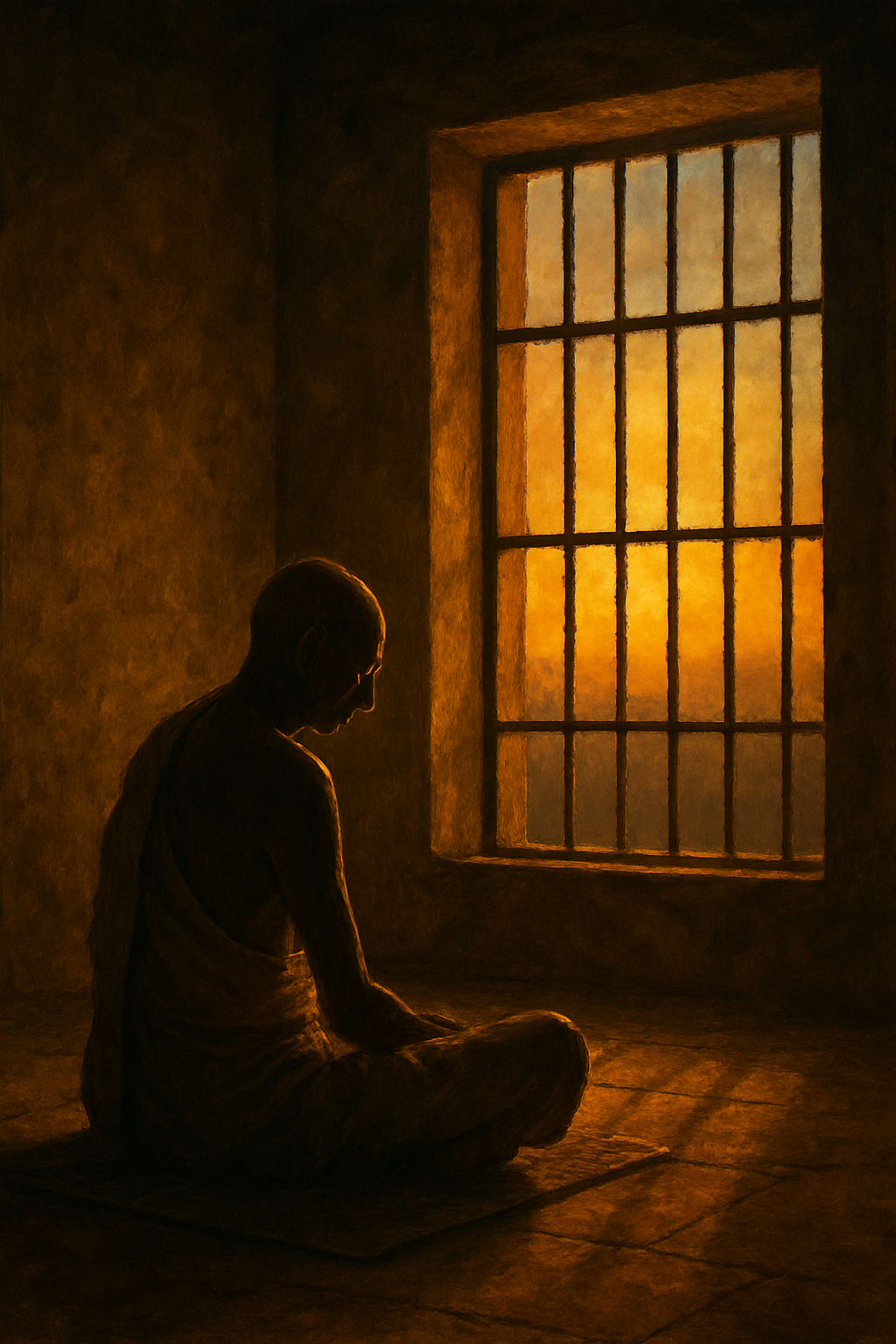
April 10, 1930 – Yerwada Jail, Pune
Threads in the Wind
The wind is stronger today.
It presses against the bars of my window like a traveler trying to deliver news without a name. It carries the scent of dry earth, sweat, perhaps even distant jasmine. There is dust in the air, but also something else — a rhythm, a thrum, as if all of India is breathing just under the surface.
Within these stone walls, time moves differently. Yet my thoughts remain tethered to the outside — to villages and cities, forests and rivers, spinning wheels and ocean tides. Though I am still, I feel their motion.
Each day brings small reports. Not official dispatches — no, the British keep those for their own files — but human stories, carried in whispers, smuggled smiles, a tilt of the head from a sympathetic jailor. They do not realize that these fragments are more valuable than any headline.
A young soldier told me yesterday that in Allahabad, railway workers laid a line of salt across the tracks before the governor’s train was to pass. They did not shout. They did not block it. They simply stood beside the salt in silence. The train stopped. It waited. Then it reversed.
In Baroda, a group of untouchables were seen spinning khadi together with Brahmins. No speeches were made. They just sat in a circle, turning the wheel, letting caste melt into thread.
In Cuttack, a woman hung her dead husband’s British uniform from a neem tree and planted tulsi beneath it. She said it would grow stronger now that it no longer served oppression.
These are not coordinated actions. No one ordered them. They sprout like grass between stones — quiet, spontaneous, impossible to uproot all at once.
The guards have become gentler with me. I do not demand this. Perhaps it is the stillness I carry. Or perhaps they sense, as so many do, that something is changing — not with violence, but with meaning.
This morning, the young jailor Rao brought me water and lingered.
He said, hesitating, “Sir… my daughter now insists on washing her hair only with saltwater.”
I smiled. “Then she carries the nation’s perfume.”
He laughed, nervously. “I don’t know if I should be proud or afraid.”
“Be both,” I replied. “They often arrive together.”
I spin each morning. It is a sacred act now, more than ever. The spindle’s music steadies the heart. I lose myself in its rhythm. Sometimes I feel I am not spinning thread — I am weaving memory. For India has been taught to forget itself, to see its worth only through colonial mirrors. But this cotton — uneven, coarse, imperfect — it reminds us that we are sufficient in ourselves.
They say the Empire thrives on efficiency. But we are not machines. We are not meant to be. Our cloth breathes. Our steps meander. Our protests take the shape of stories, prayers, lullabies, and dreams passed quietly from mother to child.
A British magazine recently wrote, “Gandhi’s campaign has no central command, no clear demands, no tactical coherence.”
To them, that is chaos.
To us, it is freedom.
There is no need for command when the soul is awakened. No need for demands when dignity is reclaimed. We do not march to a drum; we move with the wind — unpredictable, but persistent.
A banyan tree does not rise in a single day. It takes years to send its roots down. And when the storm comes, it survives not because it resists, but because it bends and holds on to the earth.
That is India now — not yet in bloom, but deeply rooted.
Tonight, I will sleep with the window open, despite the chill. I want the wind to pass over me. I want to feel every thread it carries from the spinning hands of a people who are no longer waiting.
Freedom, I see more clearly each day, is not the lifting of a law or the retreat of soldiers. It is this: when an old woman in a distant village decides to walk barefoot, not because anyone told her to, but because she knows she is already free.
I am in prison.
But the nation is not.
And one day, we will all remember that we never were.
M.K. Gandhi
About the Creator
Alain SUPPINI
I’m Alain — a French critical care anesthesiologist who writes to keep memory alive. Between past and present, medicine and words, I search for what endures.
Keep reading
More stories from Alain SUPPINI and writers in Chapters and other communities.
Mastering French Without Losing Your Sanity: A Realistic Guide for Beginners
Learning French can feel like solving a Rubik’s Cube blindfolded. The tricky pronunciation, the never-ending grammar rules, and the surprising exceptions make it seem impossible. But don’t worry—equipping yourself with key expressions and effective strategies can turn frustration into fluency. Let’s simplify French and make learning enjoyable.
By Alain SUPPINIExclusive • 11 months ago
Fair Exchange, No Robberies
Dark Memoirs - Index There are at least two kinds of people in the world: those who write this half-arsed kind of intro to a story that looks to separate the rare and the norm, and those who realise it's an overused framing device and don't.
By Paul Stewart12 days ago in Chapters
How to Use Dopamine for Deep Focus and Flow
Introduction For the longest time, I thought dopamine was my enemy. It was the thing pulling me toward endless scrolling, overeating, and wasting hours on apps that gave me nothing back. I blamed my lack of focus on willpower, discipline, or motivation. But what I eventually realized changed how I work, think, and focus entirely.
By Dilip Kumaraa day ago in Chapters




Comments
There are no comments for this story
Be the first to respond and start the conversation.