
Journal of Mohandas K. Gandhi
Chapter 5 : The Viceroy’s Silence

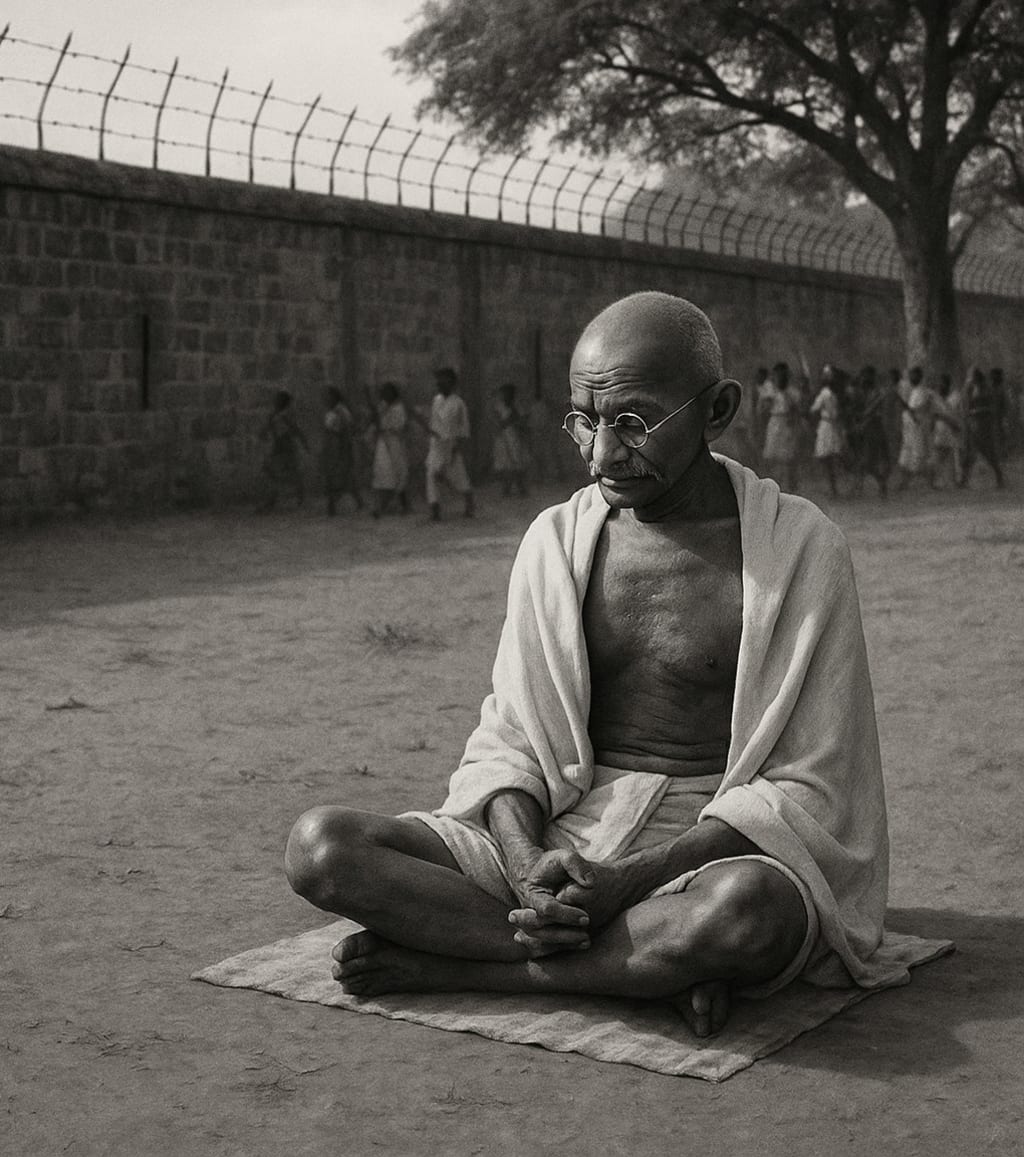
April 2, 1930 – Yerwada Jail, Pune
The Viceroy’s Silence
I now write from behind stone and steel.
Three mornings ago, they came at twilight — when the wind still carries the scent of sleeping earth. Two constables, pale and wordless, escorted a higher officer who stood at the door of my hut like a ghost from another play. I had already folded my mat and finished my prayers. I invited them in, offered warm water and silence. They declined the former and misunderstood the latter.
“You are under arrest, Mr. Gandhi, under Section 39 of the Salt Act,” said the officer.
I replied calmly, “Then it is salt that now imprisons men.”
He avoided my gaze. A part of him, I sensed, was ashamed.
There were no handcuffs. They allowed me to walk freely, even carry my own shawl and diary. Some in the ashram wept silently, others raised their palms in blessing. No shouts. No chaos. Only the soft sound of charkhas turning — as if the very air refused to panic.
They brought me to Yerwada by train. The journey was not unpleasant. My guards were courteous, even deferential. We passed mango groves and yellow fields. Peasants paused their work to bow, and some raised handfuls of salt in quiet salute.
Inside the prison, the walls are thick but not cruel. I have been granted my mat, my pen, and a small bowl of neem leaves. The jailer, a Maharashtrian named Rao, speaks to me with a mixture of duty and reverence. He brings me news in coded phrases, delivered like gossip, but glowing with revolution.
“Sir,” he said this morning, while pretending to sweep, “students in Bombay staged a salt fast on the steps of St. Xavier’s College. Four were beaten. None retaliated.”
Yesterday, it was: “A widow in Odisha walked 20 miles to reach the coast. She boiled her salt in silence, then gave it away to every family in her village.”
These are not stories. They are evidence — that the spirit of satyagraha lives without me. That this movement was never mine, only born through me.
But what weighs heavier than iron bars is the silence of the Viceroy.
He has made no speech. No condemnation. No overt move to reassure the empire. Perhaps he believes his restraint is wise — that ignoring us will starve us of attention. But he misjudges the force we have awakened. Silence, in truth, is our native language.
We have always spoken through gestures. Through spun thread and bare feet. Through bowls of rice shared across caste. Through children refusing to recite British anthems. Through women who salt their food with defiance and feed it to the next generation.
The Viceroy’s silence does not stifle us. It only confirms what we already know — that there is no moral defense for empire. And without morality, even steel thrones melt like wax.
I reflect now on a letter I once received from a fisherman in Kutch. He had written, “Bapu, I do not know politics. But I know the sea. And I know that when the tide rises, no one can stop it — not even the gods.”
He was right. The tide has risen.
Across Bengal, people now weave salt crystals into garlands. In Delhi, a young Muslim poet has written a ghazal comparing satyagraha to the moon: silent, but irresistible. In Madras, a temple priest placed a bowl of salt before the deity and called it “India’s first true offering.”
This is not protest. This is rebirth.
Today, the sun set behind the prison walls like a silent witness. I walked slowly in the courtyard as crows circled overhead. I am not alone. The air carries more than dust — it carries the knowledge that a nation is learning to stand upright, without shouting, without striking, without fear.
Let the Viceroy remain silent. Let the newspapers print their silence beside his. Let the Empire pretend that salt has no taste.
Because when he does finally speak, his voice will arrive in a world already transformed — reshaped not by power, but by vow.
M.K. Gandhi
About the Creator
Alain SUPPINI
I’m Alain — a French critical care anesthesiologist who writes to keep memory alive. Between past and present, medicine and words, I search for what endures.
Keep reading
More stories from Alain SUPPINI and writers in Chapters and other communities.
Mastering French Without Losing Your Sanity: A Realistic Guide for Beginners
Learning French can feel like solving a Rubik’s Cube blindfolded. The tricky pronunciation, the never-ending grammar rules, and the surprising exceptions make it seem impossible. But don’t worry—equipping yourself with key expressions and effective strategies can turn frustration into fluency. Let’s simplify French and make learning enjoyable.
By Alain SUPPINIExclusive • 11 months ago
Bruce Lee and The God of War: Kuan Ti
It starts with love.. The Power to the God Of War and Wealth Walk into a Chinese restaurant (even in Oklahoma, USA), a Chinese police station, a kung fu martial arts studio or even a Chinese temple and you often see a red faced warrior holding a heavy quan-do (spear like weapon).
By WILD WAYNE : The Dragon King12 days ago in Chapters
The Ritual of Demand, Chapter Two
The subsequent phases of the solar cycle saw a tremendous change in Flashpower. He was a happier and more confident Mini-Flash all round. He lost his wan distracted look and his cheeks flushed with colour, the freckles on his snub nose standing out boldly. In class he could concentrate again, and his grades began to improve. Even his Flashball picked up a little, and when someone got the better of him he started taking it as any boy would, instead of getting his knickers in a twist. The adult Flashes all agreed Flashpower was finally getting the hang of being the age he was.
By Doc Sherwood6 days ago in Chapters




Comments (1)
This account of Gandhi's arrest is fascinating. It shows how calm and composed he was. I wonder how the British thought they'd break his spirit. And those stories of people following his lead despite his arrest are truly inspiring. Makes you realize the power of a just cause.