
Journal of Mohandas K. Gandhi
Chapter 7 : Roots Beneath the Surface

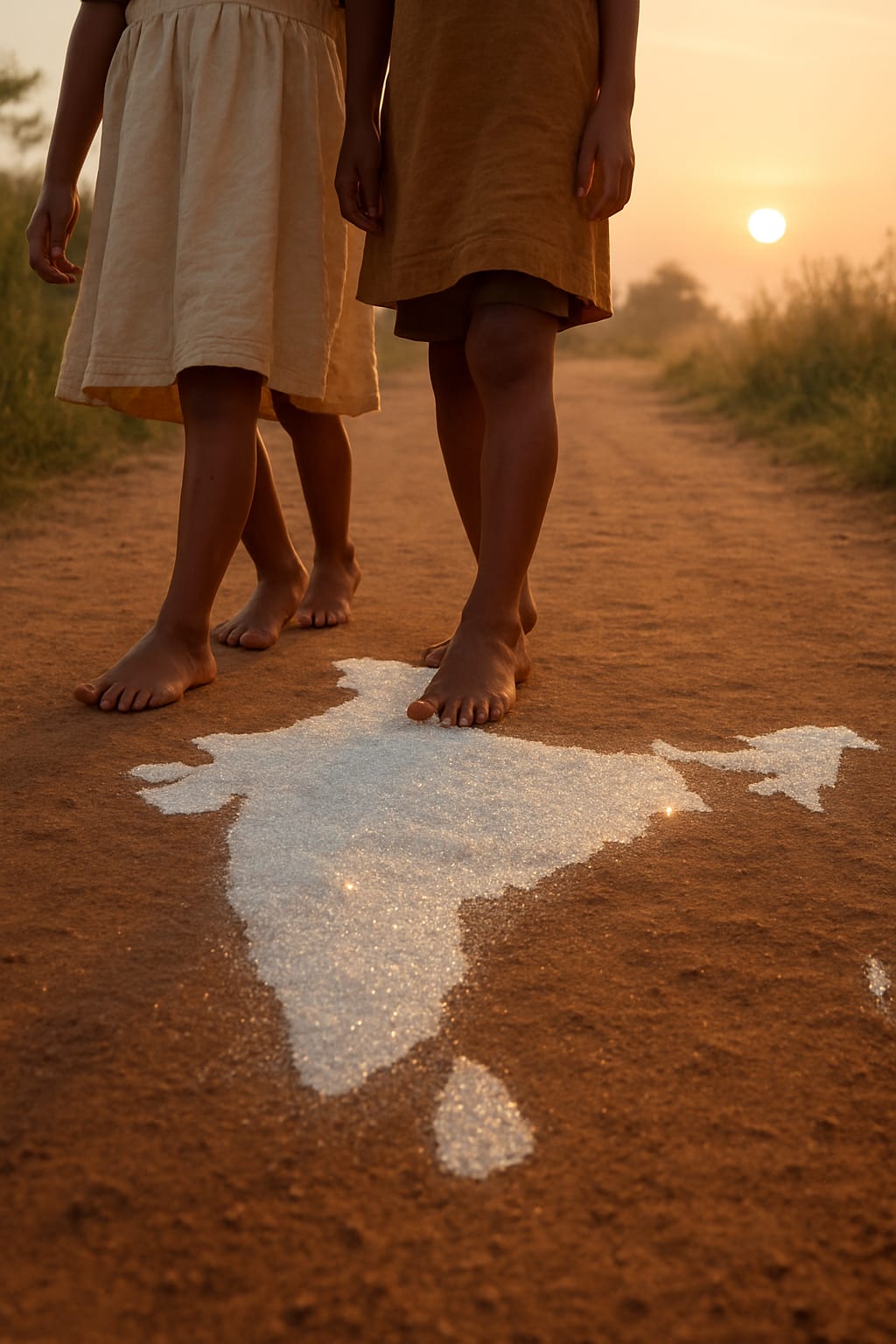
April 20, 1930 – Yerwada Jail, Pune
Roots Beneath the Surface
The silence before dawn is not emptiness — it is a gathering. In it, I hear the whisper of millions who have not yet spoken aloud, but who are preparing to. Their resolve stirs like sap rising through the roots of a tree, unseen yet alive. Every morning now feels as though the country is stretching before it begins to walk.
This morning, Jagan, the young prison guard, brought me news from Madurai. “They are no longer waiting for leaders,” he said. “Even the children are making salt in the fields.” There was no hint of mockery in his voice, only awe.
I asked him if they had been punished.
He looked away. “The police hesitated. What can one do when a ten-year-old kneels in the sun and says, ‘I make this for my mother’?”
I had no answer. But my heart stirred with a strange mixture of humility and pride. Ahimsa is not inherited — it is discovered anew by each generation, and often most purely by those untouched by power or fear.
Later that day, I spoke through the bars with a teacher from Bengal, briefly held in the wing adjacent to mine. His words painted scenes more vivid than any newspaper:
“In our village,” he said, “the students arrived barefoot, not because they lacked shoes, but because the shoes had been stitched in Manchester.”
He asked one of the girls, “Why do you walk like this?”
She replied, “Because my mother weeps when she buys what Britain sells.”
A boy added, “We walk with India now.”
The teacher could not continue. He wept. So did I.
This movement was never meant to be mine. It belongs to the ones who walk barefoot without shame, who give up comfort without anger, who transform obedience into conscience.
These past days I have found a strange peace in repetition. I spin each morning with thread uneven and thin. The charkha creaks, the cotton resists, but there is discipline in its rhythm. It reminds me that not all resistance is dramatic. Sometimes, it is quiet and circular, like the wheel itself — moving forward through stillness.
The British do not yet understand what grows under their feet.
They seek to measure strength by numbers, weapons, and proclamations. But this is not that kind of war.
Our revolution is not fought with rifles, but with rituals. With bread shared instead of hoarded. With salt boiled beneath the sun. With head held high when the lash falls.
In Nasik, a woman placed a white cloth over her cow and declared it “India’s spirit.” When the constables came to confiscate her salt, she stood in front of the pot and said only, “This is not for sale.”
They asked for her name.
She said, “I have none that you would recognize.”
When they threatened her, she handed them a rose. One of them took it. And they walked away.
Such stories now arrive each day — not through papers or radios, but through voices too persistent to silence.
I keep thinking of a question that haunts me even in meditation: Are we only resisting, or are we becoming?
I believe it must be both.
Freedom is not just the absence of chains. It is the presence of dignity. A country may break its bonds, and yet remain unfree if its people forget how to live truthfully.
We must learn to carry truth without pride, and resistance without hatred.
If we are to govern ourselves, we must first rule our tempers, our egos, our thirst for vengeance.
Otherwise, what will distinguish us from those who ruled with muskets and laws they did not live by?
I walk the length of my cell and pray. I do not ask for release. I ask for clarity, for courage, and for patience. I ask that my people remember not only what they resist — but what they hope to become.
A gardener waters the soil even when the seed remains unseen. He does not say, “Where is the flower?” on the third day. He trusts.
So must we.
We pour salt into our wounds and call it healing. We spin broken cotton and call it national cloth. We fall and rise, again and again — not to prove something to the world, but to remember who we are without it.
Tomorrow will bring more news. More fear, perhaps. More small triumphs.
I will sit by the barred window and listen for the wind. And perhaps I will hear, once more, the sound of bare feet walking across a village road somewhere far away — walking with India.
We do not walk alone.
M.K. Gandhi
About the Creator
Alain SUPPINI
I’m Alain — a French critical care anesthesiologist who writes to keep memory alive. Between past and present, medicine and words, I search for what endures.
Keep reading
More stories from Alain SUPPINI and writers in Chapters and other communities.
Mastering French Without Losing Your Sanity: A Realistic Guide for Beginners
Learning French can feel like solving a Rubik’s Cube blindfolded. The tricky pronunciation, the never-ending grammar rules, and the surprising exceptions make it seem impossible. But don’t worry—equipping yourself with key expressions and effective strategies can turn frustration into fluency. Let’s simplify French and make learning enjoyable.
By Alain SUPPINIExclusive • 11 months ago
Bruce Lee and The God of War: Kuan Ti
It starts with love.. The Power to the God Of War and Wealth Walk into a Chinese restaurant (even in Oklahoma, USA), a Chinese police station, a kung fu martial arts studio or even a Chinese temple and you often see a red faced warrior holding a heavy quan-do (spear like weapon).
By WILD WAYNE : The Dragon King11 days ago in Chapters
Is Living For Your Hobbies A Good Thing
When we live life do we do so for our hobbies or do we just live life to live life. Living life for your hobbies is a good thing but how can we live life for the hobbies that we have? Is it just doing the hobbies that we enjoy. Is it to make our lives the way we want to with doing the hobbies that make life the best it is for us. The more we put our hobbies and life together the more we will be living life for the hobbies that we have, and yes living for your hobbies is a good thing because, you get so much more out of life when you put your hobbies into your life. Reading, writing, blogging, re-organizing things. Just live life the way that works for you. Figure out what hobbies work for you and you will have so much more happening in life as you figure out how to put your life and hobbies together. The more you put your hobbies and life together the more you will be living for the two things and the better you will feel if you try to do this.
By Louise Barraco7 days ago in Chapters


Comments (1)
The story of the children making salt and the students' stance is powerful. It shows how the spirit of resistance is passed on. Made me think about how small acts can lead to big change. How can we encourage more people to find their own forms of peaceful resistance today? The description of the spinning also gives a sense of calm determination. It makes me wonder what simple, repetitive acts we can all do in our daily lives to show our support for a cause. Maybe something as basic as choosing local products over imports?