
Journal of Mohandas K. Gandhi
Chapter 18 : Of Scribes and Embers

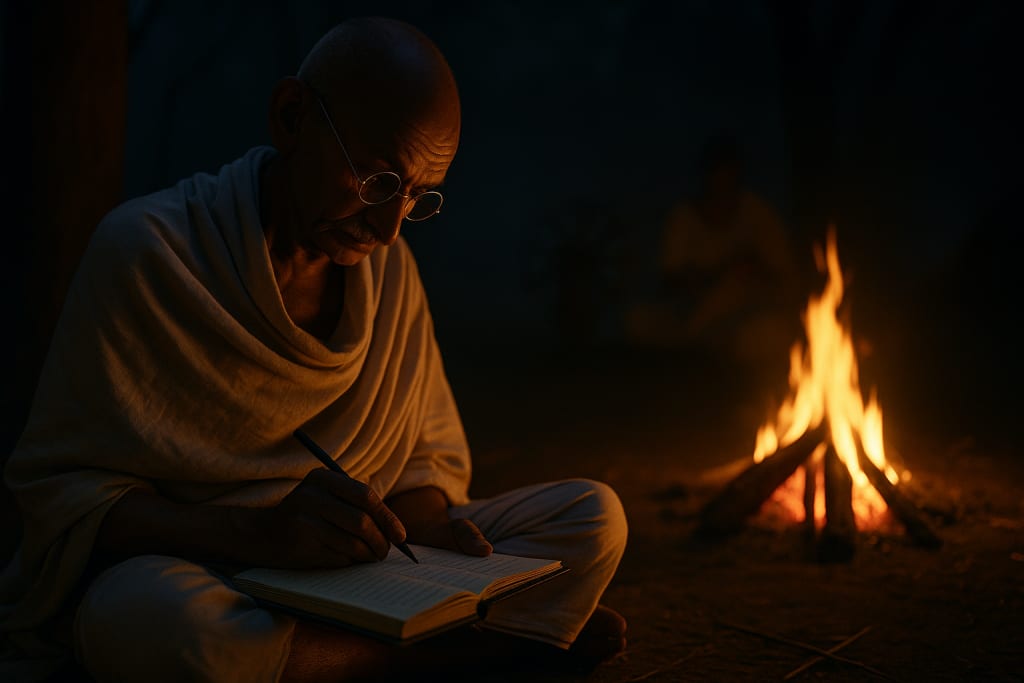
June 7, 1930 – Camp near Vadodara
The air was warm, but in the stillness of the dawn, it held a quiet tension—like the breath before a song. In that pause, life prepared itself for one more act of resistance. I sat with a boy named Ravi today—a child no older than ten, who had once scrawled lessons in the dirt with a twig because his family could not afford slates. His handwriting, shaped by earth and necessity, now fills scrolls and letters that travel from hamlet to hamlet. He transcribes declarations, poems, maps, and secrets. His fingers move faster than the trains that still carry Indian salt to British ports, as if he’s determined to write a new destiny before the old one catches up.
When I asked him if he missed school, he smiled faintly and replied, “Bapu, I learn every day now. Only the lessons have changed.” Indeed, they have. In our republic of conscience, every person is both student and teacher.
The sabhas we hold beneath neem and banyan trees swell larger each day. Word spreads like fire through dry grass. There are no trumpets, no banners. Only presence. A potter may bring his wheel, a widow her story, a farmer his silence. In Vadodara, I saw a mason lay bricks for a school he hoped to build one day, even while British police hovered nearby. "My hands don’t fear chains," he said, pressing mud into shape. "They only remember how to build."
It is always the ordinary who surprise me. This morning, a woman from Amreli stood before us with her hands clasped over her chest. She had never spoken before a crowd. But her voice rang clear, like temple bells. She burned her imported saris, she said—not in anger, but in purification. “I used to wear chains of silk,” she said, her eyes steady. “Now I wear our freedom.” The crowd didn’t cheer—they bowed.
How strange and beautiful that resistance takes such domestic forms—thread, clay, salt, paper. Not weapons, but tools of daily life transformed into shields and signals. A meal refused, a fabric rewoven, a pot left unglazed: these, too, are thunder in disguise.
The British, confused by the quiet, grow more agitated. They expected mobs, not spinning wheels. They prepared for riots, not resolve. And so, they lash out. In Surat, they raided a textile workshop for displaying a portrait of Bharat Mata. In Porbandar, they imprisoned a blind man for distributing homemade salt. I see now: it is not disobedience they fear. It is dignity.
Last evening, I received a letter smuggled from a prison cell in Bengal. It bore no signature, but I recognized the slant of the script—Kamala, once a teacher in Calcutta. Her words brought both fire and stillness.
“They have locked me in a place without windows, but I see more clearly than ever. I see the end of this empire, and the beginning of what we have yet to imagine. Teach the people not only to resist, Bapu—but to dream.”
I closed my eyes for a long time after reading those words.
Tonight, as the fire dies low, I sit and write by its glow. Not far from me, someone hums a bhajan. Another tends to her spinning wheel with the same care a mother gives a child. Beyond the tree line, I hear footsteps in the dark—more travelers arriving, their torches flickering like stars fallen to earth.
The empire counts arrests, but it cannot count awakenings. And something is awakening here—not just in hearts, but in the very air. A future unnamed. A breath held. A people reclaiming the right to shape their own silence, and to fill it with meaning.
We do not yet know the name of what we build. But we build it still. Quietly. Steadily. Without fear.
And the embers remain. They wait.
M.K. Gandhi
About the Creator
Alain SUPPINI
I’m Alain — a French critical care anesthesiologist who writes to keep memory alive. Between past and present, medicine and words, I search for what endures.
Keep reading
More stories from Alain SUPPINI and writers in Chapters and other communities.
Mastering French Without Losing Your Sanity: A Realistic Guide for Beginners
Learning French can feel like solving a Rubik’s Cube blindfolded. The tricky pronunciation, the never-ending grammar rules, and the surprising exceptions make it seem impossible. But don’t worry—equipping yourself with key expressions and effective strategies can turn frustration into fluency. Let’s simplify French and make learning enjoyable.
By Alain SUPPINIExclusive • 11 months ago
Bruce Lee and The God of War: Kuan Ti
It starts with love.. The Power to the God Of War and Wealth Walk into a Chinese restaurant (even in Oklahoma, USA), a Chinese police station, a kung fu martial arts studio or even a Chinese temple and you often see a red faced warrior holding a heavy quan-do (spear like weapon).
By WILD WAYNE : The Dragon King10 days ago in Chapters
Actualsis and her Arena, Chapter Two
The next couple of hours were long. As Flashslip had observed to himself once already, there was nothing new about any of it. These days he could barely go to the Conurbation at weekends, or brave the Headquarters corridors when neophytes were finishing their shifts, without one girl or other subjecting him to the same species of tease. Some show-off whose day couldn’t be complete until she’d made her male senior fidgety and restless. Then however, a boy at least had the option of refusing to play along – of stalking off, or just trying to ignore the temptation to look.
By Doc Sherwood6 days ago in Chapters


Comments (1)
I love your metaphors, they are so simple, natural yet capture every feeling in them.