
Journal of Mohandas K. Gandhi
Chapter 17 : The River and the Flame

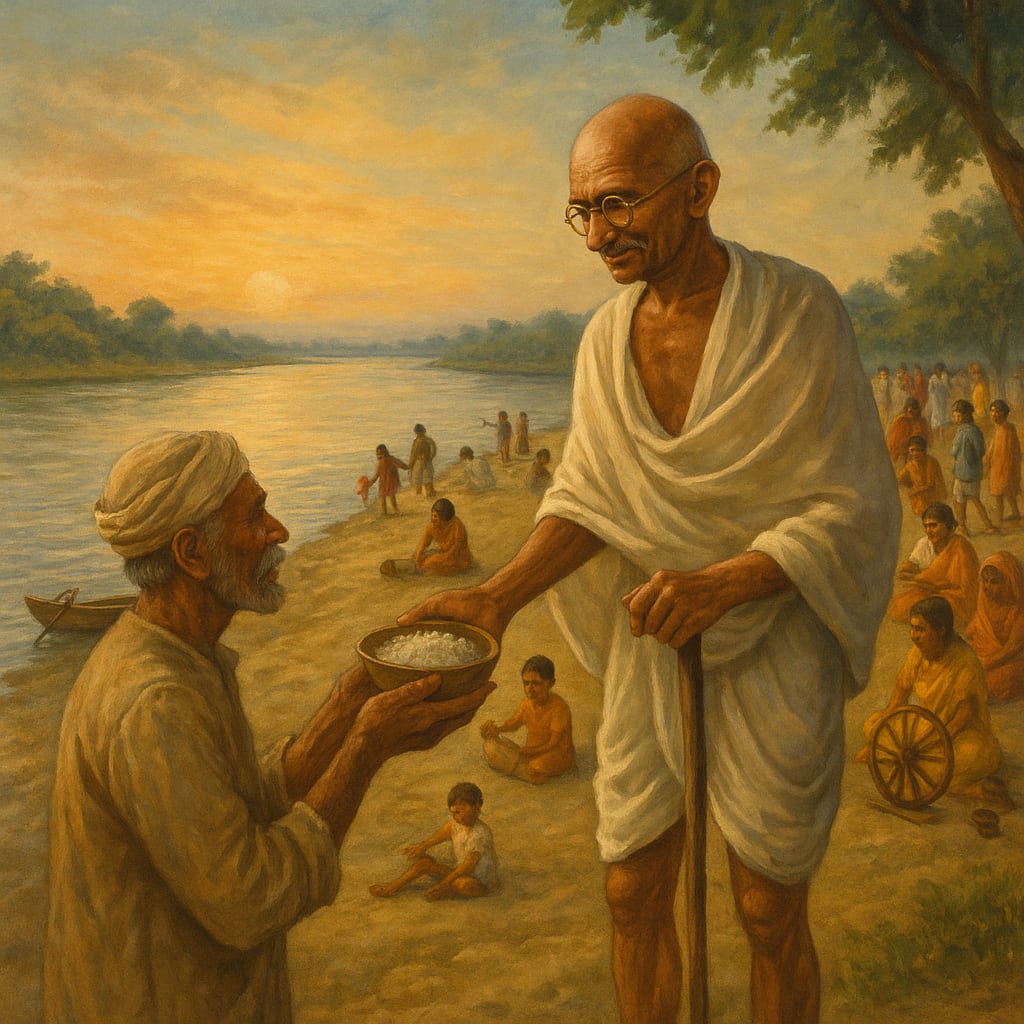
May 30, 1930 – On the Banks of the Narmada
Today, I walked for several hours along the banks of the sacred Narmada River. Its water, though quieter than the sea, carries a different strength—steady, persistent, impossible to halt. Much like our struggle. It was still early, but already the banks had begun to fill with people. Some came barefoot from nearby villages, others had walked all night from distant hamlets. They came not to protest loudly, but to sit, to listen, to prepare.
They brought with them bundles: homespun cloth, vessels of water, hand-ground salt, stories. Always stories.
A fisherman—his face weathered, his voice low—offered me a bowl of rice wrapped in a banana leaf. “For strength, Bapu,” he said. I accepted it with gratitude, though I reminded myself again: it is not just food, but a gesture, a thread in the fabric of resistance. These acts, humble and unseen by history’s grand lens, are the ones that sustain us. They remind me that our movement is not built on grand speeches or singular moments, but on the quiet persistence of those who have nothing, yet give everything.
The British authorities have intensified their campaign. In several nearby towns, they have begun seizing spinning wheels and cloth. I received word that in one village, even a child’s toy charkha was confiscated. How afraid they must be, to tremble before a spinning child! But what they do not understand is that the charkha is not just a tool—it is a prayer in motion, a symbol of a future made with our own hands.
As repression sharpens, resilience deepens.
This morning, I sat with a group of village midwives beneath a tamarind tree. Their hands, lined with the creases of countless births, spoke of endurance. One of them, older than most, looked at me directly and said:
"If we wish to birth a free India, we must raise it from the first breath. Ahimsa must begin before the child learns fear."
Her words rang louder in me than any slogan. I thought of how our mothers have always held this land together—feeding it, mourning over it, and now, leading it forward with quiet courage.
Later, I saw a young boy, perhaps ten years old, with a cloth pouch tied to his waist. When I asked what he carried, he opened it solemnly to show me a collection of white stones—salt, he had said, gathered from the dry river basin. His face bore the pride of a freedom fighter twice his age.
"If they take mine," he said simply, "I will find more."
What words could I offer him in reply? He had already understood the essence of resistance. That courage is not loud. It is steady. It walks barefoot with a pouch of salt and does not flinch.
That evening, villagers gathered for a spinning circle by torchlight. Flames danced in the breeze, throwing long shadows on the ground. We sat on woven mats and spun thread in silence. A conch shell marked each hour. Someone sang a bhajan, and others joined, weaving melody with memory. There was no leader, no script, no orders. Only a rhythm of unity.
One woman, blind in one eye, spun faster than anyone. I asked her how she found her pace. She said, “I listen to the river.” I believed her.
As night fell, I returned to my resting place on the edge of the village. I could still hear the Narmada murmuring. A line from the Upanishads came to me—“From the unreal lead me to the real, from darkness lead me to light.” This struggle is not only for the right to make salt or spin cloth. It is a return to what is real. A return to self-reliance, to courage, to a sense of shared destiny.
Let the British fear our wheels. Let them outlaw our salt, seize our homespun, silence our songs. They cannot unspin what has already taken root in the hearts of our children, our elders, our riverside midwives.
We are a current now. The Narmada flows, and so shall we.
Tomorrow, we march again.
M.K. Gandhi
About the Creator
Alain SUPPINI
I’m Alain — a French critical care anesthesiologist who writes to keep memory alive. Between past and present, medicine and words, I search for what endures.
Keep reading
More stories from Alain SUPPINI and writers in Chapters and other communities.
Mastering French Without Losing Your Sanity: A Realistic Guide for Beginners
Learning French can feel like solving a Rubik’s Cube blindfolded. The tricky pronunciation, the never-ending grammar rules, and the surprising exceptions make it seem impossible. But don’t worry—equipping yourself with key expressions and effective strategies can turn frustration into fluency. Let’s simplify French and make learning enjoyable.
By Alain SUPPINIExclusive • 11 months ago
Bruce Lee and The God of War: Kuan Ti
It starts with love.. The Power to the God Of War and Wealth Walk into a Chinese restaurant (even in Oklahoma, USA), a Chinese police station, a kung fu martial arts studio or even a Chinese temple and you often see a red faced warrior holding a heavy quan-do (spear like weapon).
By WILD WAYNE : The Dragon King11 days ago in Chapters
The Ritual of Demand, Chapter Two
The subsequent phases of the solar cycle saw a tremendous change in Flashpower. He was a happier and more confident Mini-Flash all round. He lost his wan distracted look and his cheeks flushed with colour, the freckles on his snub nose standing out boldly. In class he could concentrate again, and his grades began to improve. Even his Flashball picked up a little, and when someone got the better of him he started taking it as any boy would, instead of getting his knickers in a twist. The adult Flashes all agreed Flashpower was finally getting the hang of being the age he was.
By Doc Sherwood6 days ago in Chapters




Comments
There are no comments for this story
Be the first to respond and start the conversation.