
Journal of Mohandas K. Gandhi
Chapter 19 : The Seeds of Harvest

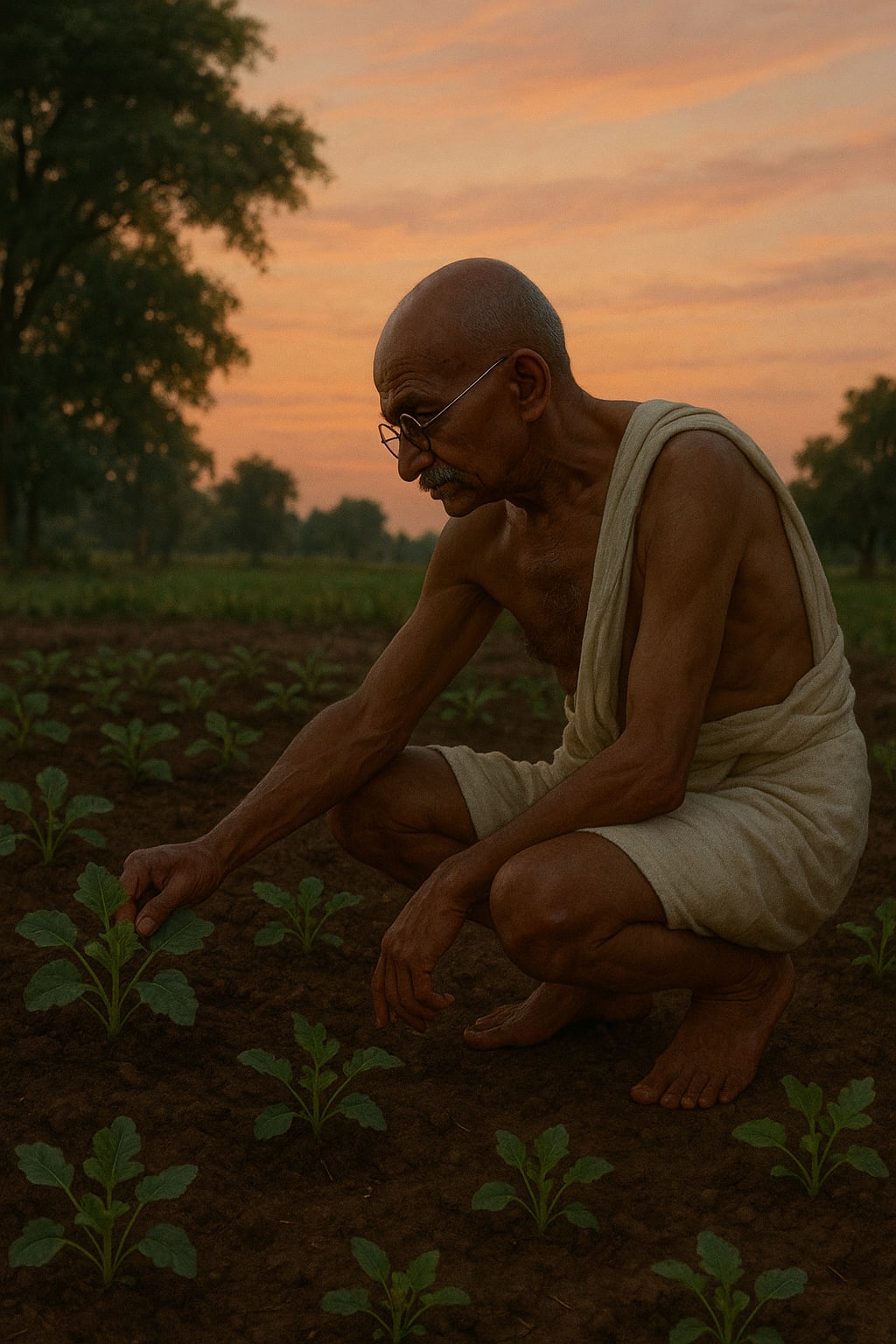
April 30, 1931 – Near the Village of Kalol, Gujarat
The soil is soft between my fingers this morning. I rise before the sun, the stars still winking overhead, and step barefoot into the small garden the villagers have let me tend while I stay here. It is not a grand field. It grows no great bounty. But in the gentle sprouts of okra, mustard greens, and tuvar dal, I see the rhythm of service, of dharma. The earth, humble and enduring, reminds me of our people—trod upon, yet full of life.
As I kneel, tilling the ground with slow, deliberate care, a boy named Pintu runs up with a bundle of letters. His bare feet kick up little puffs of dust as he grins at me. His mother tells me he now rises before dawn just for the honor of being our village’s courier. His pride in this simple duty gives me more joy than the contents of any missive.
One letter, from Madras, burns quietly in my hand. Students there have refused to sing “God Save the King” in their schools. Instead, they stand in respectful silence. No chants. No banners. Just the quiet resistance of the upright spine. In that moment, I imagine classrooms across the subcontinent where silence becomes a storm. How powerful a refusal can be when it is wrapped in dignity.
After spinning and prayer, I walk with the children to the well. The water glimmers with early morning light, and the sound of the rope creaking on the pulley merges with their laughter. Meena, always solemn for her years, tells me she no longer accepts sweets wrapped in British paper. “They taste of blood, Bapu,” she repeats. I try not to let the tears reach my eyes. It is one thing for adults to understand suffering. Another entirely for children to resist its seduction.
In the late morning, I sit beneath the mango tree with the local farmers. Their palms are calloused, their eyes sun-worn. But they speak with uncommon warmth. They are organizing a shared sowing of the fields this season. Some have no seed, others no oxen. But together, they will harvest. “When we spin together in the evenings, our tempers calm,” says Mohanlal, the oldest among them. “Even our animals feel it.”
I note how often the charkha has become not just a tool, but a medicine. Its turning wheel replaces the turning of angry thoughts. Its rhythm steadies the hand and the heart. In its silent song, there is room to think, to breathe, to imagine.
A merchant from Baroda visits me in the afternoon. He speaks in hushed tones of a possible revision to the salt law. The British, he says, may consider easing restrictions in some rural areas. I smile gently but do not rejoice. The empire, when it gives, does so with one hand while the other reaches behind your back. Still, even a crack in granite is the beginning of collapse.
As twilight descends, the lanterns flicker to life. I sit at a wooden desk by the window, the scent of neem oil and wood smoke swirling in the air. In the distance, the women’s evening songs rise like incense—soft, slow, full of weariness and strength. Their voices remind me of rivers finding their path through stone.
Before retiring, I walk once more through the garden. The tiny plants stretch toward the moonlight. Tomorrow, they will be taller. Tomorrow, they will lean toward the sun.
And so will we. India is waking—not with fire, but with breath. Not with blood, but with soil. Not with swords, but with salt, thread, silence.
Our roots are deepening. The fruit will come.
M.K. Gandhi
About the Creator
Alain SUPPINI
I’m Alain — a French critical care anesthesiologist who writes to keep memory alive. Between past and present, medicine and words, I search for what endures.
Keep reading
More stories from Alain SUPPINI and writers in Chapters and other communities.
Mastering French Without Losing Your Sanity: A Realistic Guide for Beginners
Learning French can feel like solving a Rubik’s Cube blindfolded. The tricky pronunciation, the never-ending grammar rules, and the surprising exceptions make it seem impossible. But don’t worry—equipping yourself with key expressions and effective strategies can turn frustration into fluency. Let’s simplify French and make learning enjoyable.
By Alain SUPPINIExclusive • 11 months ago
Overexposure
There is a point in the ascent where the brightness stops illuminating and starts burning. It happens gradually, then all at once — the moment when the light that once felt like clarity becomes something harsher, sharper, more invasive. This is the stage of the upward weather I call overexposure.
By Elisa Wontorcik2 days ago in Chapters
Ludacris and Nelly draw backlash over bookings at MAGA-coded music festival
Ludacris and Nelly headlining a mostly right-wing event is good for them. It’s also great for the genre of hip hop. The two rap veterans have showcased their talents on other stages. Why can’t they perform for mostly MAGA folks and grab that bag?
By Skyler Saunders3 days ago in Beat


Comments
There are no comments for this story
Be the first to respond and start the conversation.