
Einstein Remains in Europe
Chapter 6 : Echoes Through the Iron Curtain

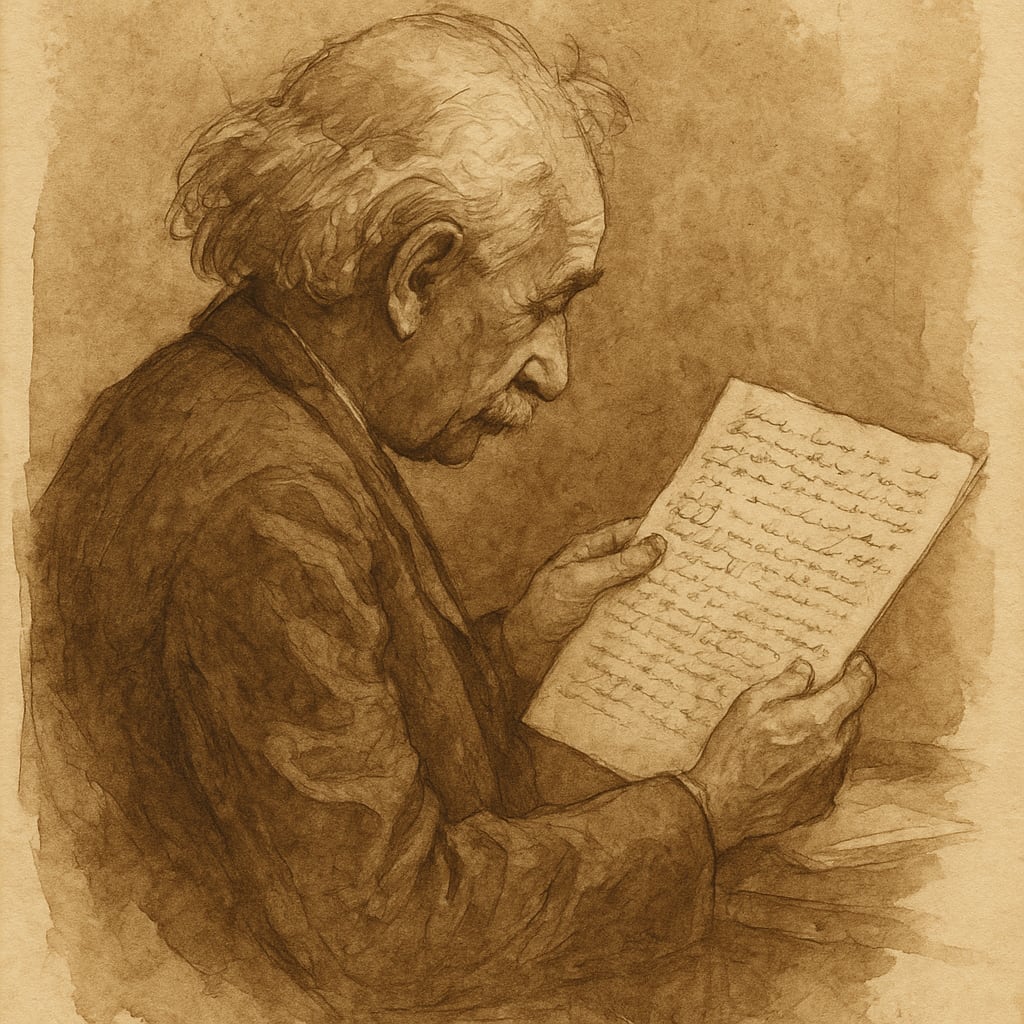
May 22, 1942
Prague
The weight of war settled heavily upon the continent, and yet, from within the embers of ruin, a new kind of light flickered. Einstein had not merely survived in Europe—he had become a guiding constellation in a night otherwise starless.
From his modest residence in neutral Prague, Albert continued to operate an informal institute of correspondence. The war had forced many physicists into silence or exile, but he turned to the written word—penning letters that defied borders. His essays, disguised as neutral scientific commentaries, traveled like whispers sewn into international journals. What seemed on the surface to be musings on spacetime or statistical mechanics were, in truth, encrypted calls for intellectual resistance.
Young minds listened. In Warsaw, Kraków, and even behind the thickening wall of the Reich, students gathered secretly to read his works. One such group, calling themselves Die Freien Gleichungen—The Free Equations—crafted clandestine seminars. They studied relativity not merely as physics but as philosophy: a universe governed not by dominance but by curvature and cooperation.
Einstein, meanwhile, found allies among the few still willing to risk collaboration. Niels Bohr, though shadowed in Denmark, managed sporadic contact. Together, they designed a theoretical framework for peaceful atomic energy—one that emphasized containment, not explosion. Their vision: an atomic reactor that would serve cities, not armies.
The Vatican, alarmed by rising nationalist science, extended cautious diplomatic channels. A Jesuit astronomer, Father Matteo Rosini, visited Einstein under the guise of academic exchange. In truth, they spoke of civilization's survival. “Faith,” Einstein wrote later, “may reside in belief or in inquiry—but either path must stand against cruelty.”
Not all communications went unnoticed. By June, German agents had begun intercepting Einstein's letters. The Gestapo, ever aware of the power of the mind, added his name to their list. But the Nazis could not comprehend his influence—he was not fomenting rebellion in the trenches, but in the chalk-stained minds of physicists, students, and silent clerks.
Then came the Prague Lecture.
Smuggled in pieces via underground couriers and translated across a dozen dialects, Einstein’s address—delivered from the living room of a modest Czech home—spread like lightning. Recorded via phonograph, it bore a single message:
"No equation mandates subjugation. No theorem justifies tyranny. Let those who manipulate the atom for harm know this: the arc of energy must serve life, or be shattered by it."
Though his voice was soft, the echo was enormous. In resistance circles across Europe, the Prague Lecture became a kind of scientific manifesto. Graffiti quoting its lines appeared in Warsaw, Paris, even Munich. His words adorned the walls not of laboratories, but of tenements and tunnels.
One week later, a young German soldier—once a physics student—defected. He carried in his coat a scribbled version of Einstein's lecture and a plea: “I fight no longer.”
Einstein’s peaceful front now had its own deserters.
The Allies, meanwhile, had taken note. In London, exiled scientists begged the British Cabinet to extract Einstein before the Gestapo moved. But Albert refused. “What I do now,” he told them in code, “must be done here, under the shadow of those who fear it most.”
He knew the endgame was approaching. Soon, the great powers would seek to harness the atom. Whether for war or wonder, he did not yet know. But in quiet rooms, by candlelight, in the cracked libraries of war-torn cities, ideas were catching fire.
And across Europe, the name Einstein had come to mean something far greater than a man. It meant a refusal to let intellect bow to terror. It meant that even in a world crumbling to war, reason could yet resist.
About the Creator
Alain SUPPINI
I’m Alain — a French critical care anesthesiologist who writes to keep memory alive. Between past and present, medicine and words, I search for what endures.
Keep reading
More stories from Alain SUPPINI and writers in Chapters and other communities.
Mastering French Without Losing Your Sanity: A Realistic Guide for Beginners
Learning French can feel like solving a Rubik’s Cube blindfolded. The tricky pronunciation, the never-ending grammar rules, and the surprising exceptions make it seem impossible. But don’t worry—equipping yourself with key expressions and effective strategies can turn frustration into fluency. Let’s simplify French and make learning enjoyable.
By Alain SUPPINIExclusive • 11 months ago
Fair Exchange, No Robberies
Dark Memoirs - Index There are at least two kinds of people in the world: those who write this half-arsed kind of intro to a story that looks to separate the rare and the norm, and those who realise it's an overused framing device and don't.
By Paul Stewart12 days ago in Chapters
Free Hobby Means What
As we look at the life we live and the hobbies we have in them do we ever wonder if the hobbies we are doing are free ones? What are free hobbies exactly? Is there such a thing as free hobbies and if so what are they? Free hobby means putting everything you have into the hobbies that you have and making them a part of your life and with that your life and hobbies are free for you and the people around you. Free hobby can mean a number of different things, it can mean your hobby doesn’t cost money or it can free your mind and soul so that you can relax throughout whatever hobby you are doing. Free hobby means doing the hobbies you enjoy and letting your mind go as you are doing them. The more you do this while doing the hobbies that you enjoy the more free the hobby will be for you. Hobbies are meant to relax you in life. So it doesn’t cost money and it can relax your mind, body and soul, isn’t that what all hobbies are supposed to do?
By Louise Barraco7 days ago in Chapters


Comments
There are no comments for this story
Be the first to respond and start the conversation.