
Einstein’s Choice
Chapter 5: Shadows Over Prague

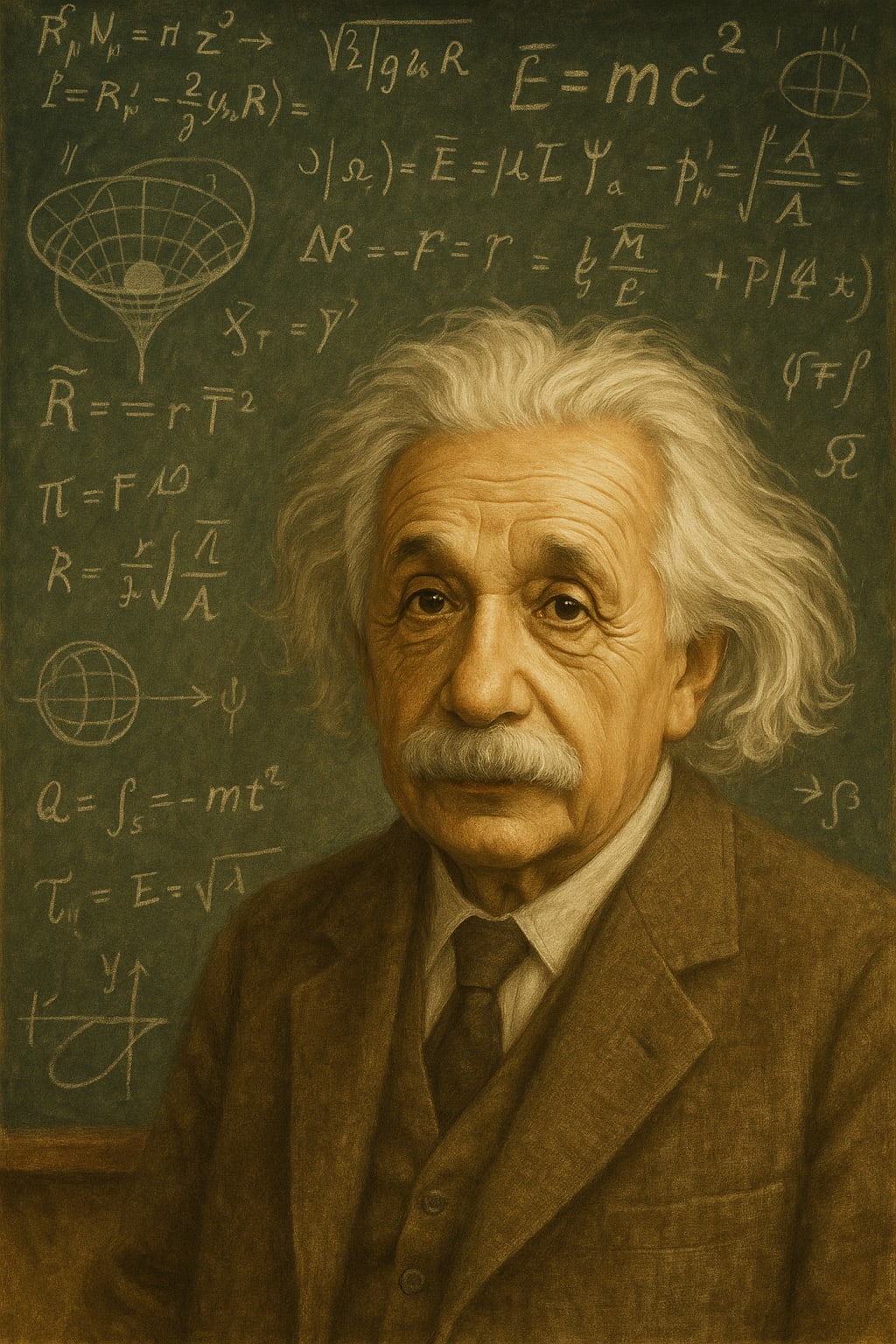
May 18, 1935
Prague
I arrived in Prague under a veil of unease. The city, a cradle of intellect and resistance, shimmered beneath gray spring clouds, its spires rising like quills of memory against the troubled European sky. I had been invited to address the philosophical faculty at Charles University, ostensibly to discuss the intersection of physics and ethics — but all of us knew there was something deeper at stake.
The rise of fascism was no longer a shadow in Germany alone. It crept like mold across Europe, twisting truth, strangling dissent, and fueling the machinery of hate. From the podium that afternoon, I looked out upon faces young and old, some wide-eyed with hope, others furrowed with worry. I spoke of relativity, yes — but also of responsibility.
“It is not the equations alone that define our world,” I said. “It is what we choose to do with the knowledge we uncover. Science divorced from conscience is the most dangerous force imaginable.”
I quoted Spinoza. I invoked Gandhi. And I ended with a quiet plea: that students and professors alike hold fast to truth, even as it grows inconvenient.
Afterward, a young man approached me, his Czech accent thick, his eyes fevered with urgency. “Professor Einstein,” he said, “we are organizing to resist. Not only in academia, but in the streets. Can we count on you?”
I did not hesitate. “Yes,” I said, though my heart fluttered with uncertainty. I had chosen to stay in Europe. I would not watch it collapse without raising my voice—and, if necessary, my hands.
That evening, I met with organizers in a candlelit cellar beneath a bookstore in Malá Strana. They had plans—discreet publications, secret lectures, coded networks linking students in Prague, Vienna, Warsaw. They called it Projekt Svetlo — Project Light.
I offered to contribute essays and lectures. More than that, I offered shelter in my small house outside Brno, a place to hide those pursued by the Gestapo or the Hlinka Guard. I knew this would draw attention. But I also knew that silence would make me complicit.
In the weeks that followed, I wrote feverishly. Not only physics, but letters to scientists, rabbis, bishops, and writers across Europe. I urged them to stay. To fight not with bombs but with truth, unity, and the stubborn refusal to lie.
Some replied with courage. Others with despair. A few with warnings.
“Albert,” Max Born wrote, “your resolve is admirable. But they will come for you. Are you prepared for that?”
I was not sure. But I remembered a line I had once read in Hebrew scripture: “Justice, justice shalt thou pursue.” It did not say justice would be comfortable—or safe.
On May 25th, I learned that German authorities had raided the home of a Jewish physicist in Leipzig. His work confiscated. His family imprisoned. His name was on a list I had seen. My name, too, was on that list.
That night, I took my violin down from the shelf. I played not Bach, nor Mozart, but a tune I had learned from a Czech child who had come through Brno—a folk song, plaintive and cracked with longing. I thought of Anna, my first love. Of Mileva. Of my lost children. Of time itself, stretching like a string across a violin’s arc.
In the echo of that song, I understood something simple: that truth without witness fades. That silence is the last victory of the tyrant.
So I would not be silent.
Tomorrow, I return to Berlin—not as a citizen of fear, but as a scientist who will speak, again and again, until the walls themselves are made to listen.
— Albert Einstein
About the Creator
Alain SUPPINI
I’m Alain — a French critical care anesthesiologist who writes to keep memory alive. Between past and present, medicine and words, I search for what endures.
Keep reading
More stories from Alain SUPPINI and writers in Chapters and other communities.
Mastering French Without Losing Your Sanity: A Realistic Guide for Beginners
Learning French can feel like solving a Rubik’s Cube blindfolded. The tricky pronunciation, the never-ending grammar rules, and the surprising exceptions make it seem impossible. But don’t worry—equipping yourself with key expressions and effective strategies can turn frustration into fluency. Let’s simplify French and make learning enjoyable.
By Alain SUPPINIExclusive • 11 months ago
Fair Exchange, No Robberies
Dark Memoirs - Index There are at least two kinds of people in the world: those who write this half-arsed kind of intro to a story that looks to separate the rare and the norm, and those who realise it's an overused framing device and don't.
By Paul Stewart12 days ago in Chapters
A Dart at Dusk
Seconds ago, the sullen sun set on the two of us… my exuberant furry companion and me. A fresh breeze embraces us, delivering welcome relief from the day’s oppressive heat. His typical stumbling and staggering along — apace with a sloth — has turned into trip-trapping, high-stepping, almost skipping along.
By Angie the Archivist 📚🪶3 days ago in Petlife



Comments (1)
The call to resist fascism in Europe was powerful. You showed real courage, Einstein. Staying in Europe to fight against the rise of fascism was a bold and noble choice.