
Einstein in Europa
Chapter 4: The Prague Concord

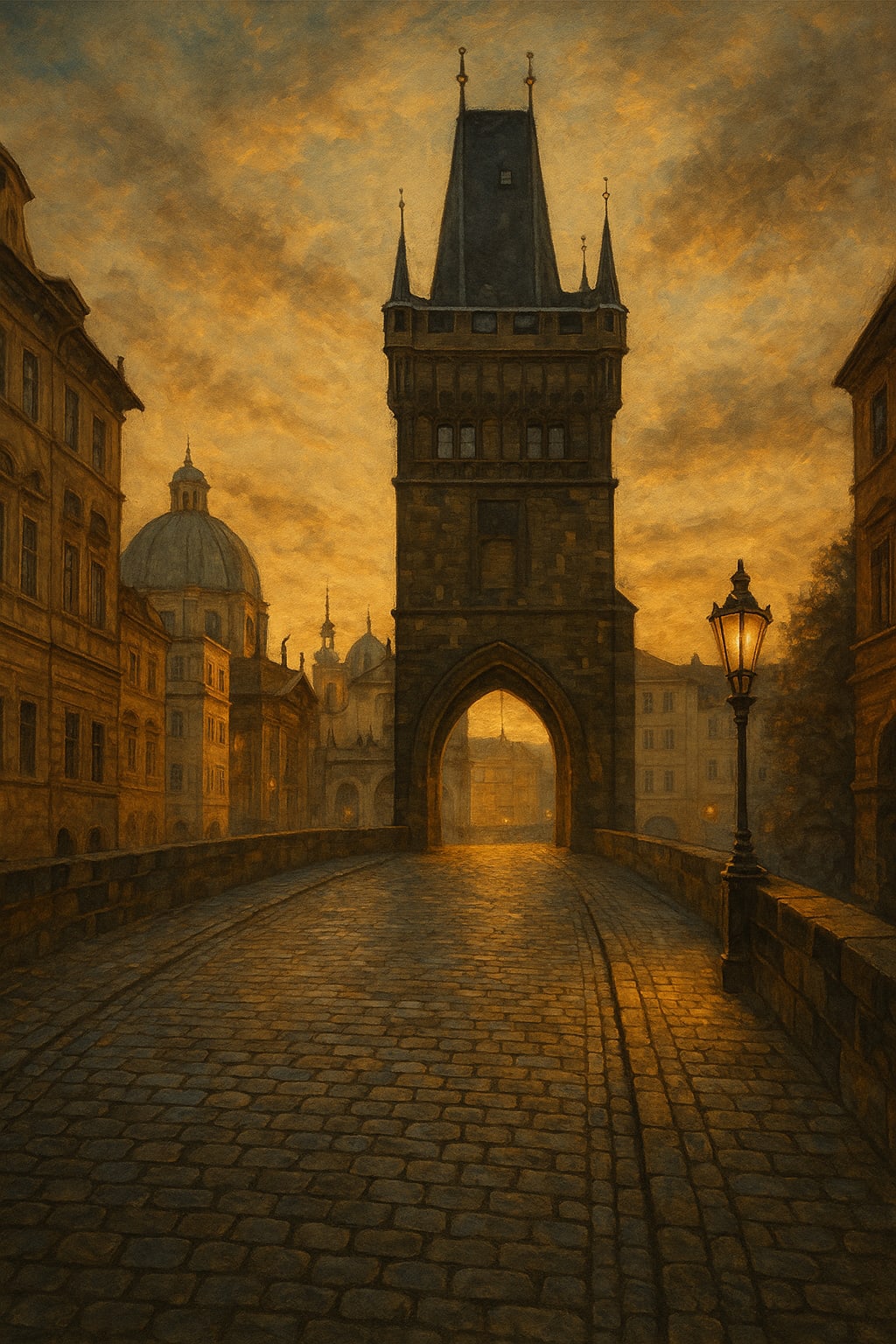
May 12, 1935
Prague, Czechoslovakia
I arrived in Prague just before dusk, the air thick with lilac and the memory of rain. The Vltava flowed like molten silver beneath the bridges, and the rooftops, slick from earlier showers, glistened under a hazy sun. Prague has always felt like a city suspended between times—Gothic spires reaching for the heavens and Kafkaesque alleyways pulling you inward, toward thought, toward unease. It felt fitting that such a place would become the cradle of a quiet resistance.
I came not as a physicist, but as a courier of ideas and alliances. My days at the Kaiser Wilhelm Institute were behind me. The black boots of Nazism had crushed the soil of German academia. The new world order they sought was built on the bones of books and the burning of minds. I had no army, no party, no nation even. But I had pages, ink, and the undeniable urgency of truth.
President Edvard Beneš agreed to meet me in private, far from the scrutiny of embassies or press rooms. We gathered at a villa nestled in Bubeneč, where chestnut trees flowered defiantly beside iron gates. The drawing room was silent but for the ticking of a modest Czech clock. I handed him the document I had brought: a draft of what I hoped would become The Prague Concord—a charter of intellectual and moral alliance among Europe’s democratic enclaves.
“We are not speaking of war,” I told him. “We are speaking of preservation. Of ideas. Of people who must not vanish behind barbed wire or beneath banners.”
Beneš, always thoughtful, leaned back. “You ask for something very delicate, Herr Professor. Not military intervention, not diplomacy—something deeper. Conscience as policy.”
I nodded. “Exactly. Let conscience be the cornerstone of this century. If we cannot act yet with tanks, we must act with sanctuary. For the mind. For the soul.”
The Concord proposed three key principles: first, the academic and cultural sanctuaries for persecuted scholars and thinkers; second, a shared denunciation of fascist pseudoscience and propaganda; third, the moral obligation of democratic governments to protect, at all costs, the dignity of the individual.
The president read every line. Then again. Then, slowly, he took his pen.
It was the first signature. There would be more.
That evening, I gave an address at Charles University. Word had spread through the faculty. Despite warnings from the German embassy, the auditorium filled. There were students—young men and women who should have been worried about exams and lovers but were instead watching their world unravel. I spoke without notes.
“I do not ask you to march,” I told them. “I ask you to think. Think freely. Think bravely. And if the time comes, act as if truth were a flame you must carry through the dark. The lie is louder. But it cannot outlast the patient fire of the mind.”
There was silence. Then applause—not thunderous, but trembling and true.
Afterward, in a quiet café just off Staroměstské náměstí, I met with a group of Czech scientists and German expatriates. We shared bread, black coffee, and blueprints for the future. An idea emerged that night, whispered between gulps of anxiety: a university without borders. A network. A hidden fellowship of European institutions pledging refuge to those expelled from their homelands. An invisible campus stretching from Geneva to Stockholm to Lisbon.
We would call it The Free Minds Alliance.
I walked back across the Charles Bridge after midnight, the cold air stinging my cheeks. The river below reflected the stars as if they, too, sought asylum. On the other side, a violinist stood alone beneath a gas lamp, playing Dvořák’s “Songs My Mother Taught Me.” I stood still and listened.
It is moments like this that remind me: brutality may win battles, but it cannot compose symphonies.
There is still beauty. Still memory. Still resistance.
Postscript: The Prague Concord was signed by six universities and two national governments by year’s end. Though symbolic, it marked the beginning of a moral coalition that would later shelter thousands of dissidents and displaced scholars. For Einstein, it was a personal turning point: from exile to architect of quiet revolution.
About the Creator
Alain SUPPINI
I’m Alain — a French critical care anesthesiologist who writes to keep memory alive. Between past and present, medicine and words, I search for what endures.
Keep reading
More stories from Alain SUPPINI and writers in Chapters and other communities.
Mastering French Without Losing Your Sanity: A Realistic Guide for Beginners
Learning French can feel like solving a Rubik’s Cube blindfolded. The tricky pronunciation, the never-ending grammar rules, and the surprising exceptions make it seem impossible. But don’t worry—equipping yourself with key expressions and effective strategies can turn frustration into fluency. Let’s simplify French and make learning enjoyable.
By Alain SUPPINIExclusive • 11 months ago
Firebug: Chapter 17 - Out
Theo didn't have time to think. He didn't even have time to scream. The sound was stuck sideways in his throat anyway, refusing to be dislodged. His body acted all on its own, launching him across the dance floor toward the pool. Not caring how many of his classmates he had to knock over or shove out of the way to get there. By the time his brain caught up to his body, Theo was diving head-first into that glittering, dark blue abyss.
By Natalie Gray3 days ago in Chapters


Comments
There are no comments for this story
Be the first to respond and start the conversation.