
Atlantis: The Sunken Mystery of a Lost Civilization
Exploring the Legend, Theories, and Enduring Fascination With the World's Most Famous Lost City
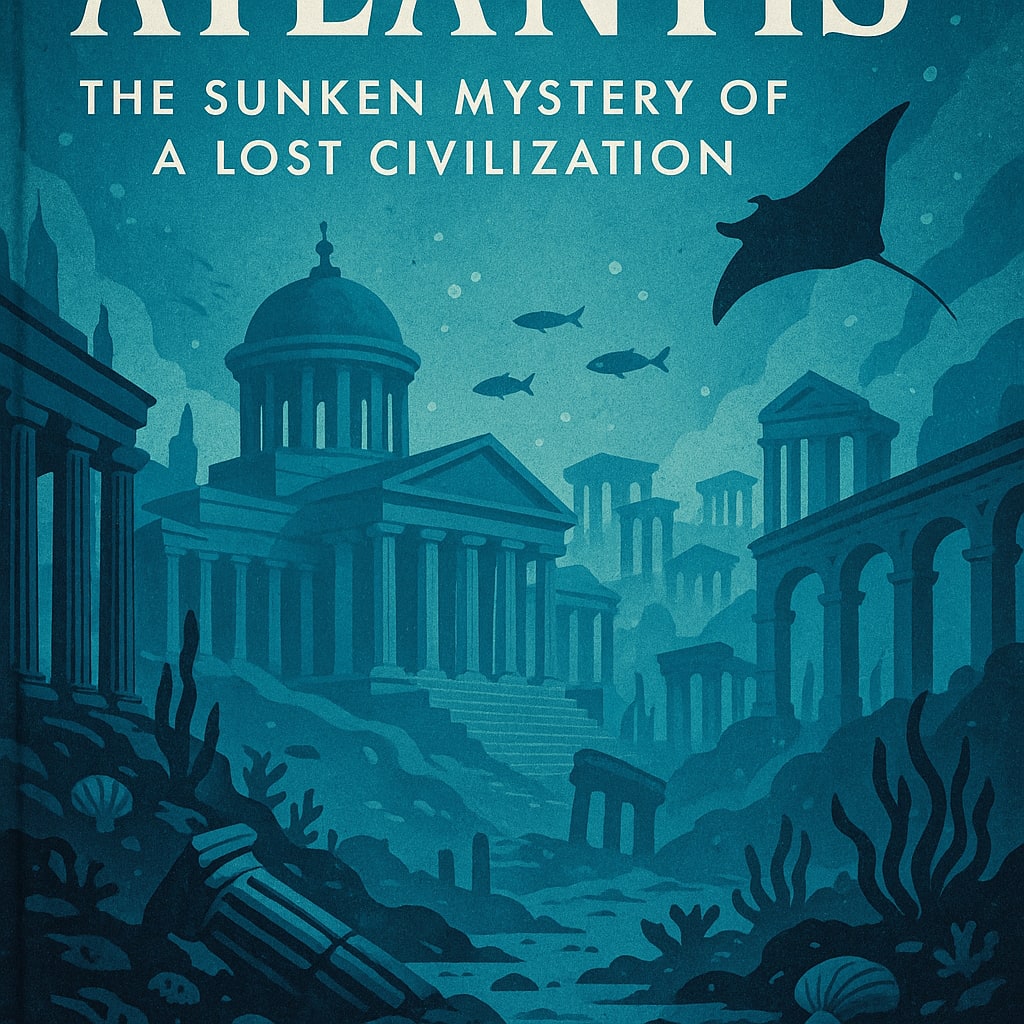
For over two millennia, the legend of Atlantis has captured the imagination of philosophers, explorers, historians, and dreamers. First mentioned by the Greek philosopher Plato in 360 BCE, Atlantis was described as a powerful and advanced island civilization that disappeared into the sea “in a single day and night of misfortune.” Was Atlantis a real place? A moral allegory? A memory of an ancient catastrophe? Or merely a myth?
Despite centuries of debate and countless theories, the truth about Atlantis remains as elusive as ever. Yet, its story endures, not just because of the mystery, but because it speaks to something deep within us—our desire to discover, to explain the unexplained, and to find lost worlds that may connect us to forgotten truths.
The Origin of the Legend
The story of Atlantis appears in Plato’s dialogues Timaeus and Critias, where the philosopher describes a mighty empire located beyond the "Pillars of Hercules" (widely believed to be the Strait of Gibraltar). According to Plato, Atlantis was larger than Libya and Asia combined, rich in resources, advanced in architecture, and ruled by kings descended from the god Poseidon.
Plato claims Atlantis waged war against the known world but eventually fell out of favor with the gods due to its moral corruption. As a result, the entire island was swallowed by the ocean in a single catastrophic event.
It’s important to note that Plato presented Atlantis as a cautionary tale—a narrative about the dangers of hubris and the moral decay of civilizations. But whether he based it on a real place or intended it purely as a philosophical metaphor is a question that still divides scholars.
The Theories: Was Atlantis Real?
Over the centuries, countless theories have emerged trying to locate Atlantis. Some of the most popular include:
1. The Minoan Civilization (Crete and Santorini, Greece)
Many historians believe Plato may have been inspired by the Minoans—a real, advanced Bronze Age civilization that flourished on the island of Crete and nearby Santorini. The Minoans built complex cities and had a powerful navy. Around 1600 BCE, the volcanic eruption of Thera (modern-day Santorini) triggered a tsunami and ashfall that devastated the region. This natural disaster could have inspired Plato’s tale.
2. Antarctica Theory
Some fringe theorists suggest Atlantis lies beneath modern-day Antarctica, covered by ice after a shift in the Earth’s crust. This theory, though lacking scientific support, remains popular among those who believe in hidden ancient technologies.
3. The Azores and Atlantic Ocean Hypothesis
Others believe Atlantis was located somewhere in the mid-Atlantic near the Azores Islands. This idea aligns with Plato’s reference to a powerful kingdom beyond the Pillars of Hercules, but no credible archaeological evidence has been found to support this claim.
4. Plato's Pure Allegory
Many academics argue that Atlantis never existed at all. They believe Plato invented the story to illustrate philosophical and political lessons about ideal societies, much like Thomas More’s Utopia centuries later.
Why We’re Still Fascinated
Regardless of whether Atlantis was real, its enduring appeal is undeniable. It combines elements of mythology, archaeology, lost history, and even science fiction. Its allure lies in its mystery: a highly advanced civilization, perhaps more sophisticated than our own, wiped out by natural catastrophe or divine punishment.
Atlantis has inspired explorers like Christopher Columbus, novelists like Jules Verne, and modern filmmakers. Its legend is embedded in popular culture, from Disney’s Atlantis: The Lost Empire to conspiracy theories involving aliens and underwater ruins.
But Atlantis also taps into something primal. It's the ultimate "what if"—what if knowledge was lost? What if history is incomplete? What if something powerful and beautiful existed before us and was simply erased by time and nature?
Modern Explorations and Pseudoscience
Despite mainstream skepticism, modern technology has fueled renewed interest in underwater archaeology. From satellite imaging to sonar scans of the ocean floor, researchers continue to investigate mysterious underwater formations.
Some pseudoarchaeologists have even claimed to discover Atlantis in places like Cuba, Spain, or the Caribbean. These claims often gain viral attention but rarely withstand scholarly scrutiny.
Still, these modern “discoveries,” regardless of credibility, prove one thing: the legend of Atlantis still has the power to inspire exploration and curiosity.
Conclusion: A Legend That Refuses to Sink
Whether Atlantis was a real civilization, a poetic metaphor, or a combination of both, it has become more than just a story. It’s a cultural mirror reflecting our fears, hopes, and the eternal human urge to search for meaning in the unknown.
Atlantis may never be found beneath the waves, but its legacy lives on—in literature, art, film, and the hearts of those who believe that some mysteries are too powerful to fade.
And maybe that’s the real treasure of Atlantis—not in its gold or lost knowledge, but in its ability to keep us wondering.
About the Creator
Keep reading
More stories from Anwar Jamil and writers in Chapters and other communities.
Into the Unknown: The Bermuda Triangle Enigma
For decades, the Bermuda Triangle has captivated imaginations around the globe. Situated in the western part of the North Atlantic Ocean, this mysterious region—bounded roughly by Miami (Florida), Bermuda, and San Juan (Puerto Rico)—has become infamous for the unexplained disappearances of ships and aircraft. Often nicknamed “The Devil’s Triangle,” it’s a place where navigational tools go haywire, distress signals are never heard, and vessels simply vanish without a trace.
By Anwar Jamil9 months ago in Chapters
Brass Ring Interlude 5: The Importance of Being Earnest
Fleaboy jumped between buildings. He liked that Overton didn’t have any skyscrapers; it made his particular mode of travel that much easier. He liked the wind rushing through his hair; he had even designed his mask so that he could feel the wind as he jumped, and had to keep his hair at a very specific length (too long and it whipped in his face, too short and he missed the sensation). He flipped with every jump so he could see if someone was in trouble. Fortunately, today was mostly boring. Weird, considering the panic the capes community is in.
By Jamais Jochim5 days ago in Chapters
Why Didn't Anyone Tell Us
Men, move along. This is not for you. This is for the women. I was forty-five when I began menopause. It is pretty young for that to be going on in a woman’s life, but I had undiagnosed PCOS, my entire life. Thank you to all the gynecologists I had seen my entire life. That in itself should encourage women to keep seeking second opinions, especially when you are not getting correct answers or any at all.
By Alexandra Grant5 days ago in Humans



Comments
There are no comments for this story
Be the first to respond and start the conversation.