
Into the Unknown: The Bermuda Triangle Enigma
Exploring the Myths, Disappearances, and Theories Behind One of the World's Most Mysterious Regions
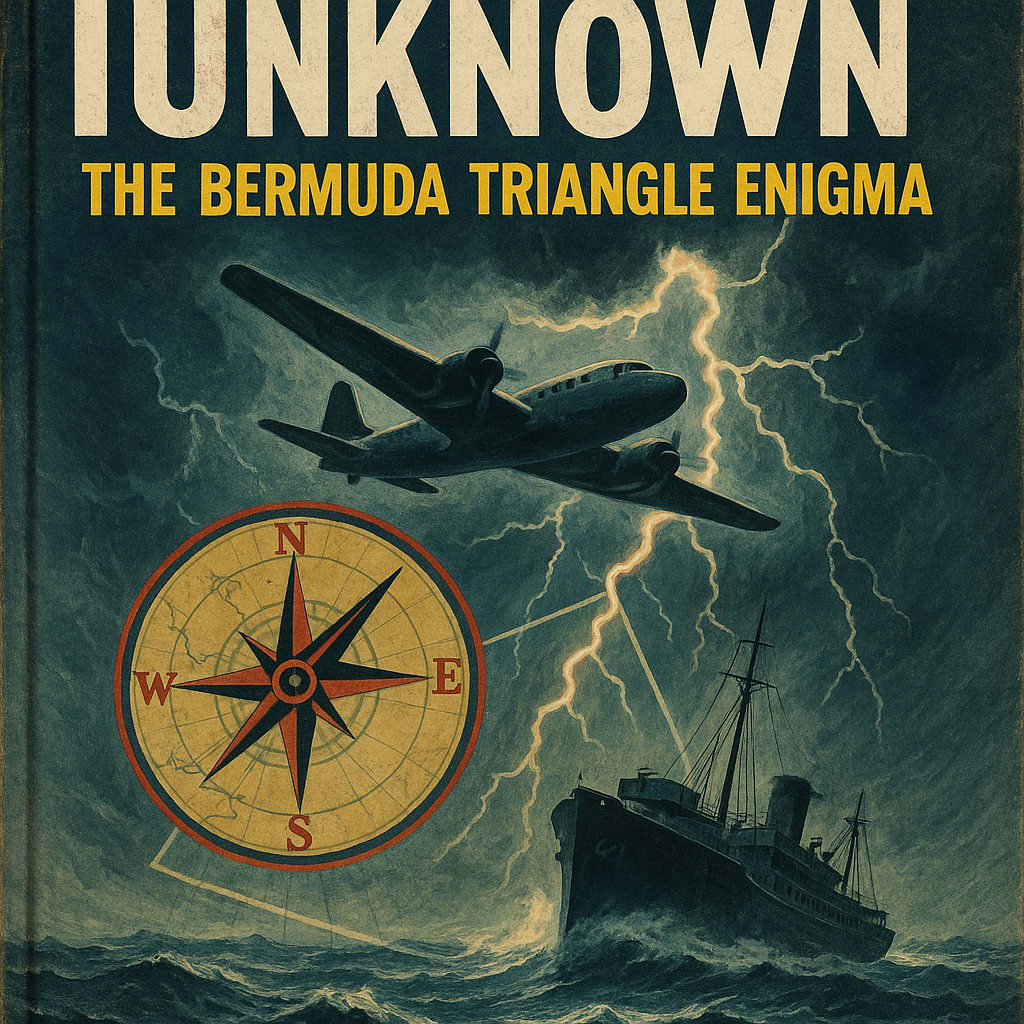
For decades, the Bermuda Triangle has captivated imaginations around the globe. Situated in the western part of the North Atlantic Ocean, this mysterious region—bounded roughly by Miami (Florida), Bermuda, and San Juan (Puerto Rico)—has become infamous for the unexplained disappearances of ships and aircraft. Often nicknamed “The Devil’s Triangle,” it’s a place where navigational tools go haywire, distress signals are never heard, and vessels simply vanish without a trace.
While many have dismissed the Bermuda Triangle as a mix of maritime myth and media sensationalism, others insist that something genuinely strange lies beneath the surface—perhaps literally. What’s true, what’s exaggerated, and what remains unknown? Let’s explore the strange phenomena that make the Bermuda Triangle one of the greatest unsolved mysteries of our time.
A History of Disappearances
The legend of the Bermuda Triangle can be traced back to the mid-20th century, although stories of strange occurrences in the area date much further back. Sailors as far back as Christopher Columbus noted unusual compass readings and mysterious lights in this region.
The legend began gaining serious traction in 1945 with the disappearance of Flight 19, a group of five U.S. Navy bombers on a training mission. All five aircraft vanished during a routine flight over the Atlantic. When a rescue plane was dispatched, it also disappeared—along with 13 more crew members. No wreckage was ever found.
This incident was widely reported and led to a flood of media coverage, followed by countless books, documentaries, and conspiracy theories. Over the years, it’s estimated that more than 50 ships and 20 airplanes have gone missing in the Bermuda Triangle under circumstances that remain unexplained.
Famous Cases That Feed the Mystery
Several notable incidents have fueled the mystique:
USS Cyclops (1918): A U.S. Navy cargo ship that disappeared with 309 crew members aboard without sending a single distress signal.
Star Tiger & Star Ariel (1948 & 1949): British passenger aircraft that vanished during flights across the Triangle with no trace or wreckage ever recovered.
SS Marine Sulphur Queen (1963): An oil tanker that vanished with 39 crew members. Only a few pieces of debris were found, and the cause remains unknown.
Each of these disappearances shares common traits—good weather, experienced crews, and no SOS calls—adding to the sense of eerie silence that surrounds the Bermuda Triangle.
The Scientific Theories
While stories of the Triangle suggest something otherworldly, science offers several plausible explanations:
Human Error: The region is one of the most heavily traveled shipping lanes in the world. Given the volume of traffic, a higher number of accidents is statistically expected.
Unpredictable Weather: The Triangle is prone to sudden storms, waterspouts, and rapid changes in weather. Rogue waves—enormous and spontaneous ocean waves—can reach heights of 100 feet and may easily sink ships.
Magnetic Anomalies: Some reports claim that compass variations in the Triangle can mislead navigators. While there are areas on Earth where magnetic north and true north align—causing navigational errors—this phenomenon isn't unique to the Triangle.
Methane Hydrate Explosions: Scientists have discovered large fields of methane gas trapped under the sea floor. If released suddenly, this gas could reduce water density and cause ships to sink rapidly. It could also stall aircraft engines.
The Theories That Cross into the Paranormal
Of course, scientific reasoning doesn’t stop the flow of more fantastic theories:
Aliens: Some believe the Bermuda Triangle is a hotspot for extraterrestrial activity or even a portal to another dimension.
Atlantis: Others link the Triangle to the lost city of Atlantis, theorizing that its advanced technology might be responsible for the strange phenomena.
Time Warps: A few theorists suggest the Triangle contains a time vortex that distorts reality and swallows anything that crosses it.
While none of these claims are supported by hard evidence, they persist in popular culture, keeping the mystery alive.
Is It Still Dangerous Today?
Despite the stories, modern aircraft and ships regularly cross the Bermuda Triangle without incident. Advances in navigation, communication, and weather forecasting have drastically reduced the risks. The U.S. government does not officially recognize the Bermuda Triangle as a hazard, and insurance companies do not charge higher premiums for travel through the area.
So, is the Bermuda Triangle truly dangerous, or is it simply a legendary reputation built on coincidence and human curiosity?
Conclusion: Mystery Meets Reality
Whether you believe the Bermuda Triangle is a magnetic vortex, a site of alien abductions, or simply a misunderstood stretch of ocean, its enduring mystery continues to fascinate. The combination of science, myth, and the ocean’s unforgiving nature makes it a powerful symbol of the unknown. Perhaps the real power of the Bermuda Triangle lies not in its ability to destroy, but in its ability to inspire imagination, exploration, and the timeless human need to seek answers where none seem to exist.
About the Creator
Keep reading
More stories from Anwar Jamil and writers in Chapters and other communities.
The Stranger Who Saved Me: A Moment of Kindness That Changed Everything
I don’t remember their name. I’m not sure I’d even recognize their face if I passed them on the street today. But there was a moment in my life when I was drowning silently—and one stranger’s kindness gave me the air I didn’t know I needed.
By Anwar Jamil8 months ago in Chapters
The First Hours of World War III
The First Hours of World War III World War III will not begin with a formal declaration, a single invasion, or a dramatic announcement on television. If it comes, it will begin quietly—through alerts, miscalculations, automated systems, and decisions made under extreme pressure. The early hours of a global war will feel confusing, fragmented, and unreal, long before the world understands what has happened.
By Wings of Time 3 days ago in Chapters



Comments
There are no comments for this story
Be the first to respond and start the conversation.