
AI Agent Receptionists in Healthcare: Transforming Patient Experience in 2025
Explore how AI agent receptionists are transforming healthcare in 2025 with 24/7 support, automation, and enhanced patient experiences.

Introduction
In 2025, AI-powered receptionists are revolutionizing healthcare, enhancing patient experience, and improving operational efficiency. These intelligent virtual assistants streamline appointment scheduling, patient inquiries, and administrative tasks, allowing healthcare providers to focus on quality care. As the demand for digital transformation rises, AI agents are becoming indispensable for hospitals and clinics worldwide.
How AI Agent Receptionists Work
AI Agent receptionists leverage Natural Language Processing (NLP) and machine learning to communicate with patients efficiently. Here’s how they function:
- Automated Appointment Scheduling: AI Assistants handle bookings, cancellations, and reschedules seamlessly.
- Smart Patient Interaction: AI agents understand and respond to queries related to doctors’ availability, insurance policies, and treatment procedures.
- EHR Integration: They synchronize patient records with Electronic Health Records (EHR), reducing manual data entry and improving accuracy.
- Multilingual Support: AI receptionists cater to diverse patient demographics by providing support in multiple languages.
Benefits of AI Receptionists in Healthcare
1. 24/7 Availability
Unlike human receptionists, AI-powered agents are operational round the clock, reducing patient wait times and improving accessibility.
2. Improved Accuracy & Efficiency
AI-driven systems eliminate human errors in appointment scheduling and medical data handling, ensuring a smooth workflow.
3. Enhanced Patient Satisfaction
AI agents provide instant responses to queries, making patient interactions faster and more personalized.
4. Reduced Administrative Burden
Healthcare staff can focus on core medical tasks while AI handles repetitive administrative duties.
Challenges & Ethical Considerations
Despite their benefits, AI receptionists pose challenges:
- Data Security Risks: Ensuring HIPAA-compliant AI models is critical to maintaining patient confidentiality.
- Lack of Human Empathy: AI cannot fully replicate human emotions, which may impact sensitive patient interactions.
- Adoption Resistance: Some patients and healthcare providers may be hesitant to trust AI with critical tasks.
Future Trends & Adoption Rate in AI Receptionists 2025
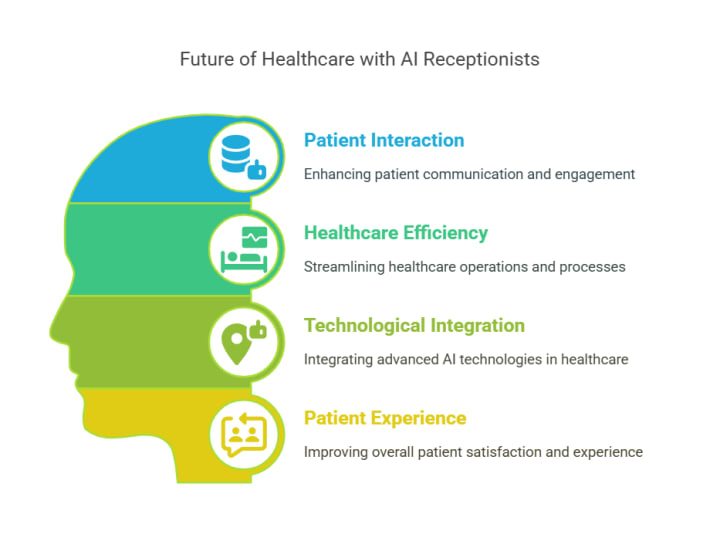
AI Receptionists in healthcare will continue evolving with:
- Advanced Sentiment Analysis: AI will better understand patient emotions to offer empathetic responses.
- Voice & Facial Recognition: Improving patient identification and verification.
- AI-Driven Chatbots & Virtual Assistants: Expanding their role in medical consultations and diagnostics.
- Increased Adoption in Hospitals & Clinics: More institutions will integrate AI agents to optimize operations.
Top 7 FAQs About AI Agent Receptionists in Healthcare
1. How do AI agent receptionists improve patient experience?
Ans: AI receptionists provide instant responses, reduce wait times, and ensure accurate appointment scheduling, leading to a smoother patient journey.
2. Are AI agent receptionists secure for handling patient data?
Ans: Yes, AI receptionists follow strict HIPAA-compliant protocols to safeguard patient information and maintain confidentiality.
3. Can AI agents replace human receptionists in healthcare?
Ans: AI agents enhance efficiency but cannot fully replace human receptionists. They work alongside human staff to manage repetitive tasks while maintaining a human touch where necessary.
4. What technologies power AI agent receptionists?
Ans: AI receptionists use Natural Language Processing (NLP), machine learning, speech recognition, and EHR integration to handle patient interactions efficiently.
5. How do AI receptionists handle multiple languages?
Ans: AI receptionists leverage multilingual NLP models to communicate in various languages, ensuring accessibility for diverse patient demographics.
6. Are AI receptionists expensive to implement?
Ans: While the initial investment may be high, AI receptionists reduce operational costs in the long run by minimizing staffing expenses and improving workflow efficiency.
7. Will AI receptionists be widely adopted in 2025?
Ans: Yes, AI-powered receptionists are rapidly gaining traction, with more healthcare facilities integrating them to enhance patient engagement and optimize administrative processes.
Conclusion
AI Agent Receptionists are shaping the future of healthcare by enhancing efficiency, reducing costs, and improving patient care. As technology advances, AI will seamlessly integrate into medical environments, ensuring a more accessible and efficient healthcare system. Is your healthcare facility ready for the AI revolution? Start exploring AI-powered receptionists today!
About the Creator
Amora Devid
Content Writer
Keep reading
More stories from Amora Devid and writers in Chapters and other communities.
AI Agents in Healthcare: Benefits, Challenges, and Future Trends
Understanding AI Agents in Healthcare: An Overview of Their Role Introduction Artificial Intelligence (AI) has made significant strides in various industries, with healthcare being one of the most promising fields. AI agents are transforming how healthcare providers operate, enhancing efficiency, reducing errors, and improving patient outcomes. This article explores the role of AI agents in healthcare, their applications, and their potential impact on the industry.
By Amora Devid11 months ago in Chapters
Bruce Lee and The God of War: Kuan Ti
It starts with love.. The Power to the God Of War and Wealth Walk into a Chinese restaurant (even in Oklahoma, USA), a Chinese police station, a kung fu martial arts studio or even a Chinese temple and you often see a red faced warrior holding a heavy quan-do (spear like weapon).
By WILD WAYNE : The Dragon King14 days ago in Chapters
Eight planes were shot, saved 10 million people”: Donald Trump lists ceasefire between India, Pakistan among his ‘key achievements
- In a high‑profile press briefing at the White House this week, **U.S. President Donald Trump reiterated his claim that he played a central role in ending the brief but intense military escalation between India and Pakistan last year, listing the ceasefire as one of his “key achievements” in the first year of his second term in office. Trump asserted that his intervention prevented the conflict from spiraling into a catastrophic war — possibly even a nuclear confrontation — and credited himself with saving “millions and millions” of lives.
By Salaar Jamali11 minutes ago in Chapters


Comments (1)
Good to know how to change the experience! Good work!