
What I Learned from Critique of Pure Reason by Immanuel Kant
What I Learned from Critique of Pure Reason by Immanuel Kant

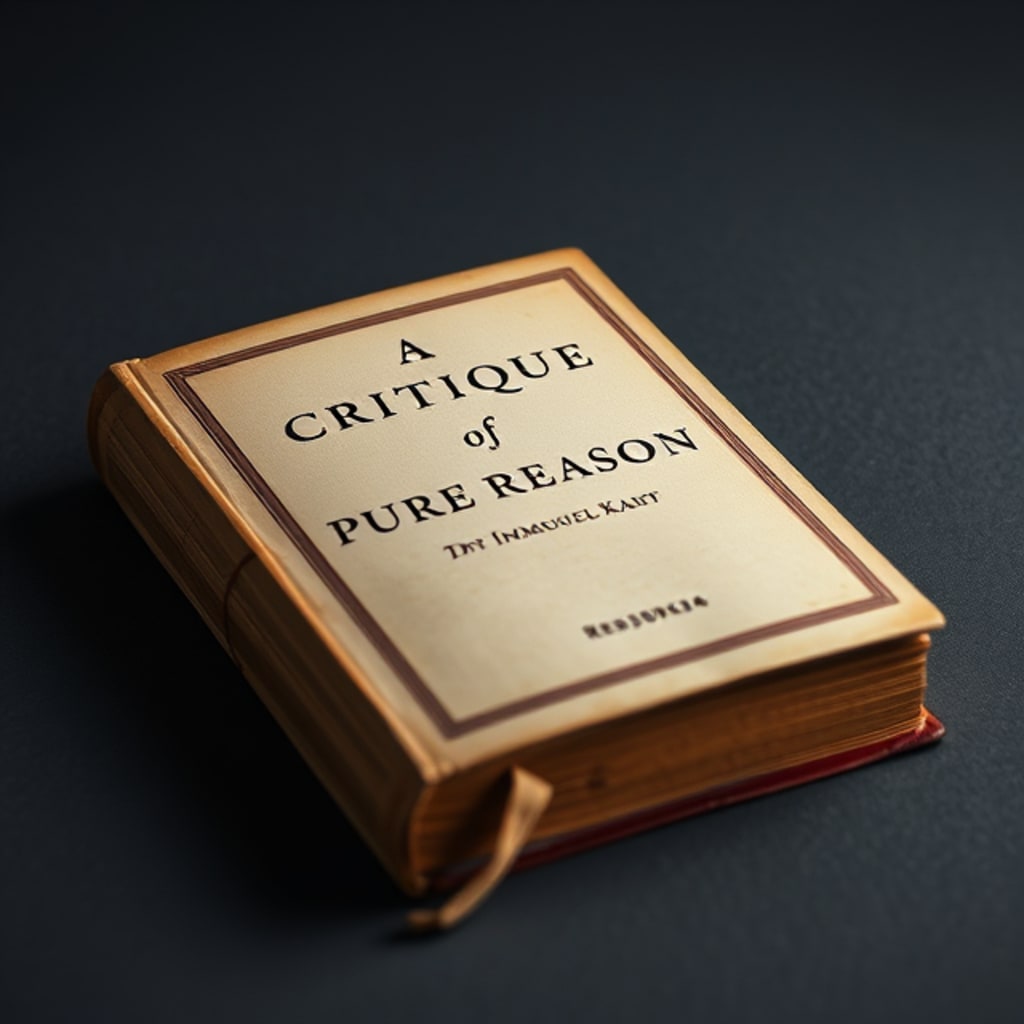
Immanuel Kant’s Critique of Pure Reason is often considered one of the most challenging yet profoundly enlightening works in the history of philosophy. Published in 1781, this monumental text seeks to answer some of the most fundamental questions about human knowledge: What can we know? How do we know it? And what are the limits of our understanding? Having delved into this masterpiece, I find myself both humbled and inspired by Kant’s intellectual depth. Here, I’d like to share some of the key lessons I have gleaned from this extraordinary work.
The Power and Limitations of Human Understanding
Kant begins with a bold premise: human reason is capable of extraordinary feats, but it is not boundless. He divides knowledge into two realms: the phenomenal (what we can experience and perceive) and the noumenal (things as they exist in themselves, beyond our perception). This distinction taught me a humbling truth: while we can explore and understand the world through experience and reason, there are aspects of reality forever beyond our grasp. The noumenal realm reminds us of the mystery and complexity of existence, cautioning against intellectual arrogance.
This idea profoundly shifted my perspective on knowledge. It is easy to assume that science or philosophy can eventually answer every question. Yet Kant’s insights suggest that certain questions—such as the ultimate nature of God, free will, or the universe’s origin—may lie outside the scope of human comprehension. This is not a failure but a recognition of the structure and limits of our minds.
Synthetic A Priori Judgments: A Revolutionary Concept
One of Kant’s most groundbreaking contributions is his distinction between analytic and synthetic judgments, as well as his introduction of a third category: synthetic a priori judgments. Analytic judgments are those whose truth is self-evident by definition (e.g., “All bachelors are unmarried”). Synthetic judgments, on the other hand, add new information based on experience (e.g., “The sky is blue”).
Kant’s innovation lies in identifying synthetic a priori judgments—statements that provide new knowledge but are not derived from experience, such as the truths of mathematics (“7 + 5 = 12”) or the principles of causality. These judgments form the foundation of our understanding of the world. This idea was a revelation to me, showing how much of what we take for granted—such as time, space, and causation—is not simply “out there” in the world but is rooted in the very structure of our minds.
This realization reshaped my view of reality. Kant argues that the human mind actively structures experience, imposing concepts like time and space onto the raw data of sensory input. This means that what we perceive is not the world as it is in itself but the world as it appears to us through the lens of human cognition. This insight encouraged me to approach knowledge with greater humility, recognizing that our understanding of the universe is always mediated by our mental framework.
The Role of the Categories of Understanding
Kant’s concept of the categories of understanding was another profound takeaway. He identifies twelve fundamental concepts—such as causality, unity, and plurality—that the mind uses to organize sensory data. These categories are not learned through experience; instead, they are inherent to human cognition, shaping how we perceive and make sense of the world.
This idea resonated deeply with me, especially in how it explains the universality and consistency of human knowledge. For example, the principle of causality—the idea that every effect has a cause—is not something we infer solely from experience but is a fundamental way our minds process events. This insight made me appreciate the remarkable coherence of human thought while also acknowledging that our understanding is shaped by innate mental structures.
The Copernican Revolution in Philosophy
Kant famously described his philosophical approach as a “Copernican Revolution.” Just as Copernicus proposed that the Earth revolves around the sun rather than the other way around, Kant argues that knowledge does not conform to objects; instead, objects conform to the way we perceive and understand them. This shift in perspective was transformative for me. It challenges the assumption that the mind is merely a passive receiver of information, emphasizing instead its active role in constructing reality.
This lesson has practical implications for how we approach knowledge and inquiry. It encourages a critical examination of our assumptions, reminding us that what we take as objective reality is deeply influenced by the structures of our perception and cognition. It also underscores the importance of self-awareness in philosophical and scientific endeavors.
The Boundaries of Metaphysics
One of Kant’s central goals in Critique of Pure Reason is to delineate the proper scope of metaphysics. He critiques previous philosophers for attempting to extend human reason into realms where it cannot reliably operate. For example, he argues that traditional metaphysical debates about the existence of God, the immortality of the soul, or the infinity of the universe are ultimately irresolvable because they transcend the limits of human experience.
Rather than dismissing metaphysics entirely, Kant redefines its role. He sees metaphysics as an inquiry into the conditions of possibility for knowledge and experience. This reorientation taught me the importance of grounding philosophical inquiry in what can be known and experienced while remaining open to the mysteries that lie beyond.
Practical Lessons: The Interplay of Reason and Ethics
While Critique of Pure Reason focuses on epistemology, it lays the groundwork for Kant’s later ethical philosophy. One key takeaway is the interplay between reason and moral action. Kant’s emphasis on the universality of reason aligns with his moral philosophy, where he argues that ethical principles must be grounded in universal laws rather than subjective desires.
This connection between reason and ethics inspired me to reflect on the broader implications of Kant’s philosophy for everyday life. It underscores the importance of acting not merely based on personal preference or emotion but according to principles that can be universally justified. This lesson resonates deeply in a world often dominated by relativism and individualism.
Conclusion: A Lifelong Journey
Reading Critique of Pure Reason has been both a challenge and a revelation. Kant’s philosophy is not easy to grasp, but the effort is immensely rewarding. His insights into the nature of knowledge, the active role of the mind, and the limits of human understanding have profoundly shaped my worldview.
Above all, Kant’s work has taught me the value of intellectual humility and the importance of critical reflection. The questions he raises are not merely abstract puzzles but touch on the very foundations of how we navigate and make sense of the world. While I may never fully master the intricacies of Kant’s thought, I am grateful for the opportunity to engage with it and look forward to revisiting his work as part of a lifelong philosophical journey.
About the Creator
Fred Bradford
Philosophy, for me, is not just an intellectual pursuit but a way to continuously grow, question, and connect with others on a deeper level. By reflecting on ideas we challenge how we see the world and our place in it.
Keep reading
More stories from Fred Bradford and writers in BookClub and other communities.
What I Learned from The Book of Five Rings by Miyamoto Musashi
When I first picked up The Book of Five Rings by Miyamoto Musashi, I expected a text solely about swordsmanship and the samurai ethos. What I discovered instead was a profound work of philosophy that transcends martial arts, offering timeless wisdom on strategy, discipline, and the art of living. Here are the key lessons I gleaned from this masterpiece.
By Fred Bradford12 months ago in BookClub
My New Book is Finally Here
My poetry collection Beautiful and Brutal Things is done. It's actually done and finally published over 270 pages. Over a year of my life went into this book. More than a year, really. Long days at my computer, sometimes seven days a week because I couldn't stop even when I probably should have. Then two months of editing that felt harder than the writing itself. But it's finished, and I'm still standing, and the book is real.
By Tim Carmichael2 days ago in BookClub
Hildegard von Bingen
Light, Intellect, and Authority in the Medieval World Hildegard von Bingen stands as one of the most extraordinary intellectual figures of the Middle Ages, a woman whose range of achievement resists narrow definition. Born in 1098 in the Rhineland region of what is now Germany, Hildegard entered a world shaped by monastic reform, theological debate, and emerging centers of learning. From this environment emerged a thinker whose influence reached far beyond the walls of any cloister. Across a long life, Hildegard produced visionary theology, original sacred music, works of natural history and medicine, and a vast body of correspondence that circulated among the most powerful religious and political leaders of the twelfth century. Recognition during life was not limited to local admiration but extended across the Holy Roman Empire and into the highest ranks of the medieval Church.
By Marcus Hedare2 days ago in BookClub




Comments
There are no comments for this story
Be the first to respond and start the conversation.