
Hildegard von Bingen
Woman and Visionary Ahead of Her Time

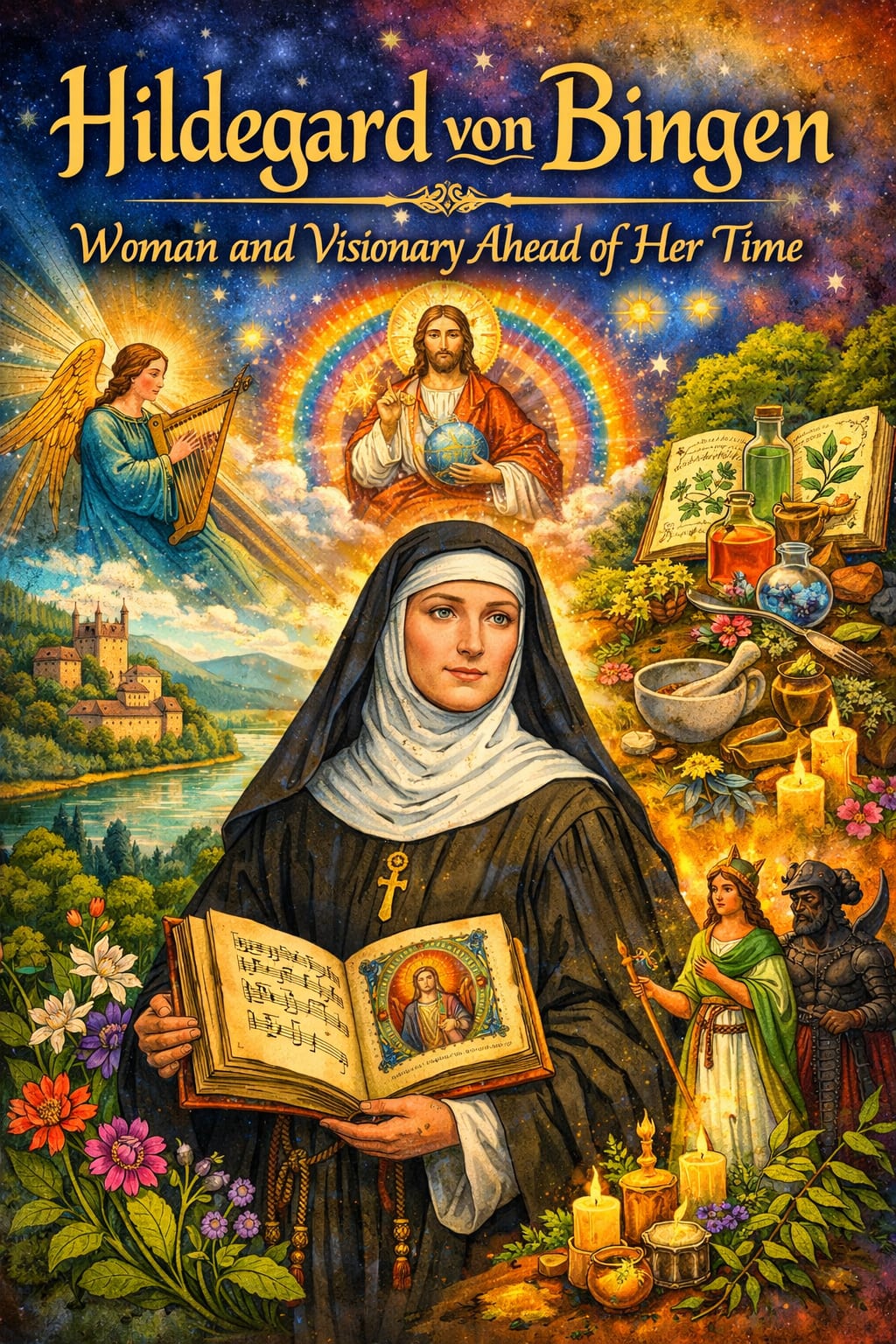
Light, Intellect, and Authority in the Medieval World
Hildegard von Bingen stands as one of the most extraordinary intellectual figures of the Middle Ages, a woman whose range of achievement resists narrow definition. Born in 1098 in the Rhineland region of what is now Germany, Hildegard entered a world shaped by monastic reform, theological debate, and emerging centers of learning. From this environment emerged a thinker whose influence reached far beyond the walls of any cloister. Across a long life, Hildegard produced visionary theology, original sacred music, works of natural history and medicine, and a vast body of correspondence that circulated among the most powerful religious and political leaders of the twelfth century. Recognition during life was not limited to local admiration but extended across the Holy Roman Empire and into the highest ranks of the medieval Church.
Historical records describe a childhood marked by unusual spiritual awareness. As the tenth child of a noble family, Hildegard was dedicated to religious life at an early age and placed as an oblate under the care of Jutta of Sponheim at the Benedictine community of Disibodenberg. There, Hildegard received instruction in Latin psalmody, Scripture, and monastic discipline, while also developing skills in reading, writing, and musical practice. This early education formed the foundation for a life that balanced intense contemplation with disciplined intellectual labor. Medieval monastic culture prized memory, symbolic interpretation, and theological reflection, all of which became hallmarks of Hildegard’s later work.
From childhood onward, Hildegard experienced vivid visionary phenomena described as perceptions of radiant light accompanied by complex symbolic imagery. These visions were not associated with trance or loss of awareness but occurred in a fully conscious state, allowing careful observation and later articulation. For decades these experiences remained largely private, shared only with trusted spiritual mentors. In midlife, however, ecclesiastical encouragement and papal approval made it possible for Hildegard to commit these visions to writing. The resulting texts combined theological doctrine, moral instruction, and cosmological reflection, presented with a confidence that signaled spiritual authority rather than hesitation.
Authority was not merely literary. Hildegard rose to leadership as abbess, founded independent religious communities, and exercised influence as a public figure in an era when women rarely addressed mixed audiences or challenged clerical behavior. Letters attributed to Hildegard reveal direct engagement with emperors, bishops, abbots, and civic leaders, often offering admonition, encouragement, or correction. Such correspondence reflects widespread belief in the legitimacy of Hildegard’s insight and judgment. Reputation as a visionary and moral guide granted access to spheres of influence closed to most women of the period.
Longevity further amplified this influence. Living into the eighth decade of life, Hildegard witnessed significant political and ecclesiastical change, including conflicts between imperial and papal authority and debates over church reform. Throughout these upheavals, Hildegard maintained a consistent intellectual vision rooted in order, balance, and the interdependence of spiritual and natural realms. The concept of divine vitality flowing through creation shaped theological reflection, medical writing, and poetic expression alike, producing a body of work unified by coherence rather than contradiction.
The historical record affirms Hildegard von Bingen as far more than a mystical curiosity. Evidence supports recognition of a disciplined thinker, an innovative composer, a careful observer of the natural world, and a commanding leader whose voice carried authority in a male-dominated society. Centuries after death in 1179, formal recognition as a Doctor of the Church confirmed what contemporaries already understood. Hildegard von Bingen belonged among the great minds of medieval Europe, not as an exception to history but as a defining presence within it.
The Visionary Writings
The written works of Hildegard von Bingen stand as a central pillar of medieval intellectual and spiritual history. These texts emerged from decades of disciplined reflection and careful transcription of visionary experience, shaped by theological training and monastic scholarship. The earliest and most foundational of these works, Scivias, completed between 1141 and 1152, presents twenty six distinct visions arranged in three books. Each vision is accompanied by extensive theological commentary that situates symbolic imagery within orthodox Christian doctrine. The structure of Scivias reflects a comprehensive cosmology, addressing creation, redemption, ecclesiastical order, and the ultimate destiny of humanity within divine justice.
The visions recorded in Scivias employ elaborate symbolism drawn from Scripture, liturgy, and natural imagery. Images of light, fire, wind, and architecture recur throughout the text, serving as vehicles for theological explanation rather than poetic embellishment alone. Moral instruction is interwoven with cosmic imagery, emphasizing responsibility, ethical conduct, and spiritual discipline. Medieval audiences recognized the work not as private mysticism but as authoritative teaching, a perception reinforced by ecclesiastical approval and public endorsement from senior church leaders.
Hildegard expanded this theological project with Liber Vitae Meritorum, composed during the 1150s. This work shifts focus toward moral psychology and ethical consequence, presenting a detailed examination of virtues and vices through allegorical dialogue. Human behavior is analyzed in terms of spiritual cause and effect, linking inner disposition to outward action and eternal outcome. The text reflects familiarity with monastic moral instruction while introducing a distinctive visionary framework that renders abstract ethical concepts vivid and accessible.
The culmination of Hildegard’s visionary theology appears in Liber Divinorum Operum, completed in the final decades of life. This expansive work presents a mature synthesis of cosmology, anthropology, and theology, portraying the universe as an ordered system animated by divine presence. Humanity occupies a central position within this cosmic structure, bearing responsibility for maintaining harmony between spiritual intention and material reality. The text demonstrates advanced conceptual integration, uniting theological speculation with symbolic representation and philosophical coherence.
Distinctive among medieval theological writers, Hildegard fused visionary perception with analytical clarity. Visionary experience was neither isolated nor unexamined but subjected to structured interpretation and doctrinal alignment. This method allowed visionary authority to coexist with intellectual rigor, reinforcing credibility in an era that demanded orthodoxy alongside inspiration. As a result, these writings circulated widely during Hildegard’s lifetime and were consulted by clergy, monastic leaders, and educated laity.
The reception of these works confirms the exceptional position occupied by Hildegard within twelfth century religious culture. Recognition as a prophetic voice granted access to audiences typically unavailable to women, while textual production established lasting authority within theological discourse. These writings continue to serve as primary sources for understanding medieval mysticism, cosmology, and ethical thought, standing as enduring evidence of a disciplined mind capable of transforming visionary experience into structured and influential doctrine.
Music, Poetry, and Liturgical Innovation
Musical composition formed a vital dimension of Hildegard von Bingen’s creative and theological expression. Within the context of twelfth century monastic culture, sacred music functioned as both prayer and instruction, shaping communal worship and spiritual formation. Hildegard expanded this tradition through an extensive body of original compositions that surpasses that of any other known medieval composer of sacred monophonic music. More than seventy surviving works include antiphons, responsories, hymns, sequences, and liturgical songs dedicated to saints, the Virgin Mary, and theological themes central to Christian belief.
These compositions are preserved within the collection titled Symphonia Armonie Celestium Revelationum, a title that reflects an understanding of music as a reflection of cosmic and divine order. The melodic language employed throughout this collection departs noticeably from conventional Gregorian chant. Wide vocal ranges, unexpected intervallic leaps, and extended melodic phrases create a sound that is both expansive and expressive. Musical structure serves theological meaning, with melodic ascent often associated with divine light, heavenly realms, and spiritual transformation. The result is a repertoire that communicates doctrine not only through text but through musical form itself.
Textual poetry plays an equally significant role within these compositions. Hildegard authored the Latin lyrics for each work, employing rich imagery drawn from Scripture, natural symbolism, and visionary experience. Language emphasizes light, fire, greenness, and celestial harmony, reinforcing theological themes already present in written visionary texts. Poetry and melody operate together as integrated vehicles of spiritual instruction, intended for communal performance within the monastic liturgy rather than private contemplation.
Among these musical works, Ordo Virtutum occupies a singular place in medieval artistic history. Composed as a morality play, this work dramatizes the struggle of the human soul through encounters with personified virtues and the Devil. Musical distinction underscores theological meaning, as the virtues and soul sing expressive melodic lines while the Devil speaks or shouts without melody. This deliberate absence of song symbolizes separation from divine harmony and reinforces the moral structure of the drama. Ordo Virtutum is widely regarded as the earliest surviving morality play with music, predating later developments in European theatrical tradition.
Performance of Hildegard’s music would have taken place within the liturgical life of her monastic communities, sung by women whose voices shaped and sustained this repertoire. Manuscripts preserving these works demonstrate careful notation, indicating both musical sophistication and intentional transmission. In modern times, renewed scholarly and musical interest has brought these compositions to international audiences. Performances and recordings continue to reveal the emotional depth and intellectual complexity embedded within this body of work.
The musical legacy of Hildegard von Bingen stands as evidence of an integrated artistic vision in which theology, poetry, and sound converge. These compositions challenge assumptions about medieval musical conservatism and affirm the capacity for innovation within monastic tradition. Through music, Hildegard articulated a theology of harmony that continues to resonate across centuries, offering insight into a medieval worldview where art and devotion were inseparable.
Natural Science, Medicine, and Holistic Thought
Intellectual activity in the life of Hildegard von Bingen extended deeply into the study of the natural world. Two major works, Physica and Causae et Curae, reflect sustained engagement with natural history, healing practices, and the relationship between physical conditions and spiritual states. These texts were composed within a monastic environment that preserved classical learning while encouraging practical knowledge related to health and daily life. Together, they form one of the most extensive medical and scientific corpora attributed to a woman in the Middle Ages.
Physica, sometimes referred to as Liber simplicis medicinae, presents a systematic catalog of natural substances, including plants, animals, stones, and elements. Each entry describes observable characteristics alongside medicinal properties and practical applications. Descriptions often include methods of preparation, dietary considerations, and therapeutic uses, indicating familiarity with empirical observation and lived experience. While grounded in medieval cosmology, the text demonstrates attention to cause and effect rather than reliance solely on inherited authority. This approach reflects an early effort to organize natural knowledge in a coherent and functional manner.
Causae et Curae expands this inquiry by examining the origins of illness and appropriate treatments. The work addresses physical ailments, emotional imbalance, and environmental influence, presenting health as the result of interaction between body, soul, and surroundings. Disease is not treated as an isolated phenomenon but as a condition arising from imbalance or disruption within an integrated system. Such an understanding places emphasis on prevention, moderation, and alignment with natural rhythms, concepts that resonate strongly with later holistic medical traditions.
A defining concept within these writings is viriditas, commonly translated as greenness or vitality. This term signifies the life force permeating plants, human beings, and the broader cosmos. Growth, fertility, healing, and spiritual renewal are all expressions of this generative power. When viriditas flourishes, health and moral clarity follow. When depleted, weakness and disorder emerge. This framework links physical well-being to spiritual condition, reinforcing the belief that care for the body cannot be separated from care for the soul.
In addition to scientific and medical writing, Hildegard developed an original constructed language known as Lingua Ignota. Consisting of hundreds of invented words and a unique alphabet, this language appears primarily in glossaries and isolated passages. Its precise function remains debated, though symbolic and contemplative use within the monastic community is evident. The creation of such a language reflects an interest in naming, meaning, and the limitations of ordinary speech when addressing divine or mystical realities.
The scientific and medical contributions of Hildegard von Bingen reveal a mind attentive to observation, synthesis, and balance. These works bridge spiritual philosophy and practical care, offering a vision of health rooted in harmony with nature and inner order. Within the broader history of medieval thought, these texts stand as rare examples of comprehensive natural inquiry authored by a woman, underscoring both intellectual range and enduring relevance.
Viriditas, Mysticism, and the Roots of Occult Thought
Hildegard von Bingen occupies a complex position in the history of Western esotericism. Although firmly grounded within orthodox Christian theology, several aspects of Hildegard’s thought later resonated strongly with currents now described as occult, mystical, or esoteric. This connection does not arise from secret ritual practice or hidden doctrine but from an integrated cosmology in which nature, spirit, humanity, and the divine are understood as dynamically interconnected. Medieval mysticism, natural philosophy, and symbolic theology converge within this worldview, creating conceptual foundations that later esoteric traditions would revisit and reinterpret.
At the center of this contribution stands the concept of viriditas, often translated as greenness, vitality, or life force. Viriditas represents the animating energy present in all creation, flowing from the divine source into plants, animals, the human body, and the soul. This vitality is not metaphorical alone but functions as a real and sustaining principle within the natural and spiritual order. Health, morality, and spiritual clarity depend upon the proper circulation of this life force, while decay, illness, and sin arise from its obstruction or depletion. Such a framework anticipates later occult and philosophical concepts concerned with vital energy, correspondence, and balance.
Viriditas operates as both a theological and cosmological principle. Divine creativity expresses itself through abundance, growth, and generative power, visible in the fertility of the earth and mirrored in human creativity and ethical action. The human body functions as a microcosm reflecting the structure and harmony of the larger universe. This understanding aligns closely with later hermetic and esoteric models that emphasize the relationship between macrocosm and microcosm. Although Hildegard did not employ the terminology of later occult systems, the conceptual parallels are unmistakable.
Symbolism plays a central role in this vision. Light, fire, water, wind, and greenery appear repeatedly in visionary imagery, each carrying layered meanings that link physical phenomena to spiritual realities. Such symbolic literacy became foundational to later mystical and occult traditions, where natural elements serve as carriers of metaphysical significance. Hildegard’s visions present the cosmos as a living, ensouled structure governed by intelligible order rather than mechanical function. This approach contrasts sharply with later purely materialist models and offers a framework that values meaning, resonance, and participation.
Interest in healing and natural correspondences further situates Hildegard within the prehistory of occult natural philosophy. The medical writings emphasize the inherent properties of plants, stones, and animals, each understood to possess specific virtues affecting the human body and spirit. These ideas influenced later herbal traditions and natural magic systems, particularly those concerned with sympathetic relationships between substances and bodily conditions. While firmly embedded in Christian moral teaching, this approach recognizes nature as a repository of divine wisdom accessible through study and experience.
Language itself becomes a mystical tool within this framework. The constructed Lingua Ignota reflects an attempt to articulate realities perceived as exceeding ordinary speech. The creation of sacred or specialized languages later became a recurring feature in esoteric traditions, where words are believed to carry vibrational or symbolic power. In Hildegard’s context, this linguistic experimentation underscores the belief that creation contains layers of meaning not fully captured by conventional expression.
Modern occultism often draws selectively from historical sources, sometimes removing concepts from original theological contexts. Hildegard’s work demonstrates the importance of grounding mystical exploration in ethical discipline and intellectual responsibility. Viriditas is not an abstract energy to be manipulated but a gift requiring stewardship, balance, and humility. This distinction remains essential for contemporary readers exploring spiritual or esoteric traditions influenced by medieval thought.
The contribution of Hildegard von Bingen to occultism lies not in secrecy or transgression but in a holistic vision of reality infused with meaning, vitality, and moral coherence. Viriditas serves as a unifying principle that bridges theology, medicine, cosmology, and mysticism. Through this concept, the natural world becomes a sacred text, readable through careful observation and disciplined reflection. Such a vision continues to shape conversations at the intersection of spirituality, ecology, and esoteric philosophy, affirming Hildegard’s enduring relevance far beyond the boundaries of medieval monastic life.
Leadership, Correspondence, and Advocacy
Authority in the life of Hildegard von Bingen was exercised not only through writing and composition but through sustained leadership within ecclesiastical and public spheres. After the death of Jutta of Sponheim in 1136, Hildegard assumed responsibility as leader of the women’s community at Disibodenberg. This position marked the beginning of an increasingly visible role within monastic and church governance. Guided by visionary conviction and administrative competence, Hildegard later oversaw the establishment of an independent convent at Rupertsberg near Bingen, a move that required negotiation with male ecclesiastical authorities and resistance to entrenched institutional control. The foundation of a second house at Eibingen several years later further solidified this leadership legacy and extended institutional influence along the Rhine.
These foundations were not symbolic gestures but functioning religious centers requiring land acquisition, construction, financial management, and legal recognition. Securing autonomy for the communities demanded persistence and authority in an environment that rarely granted such independence to women. Ecclesiastical approval was achieved through a combination of spiritual reputation, political awareness, and demonstrated competence. The resulting communities became stable centers of liturgical life, education, manuscript production, and musical practice, contributing to the intellectual and cultural life of the region.
Leadership extended beyond the cloister through public preaching journeys undertaken during later life. These preaching tours carried Hildegard across cities and monastic centers throughout German territories. Addresses were delivered to clergy and laity alike, focusing on moral reform, spiritual discipline, and ethical responsibility. Public preaching by a woman was highly unusual in the twelfth century, yet contemporary records indicate that these sermons were received with respect rather than opposition. Such acceptance reflects the authority attributed to prophetic insight and moral clarity during a period marked by ecclesiastical reform movements and political tension.
An extensive body of correspondence further illustrates the reach of Hildegard’s influence. Hundreds of letters survive, addressed to popes, emperors, bishops, abbots, abbesses, and lay leaders. These letters range from pastoral encouragement to stern admonition, addressing issues such as corruption, negligence, abuse of power, and spiritual complacency. Language within this correspondence is direct and uncompromising, reflecting confidence in moral judgment and responsibility to speak against injustice. Engagement with imperial figures and senior clergy demonstrates recognition of authority that transcended gender constraints.
Within the monastic communities, leadership emphasized discipline, education, and creative expression. Instruction in Scripture, music, and copying of manuscripts fostered intellectual development alongside spiritual formation. Artistic production was not treated as ornament but as integral to worship and learning. Daily life within these houses reflected a balance of contemplation and labor, shaped by clear governance and visionary purpose.
The leadership record of Hildegard von Bingen reveals a figure capable of navigating complex institutional structures while maintaining moral independence. Influence was exercised through example, persuasion, and unwavering commitment to spiritual integrity. Within a historical landscape dominated by male authority, this form of leadership stands as a rare and well documented testament to the power of intellect, discipline, and conviction.
Recommended Reading: #commissionearned
Hildegard of Bingen: A Visionary Life by Sabina Flanagan
This biography is widely regarded as one of the most authoritative scholarly accounts of Hildegard von Bingen. The narrative is grounded in surviving letters, manuscripts, and historical records, presenting a careful reconstruction of Hildegard’s life within the religious and political realities of the twelfth century. Attention is given to monastic reform, visionary legitimacy, and institutional resistance, avoiding romanticized interpretations of mysticism. The work emphasizes how visionary authority functioned as a recognized source of influence within medieval religious culture. Leadership, theological production, and community formation are treated with equal seriousness. This book aligns closely with the blog’s focus on intellectual discipline, historical context, and sustained authority. Readers seeking academic rigor paired with clarity will find this volume essential.
Primary texts form the core of this carefully curated collection, offering direct access to Hildegard’s theological, medical, and visionary writings. The translations prioritize clarity while preserving the symbolic and rhetorical structure of the original Latin. Selections include visionary theology, reflections on nature, and excerpts from correspondence, revealing the breadth of Hildegard’s intellectual concerns. Editorial notes provide historical grounding without interrupting the primary material. This volume complements the blog by allowing engagement with Hildegard’s ideas in original form rather than interpretation alone. The collection reinforces the coherence of her worldview across multiple disciplines. For readers interested in firsthand encounters with medieval thought, this book provides an indispensable foundation.
Illuminations: A Novel of Hildegard von Bingen by Mary Sharratt
Historical fiction serves as the vehicle for this deeply researched portrayal of Hildegard’s life and inner world. The novel traces early visionary experience, monastic confinement, and the gradual emergence of public authority. Emotional struggle, resistance from institutional power, and creative determination are presented with restraint rather than dramatization. Although fictional in structure, the narrative adheres closely to established historical events and timelines. This work complements the blog by offering insight into psychological and emotional dimensions that formal histories often omit. The novel humanizes a complex historical figure without diminishing documented achievements. Readers interested in narrative immersion grounded in scholarship will find this work compelling.
Hildegard of Bingen: An Integrated Vision by Anne H. King Lenzmeier
A central strength of this study lies in its refusal to separate theology, music, science, and leadership into isolated categories. The analysis presents Hildegard as a coherent and systematic thinker whose ideas unfold consistently across different forms of expression. Recurring themes such as order, harmony, and vitality receive detailed attention, demonstrating intellectual continuity rather than fragmentation. The work balances academic depth with accessibility, making complex concepts understandable without simplification. This approach mirrors the blog’s emphasis on unity across disciplines. Readers seeking synthesis rather than specialization will benefit greatly from this perspective. The book reinforces recognition of Hildegard as an architect of integrated thought.
This volume brings together theological texts and musical compositions to illustrate how doctrine and devotion functioned together within monastic life. Chant texts appear alongside visionary excerpts, revealing how music reinforced theological meaning and spiritual formation. Editorial commentary provides context while allowing Hildegard’s own words and artistic output to remain central. The selection emphasizes lived spirituality rather than abstract theology alone. This book complements the blog’s discussion of liturgical innovation and artistic integration. Readers gain insight into how worship, creativity, and belief intersected within Hildegard’s communities. The volume is especially valuable for those interested in medieval spirituality as a lived practice.
Hildegard of Bingen: The Woman of Her Age by Fiona Maddocks
Narrative biography defines this work, which situates Hildegard within the political, ecclesiastical, and cultural upheavals of the twelfth century. Crusades, church reform, and imperial conflict provide historical texture without overshadowing the central figure. Personality, ambition, and resilience emerge through careful use of historical evidence. The prose remains accessible while maintaining scholarly credibility. This biography supports the blog’s emphasis on historical context and lived experience. Readers encounter Hildegard not only as a visionary but as a woman navigating complex power structures. The result is a portrait both grounded and engaging.
The Journal of Hildegard of Bingen by Barbara Lachman
Presented in the form of a fictionalized journal, this work offers an intimate portrayal of daily monastic life and sustained spiritual practice. Historical detail informs the narrative structure, drawing on known events, writings, and routines. Reflection, discipline, and creative labor form the backbone of the text. While imaginative in format, the work remains faithful to established scholarship. This book complements the blog by emphasizing process over spectacle and discipline over sudden inspiration. Readers are invited into the rhythm of a medieval intellectual life shaped by patience and persistence. The journal format offers a reflective counterbalance to academic studies, enriching understanding through contemplative narrative.
Continuing the Journey
The legacy of Hildegard von Bingen stands as a testament to disciplined inquiry, creative resilience, and intellectual independence within a world defined by limitation and hierarchy. The breadth of theological writing, musical composition, scientific observation, and institutional leadership reflects a life committed to understanding order, meaning, and vitality in all forms. Such a legacy resists simplification and rewards careful study rather than passive admiration. Encountering this body of work encourages sustained attention and thoughtful engagement rather than quick conclusions.
Meaningful exploration of Hildegard’s thought begins with direct interaction with texts, translations, and critical scholarship. Public libraries remain one of the most valuable and often overlooked resources for this purpose, offering access to academic studies, historical editions, and musical recordings without financial barrier. University libraries, interlibrary loan programs, and digital catalogues further expand access to reliable material. These spaces support careful reading and contextual understanding, which are essential when approaching medieval sources shaped by symbolic language and theological structure.
Online resources can also support research when approached with discernment. Digitized manuscripts, academic journals, and museum archives provide unprecedented access to primary material, yet not all digital sources maintain scholarly rigor. Evaluating authorship, institutional affiliation, and citation practices remains essential. Popular summaries and unvetted interpretations may obscure historical nuance or project modern assumptions onto medieval contexts. A careful and critical approach ensures that curiosity leads to understanding rather than distortion.
The study of Hildegard von Bingen ultimately invites reflection on the responsibility of intellectual engagement itself. Knowledge deepens through patience, comparison of sources, and openness to complexity. Continued reading and research reveal not only the depth of one remarkable life but also the broader cultural, religious, and philosophical world in which that life unfolded. Each return to the writings, music, and historical record offers new perspective. The journey does not conclude with a single article or volume but continues wherever curiosity, discipline, and respect for the past remain active.
About the Creator
Marcus Hedare
Hello, I am Marcus Hedare, host of The Metaphysical Emporium, a YouTube channel that talks about metaphysical, occult and esoteric topics.
https://linktr.ee/metaphysicalemporium
Keep reading
More stories from Marcus Hedare and writers in BookClub and other communities.
Occult Linguistics
The Hidden Architecture of Sacred Language Occult linguistics occupies a distinctive intellectual and spiritual territory where language is understood as an active, formative force rather than a passive vehicle for meaning. In this framework words, letters, sounds, and symbols are treated as living structures capable of shaping perception, consciousness, and reality itself. Language functions not only as representation but as participation, embedding human thought within cosmological, ritual, and metaphysical systems that have developed over thousands of years. Across esoteric traditions language is regarded as an extension of creation, a medium through which invisible principles become perceptible and operative.
By Marcus Hedareabout 13 hours ago in BookClub
Lights Out & Love in the Dark
Welcome back to The Chapter Café, where stories are always on the menu and comfort is served by the chapter. I’m your host, Kristen, and tonight we’re dimming the lights, pouring something strong, and stepping into the shadows with a dark romance that’s as twisted as it is tender. On today’s menu? Lights Out by Navessa Allen—a story of trauma, obsession, and the strange, electric pull between two broken souls.
By Kristen Barenthaler2 days ago in BookClub



Comments
There are no comments for this story
Be the first to respond and start the conversation.