
The Kingdom of Dahomey and the Agoodie Warriors Benin Rep.
The Agoodie

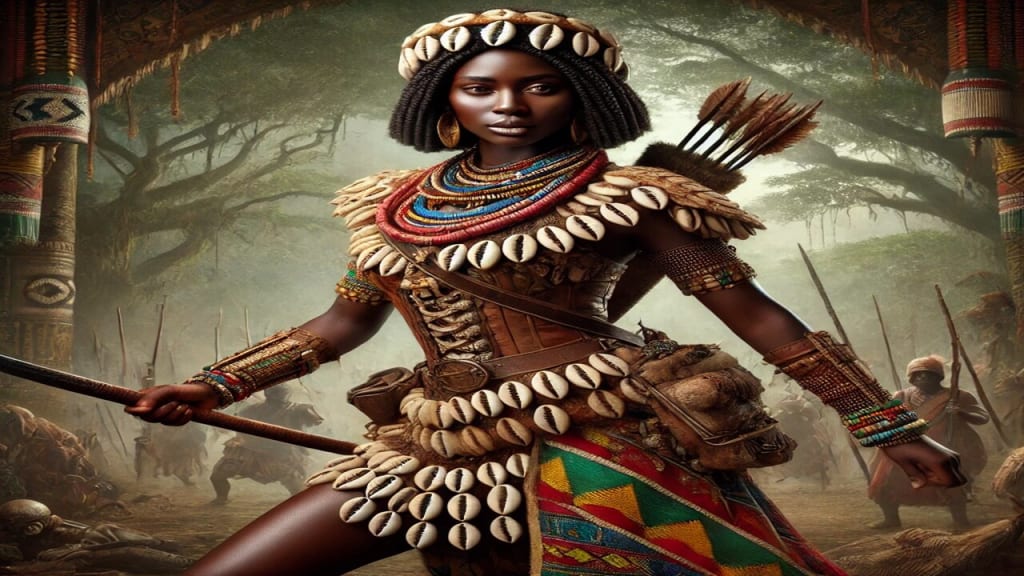
The Kingdom of Dahomey and the Agoodie Warriors
Long ago, in the heart of West Africa, where rolling savannas gave way to thick jungles, the Kingdom of Dahomey thrived as one of the most formidable powers in the region. Its people were known for their resilience, cultural brilliance, and military might. But among their forces stood a legendary corps whose story would echo through history: the Agoodie, an elite military unit of women warriors.
Rise of the Agoodie
The origins of the Agoodie date back to the reign of King Houegbadja, one of Dahomey's early rulers. Tradition says he noticed the incredible skill and endurance of women hunters in the region. Admiring their strength, he declared that women, too, would have a place in defending the kingdom. Over time, these hunters became warriors, and their ranks grew under successive kings.
By the 18th century, under the reign of King Agaja, the Agoodie had evolved into a formidable corps. They were no longer just defenders; they became a key part of Dahomey's offensive military campaigns. Trained rigorously, they were taught to wield spears, machetes, muskets, and bows with precision. The Agoodie embraced physical hardship, enduring grueling tests of strength and loyalty that surpassed even those of their male counterparts.
The Agoodie’s Code
The Agoodie lived by a strict code of discipline. Marriage and family were forbidden for them, as their loyalty belonged solely to the king and the kingdom. They were revered as protectors of Dahomey's sovereignty and symbols of female power. In battle, they moved like shadows—swift, silent, and deadly.
Their uniforms were distinctive: leather tunics adorned with shells and vibrant patterns, symbolizing their bond with the land and spirits of their ancestors. When they marched, their chants and rhythmic footfalls inspired awe among allies and terror in enemies.
Victories and Glory
For nearly 200 years, the Agoodie fought alongside their male counterparts in battles that shaped the destiny of Dahomey. They clashed with neighboring kingdoms like the Oyo Empire, often turning the tide of battle with their ferocity.
One of the most storied moments in their history came during the reign of King Ghezo in the 19th century. Facing the might of European colonial powers, the Agoodie were deployed to protect Dahomey's autonomy. Armed with traditional weapons and muskets, they demonstrated a bravery that astonished even their enemies. In one battle against French forces, the Agoodie launched a daring ambush, fighting with such tenacity that the French commander reportedly described them as "Amazons, unmatched in courage."
Legends of the Agoodie
Among the Agoodie, one warrior stands out in legend: Nawi, whose name is still whispered with reverence. Known for her unmatched skill with the machete, she was said to have led a charge against an enemy fort, leaping over its walls with the agility of a leopard. Though wounded, she refused to retreat, rallying her sisters to victory.
Nawi’s story became emblematic of the Agoodie’s spirit: unyielding, fearless, and loyal to the last breath.
The Decline of Dahomey
Despite their heroism, the Kingdom of Dahomey eventually succumbed to external pressures. By the late 19th century, French colonial forces overwhelmed the kingdom’s defenses, and Dahomey was absorbed into French West Africa. Yet, even in defeat, the Agoodie fought to the last, leaving an indelible mark on history.
Legacy
The Agoodie are remembered today as a testament to the strength and courage of women in the face of adversity. Their legacy lives on in modern depictions of the Amazons of Dahomey—a name they earned through their unwavering valor.
In a world that often overlooked the power of women, the Agoodie stood as warriors who shattered conventions, proving that bravery knows no gender. Their story continues to inspire, reminding us of a time when the Kingdom of Dahomey stood tall and proud, defended by the fierce daughters of its land.
The Agoodie (or Dahomey Amazons) played a pivotal role in the wars between the Kingdom of Dahomey and France, particularly during the Second Franco-Dahomean War of 1892-1894, leading up to the kingdom's fall in 1894-1895. Here's a more detailed recounting of that critical period:
The Agoodie’s Final Stand Against France (1892-1895)
By the late 19th century, the Kingdom of Dahomey faced mounting threats from European colonial powers. France, driven by its ambitions to dominate West Africa, sought to expand its control by subjugating Dahomey, a kingdom fiercely protective of its sovereignty.
Under the leadership of King Behanzin, Dahomey resisted French encroachment with relentless determination. The Agoodie, the kingdom's elite corps of female warriors, were central to this resistance. These women, already legendary for their courage, prepared for what would become their most grueling challenge.
The Second Franco-Dahomean War
The war began in 1892, when French forces, led by Colonel Alfred-Amédée Dodds, marched into Dahomey with modern weaponry, including repeating rifles and artillery. The Dahomeans, though outgunned, relied on their intimate knowledge of the terrain and their warrior ethos to counter the French.
The Agoodie distinguished themselves in several key battles, including the infamous Battle of Cana in November 1892. At Cana, the French forces launched an offensive on Dahomey's fortified positions. The Agoodie, armed with muskets, machetes, and their indomitable spirit, fiercely defended their land.
Eyewitness accounts from French soldiers described the Agoodie as fearless, charging into battle despite heavy losses. They were masters of guerrilla tactics, using the dense West African forests to launch surprise attacks. One French officer remarked that the Agoodie fought "with a bravery that matched the greatest warriors of history."
Fall of Abomey (1894-1895)
Despite their valor, the Agoodie and the rest of Dahomey’s forces could not overcome the technological superiority of the French. By late 1892, the capital city of Abomey was under siege. King Behanzin, unwilling to surrender, burned Abomey to deny the French its spoils and retreated into the hinterlands to wage a guerrilla war.
The Agoodie continued to fight alongside Behanzin during this phase, launching ambushes and disrupting French supply lines. But the prolonged conflict, coupled with limited resources, gradually weakened Dahomey's resistance.
By 1894, Behanzin was forced to surrender. In 1895, Dahomey was officially annexed into French West Africa.
Legacy of the Agoodie
The Agoodie’s participation in the wars against France remains one of the most striking examples of courage in the face of overwhelming odds. Even French officers acknowledged their valor, noting how these women refused to retreat even when victory was impossible.
Though the Kingdom of Dahomey fell, the Agoodie’s legacy endured. Their story has inspired countless narratives, from oral traditions to modern depictions, celebrating their role as fierce defenders of their homeland.
Today, the Agoodie are remembered not only as warriors but as symbols of resistance against colonialism and the enduring power of women in shaping history.
About the Creator
fidel ntui
Step into a realm where every word unfolds a vivid story, and each character leaves a lasting impression. I’m passionate about capturing the raw essence of life through storytelling. To explore the deeper layers of human nature and society.
Keep reading
More stories from fidel ntui and writers in BookClub and other communities.
THE DECEMBER RITUAL
In the heart of a frostbitten December, the snow-covered streets were alive with the shimmer of twinkling lights and festive cheer. But beneath the merry veneer lay a forgotten truth—a shadowy origin of what the world now celebrated as Christmas.
By fidel ntuiabout a year ago in BookClub
My New Book is Finally Here
My poetry collection Beautiful and Brutal Things is done. It's actually done and finally published over 270 pages. Over a year of my life went into this book. More than a year, really. Long days at my computer, sometimes seven days a week because I couldn't stop even when I probably should have. Then two months of editing that felt harder than the writing itself. But it's finished, and I'm still standing, and the book is real.
By Tim Carmichael3 days ago in BookClub
Hildegard von Bingen
Light, Intellect, and Authority in the Medieval World Hildegard von Bingen stands as one of the most extraordinary intellectual figures of the Middle Ages, a woman whose range of achievement resists narrow definition. Born in 1098 in the Rhineland region of what is now Germany, Hildegard entered a world shaped by monastic reform, theological debate, and emerging centers of learning. From this environment emerged a thinker whose influence reached far beyond the walls of any cloister. Across a long life, Hildegard produced visionary theology, original sacred music, works of natural history and medicine, and a vast body of correspondence that circulated among the most powerful religious and political leaders of the twelfth century. Recognition during life was not limited to local admiration but extended across the Holy Roman Empire and into the highest ranks of the medieval Church.
By Marcus Hedare3 days ago in BookClub




Comments
There are no comments for this story
Be the first to respond and start the conversation.