
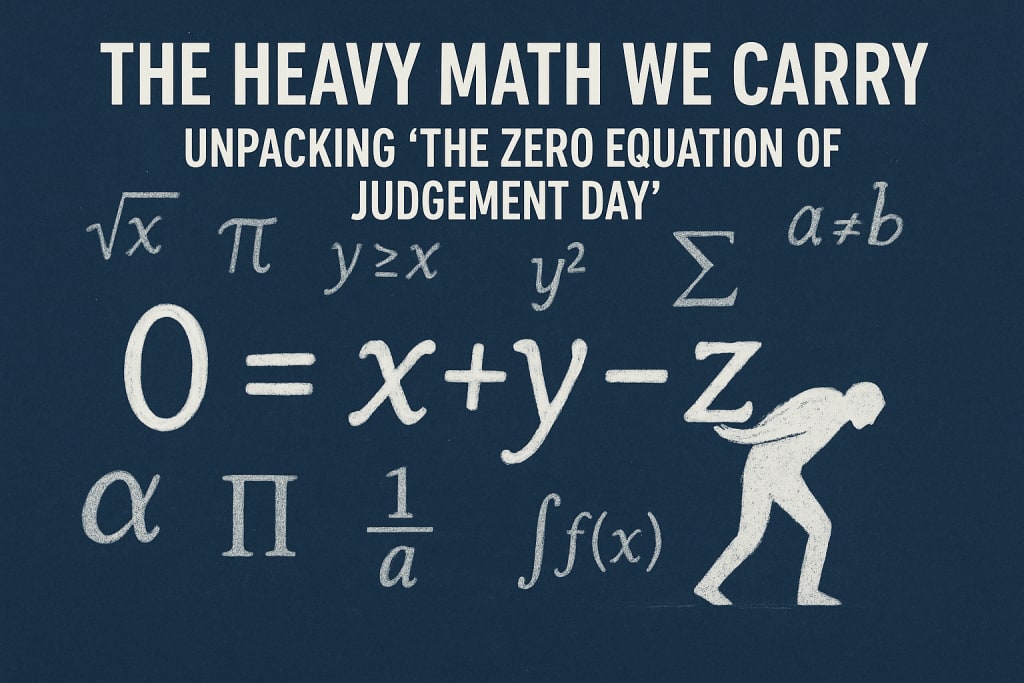
The Heavy Math We Carry: Unpacking "The Zero Equation of Judgement Day"
Standing in the grocery line, tapping your foot, watching the person ahead fumble with coupons...
You know that feeling? Standing in the grocery line, tapping your foot, watching the person ahead fumble with coupons, their cart overflowing. A tiny voice whispers: "Seriously? Could they be any slower?" Or scrolling online, seeing someone’s seemingly perfect vacation photos, and that familiar pang: "Must be nice. Must be so easy for them." Or worse, looking in the mirror after a rough day, and the internal critic launches its daily broadcast: "You messed up again. Why can’t you just…?"
We carry this constant, low-grade hum of evaluation. Judging others. Judging ourselves. Measuring, comparing, tallying scores on an invisible ledger. It’s exhausting, isn’t it? Like hauling around bricks we don’t even realize we picked up. This weight, this relentless internal accounting, is exactly what The Zero Equation of Judgement Day seeks to dissolve. It’s not about some apocalyptic event, but a quiet revolution in how we navigate our own minds and our connections with others. It’s about declaring today, right now, as the day we strive for a balance sheet that reads simply: Zero.
The Judgment Tax: What It Really Costs Us
Think of judgment as a hidden tax on your peace. Every critical thought, every snap assessment, every whispered comparison – it draws energy. It creates friction. Remember Sarah? She spent weeks agonizing over a presentation, pouring her heart into it. When she delivered it, she stumbled slightly on a statistic. Later, replaying the moment endlessly, her internal judge hammered her: "They all saw. They think you’re incompetent. That stumble ruined everything." For days, she walked around under this cloud, avoiding colleagues, feeling brittle. The reality? Most people barely registered the slip; they were impressed by her overall message. The real damage wasn't the stumble, but the relentless self-judgment afterward – the tax she paid long after the event was over.
Or consider Mark. He constantly sized up his neighbors – their cars, their landscaping, their seemingly effortless social lives. "Why can’t we have that?" became his background noise. This constant comparison wasn’t motivation; it was a slow poison, breeding resentment and making him feel perpetually "less than." He wasn’t enjoying his own home, his own life, because he was too busy auditing someone else’s. The cost? His present moment joy, eroded drip by drip by the acid of judgment.
The "Zero Equation": What Does It Actually Mean?
The Zero Equation of Judgement Day isn’t about becoming indifferent robots or denying reality. It doesn’t mean we ignore genuine harm or abandon discernment. It’s about recognizing judgment for what it often is: an automatic, often unhelpful, mental habit. It’s about aiming for a state where our default isn’t to critique, compare, or condemn – ourselves or others. Zero isn't about perfection; it's about intentionality and release.
Imagine your mind as a courtroom. Usually, the judge is always in session, banging the gavel constantly: "Guilty!" "Not good enough!" "Better than her!" "Worse than him!" The Zero Equation of Judgement Day is the decision to declare a recess. To step down from the bench. To simply observe the evidence without immediately passing sentence.
Putting Zero Into Practice: Stories from the Trenches
This isn't abstract philosophy. It’s gritty, daily work. Let’s see what striving for zero looks like in real life:
The Parenting Tightrope: Lisa felt perpetually judged as a mom. By other parents at the park ("She lets her kid eat that?"), by family ("In my day..."), and worst of all, by herself ("I yelled again. I'm failing."). Embracing The Zero Equation of Judgement Day started small. When a critical thought about another parent surfaced ("Wow, screen time much?"), she consciously noted it: "There's judgment." Then, she deliberately shifted: "I don't know their story. Maybe it’s been a long day." For herself, when the inner critic shrieked after a meltdown (hers or her toddler's), she practiced: "This is hard. I'm doing my best right now. Zero judgment." It didn't erase the challenges, but it dissolved the extra layer of corrosive shame, freeing up energy to actually be present with her child.
The Office Minefield: David worked in a competitive environment where gossip and subtle put-downs were common currency. He often participated, feeling it was the norm, but it left him feeling drained and cynical. After learning about The Zero Equation of Judgement Day, he decided to experiment. When colleagues started dissecting someone's project failure, he didn't chime in. Instead, he might say, "Yeah, that sounds tough," or simply change the subject. Internally, when he felt the urge to criticize a coworker's idea in a meeting, he paused. Instead of thinking, "That's stupid," he asked, "What part of this could work?" He wasn't being a pushover; he was choosing neutrality over negativity. The result? Less personal stress and, surprisingly, more constructive contributions.
The Mirror Moment: Maya’s harshest judge lived in her own reflection. Every glance reinforced perceived flaws. Starting her Zero Equation of Judgement Day practice meant looking in the mirror and consciously not launching into the usual critique. Instead, she practiced neutrality: "These are my eyes. They see." "This is my body. It carries me." No positive affirmations required yet – just a ceasefire. The aim was zero – neither praise nor blame, just observation. Over time, this neutral space created room for something unexpected: a flicker of acceptance, then even appreciation. The absence of constant judgment allowed her to simply be.
Why "Judgement Day"? The Urgency of Now
Calling it The Zero Equation of Judgement Day is deliberate. It injects a sense of immediacy. This isn't a vague "someday" aspiration. It’s an invitation to start today. Right now. This moment. Judgment Day isn't looming in the future; it’s the moment you catch yourself judging and choose a different path. It’s the daily decision to lay down the gavel.
Think about the sheer weight we collectively carry. The judgments that fuel online arguments, family rifts, workplace tension, and crippling self-doubt. What if, even just for pockets of today, we aimed for zero? What energy would be freed up? What connections might deepen? What peace might we find?
The Alchemy of Zero: What Emerges When Judgment Fades
Striving for zero isn’t about creating a void. It’s about clearing the debris so something else can grow. When we lessen the judgment:
Curiosity Flourishes: Instead of labeling someone "difficult," we might wonder, "What’s making them act this way?" We open ourselves to understanding.
Compassion Flows Easier: Seeing someone struggle without immediately judging their choices ("They brought this on themselves") creates space for genuine empathy.
Creativity Sparks: Self-judgment is the ultimate creativity killer. Neutrality ("This idea might not work, but let's see") allows experimentation and play.
Presence Deepens: Without the mental chatter of comparing or critiquing, we can actually experience the taste of our coffee, the sound of laughter, the warmth of the sun – right now.
Your Toolkit for the Zero Equation Journey
This isn't about flipping a switch. It’s a practice, a gentle rewiring. Here’s how to start building your own Zero Equation of Judgement Day:
Catch & Release: Become a detective of your own thoughts. Notice the judgmental ones – about others, situations, yourself. Just acknowledge: "Ah, judgment." Don't fight it; see it. Then, consciously release it. Imagine it floating away like a leaf on a stream. "Zero for this moment."
The "I Don't Know" Mantra: When tempted to judge someone's actions, whisper to yourself: "I don't know their whole story." This simple phrase creates crucial space between observation and condemnation.
Neutral Observation: Practice describing without evaluating. Instead of "This traffic is awful," try "There are many cars stopped." Instead of "I'm so lazy today," try "I feel low energy." Strip out the charged words.
The Self-Judgment Interrupt: When the inner critic starts its tirade, literally say (out loud or in your head): "Stop. Zero judgment right now." Replace it with a neutral or kind observation: "I made a mistake. Okay. What's next?"
Find Your Triggers: Notice situations or people that consistently spark judgment. Awareness is the first step to choosing a different response next time. Is it rush hour? Certain relatives? Social media? Meetings? Prepare your zero intention beforehand.
Celebrate the Attempt, Not Perfection: Some days, the gavel will bang loudly. That's human. The practice is in noticing it sooner and choosing zero again, not in never having the thought. Forgive yourself and recommit.
Beyond Ourselves: The Ripple Effect of Zero
Imagine the collective sigh of relief if more of us practiced The Zero Equation of Judgement Day. It’s contagious. When we stop judging others so readily, we offer them an incredible gift: the space to be human. We create safer spaces for vulnerability, for growth, for genuine connection. When we ease up on ourselves, we model self-compassion for those around us, especially the younger generation absorbing our every move.
This isn't about pretending everything is perfect. It’s about disentangling ourselves from the exhausting, often inaccurate, stories our judgmental minds spin. It’s about reclaiming the energy spent on mental scorekeeping and pouring it into living – fully, presently, kindly.
Today is Your Judgment Day
So, here it is. Your invitation. Your challenge. Your potential liberation.
The Zero Equation of Judgement Day starts now. Not tomorrow. Not when things calm down. Not when you feel "worthy." Right now, in this ordinary, messy, beautiful moment.
Notice the next judgmental thought that floats by. See it for what it is – just a thought, not a command. Take a breath. Let it go. Aim for zero.
What happens when you stop keeping score? When you step down from the judge's bench? What becomes possible in the quiet space that remains?
The equation is simple: Judgment = Weight. Zero Judgment = Freedom.
What will you choose to carry today?
About the Creator
Eternal Wisdom
Are you searching for deep knowledge, spiritual enlightenment, and hidden truths about existence? Eternal Wisdom is your gateway to exploring the mysteries of creation, divine wisdom, free will vs. destiny, the unseen world, and more...
Keep reading
More stories from Eternal Wisdom and writers in BookClub and other communities.
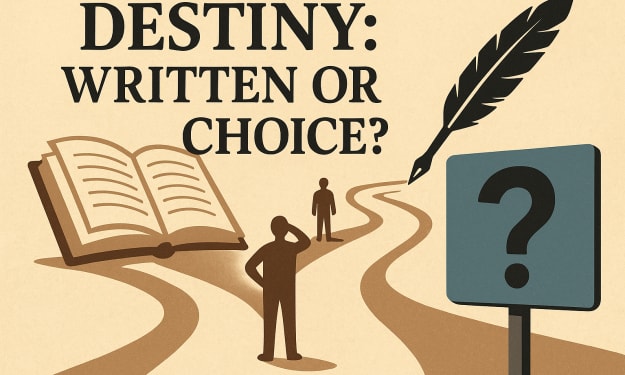
The Tug-of-War Inside Us All: Is Your Destiny Written, or Yours to Grab?
You know that feeling? Standing at a crossroads – maybe it’s quitting a soul-crushing job, finally saying "I love you," or just choosing between the safe route and the wildly uncertain one. A voice whispers, "Maybe this is just how it’s meant to be." Another fires back, "But what if I choose differently?" That internal wrestling match – Destiny: Written or Choice? – isn’t just philosophy; it’s the soundtrack to our most pivotal moments.
By Eternal Wisdom7 months ago in BookClub
My New Book is Finally Here
My poetry collection Beautiful and Brutal Things is done. It's actually done and finally published over 270 pages. Over a year of my life went into this book. More than a year, really. Long days at my computer, sometimes seven days a week because I couldn't stop even when I probably should have. Then two months of editing that felt harder than the writing itself. But it's finished, and I'm still standing, and the book is real.
By Tim Carmichael4 days ago in BookClub
Hildegard von Bingen
Light, Intellect, and Authority in the Medieval World Hildegard von Bingen stands as one of the most extraordinary intellectual figures of the Middle Ages, a woman whose range of achievement resists narrow definition. Born in 1098 in the Rhineland region of what is now Germany, Hildegard entered a world shaped by monastic reform, theological debate, and emerging centers of learning. From this environment emerged a thinker whose influence reached far beyond the walls of any cloister. Across a long life, Hildegard produced visionary theology, original sacred music, works of natural history and medicine, and a vast body of correspondence that circulated among the most powerful religious and political leaders of the twelfth century. Recognition during life was not limited to local admiration but extended across the Holy Roman Empire and into the highest ranks of the medieval Church.
By Marcus Hedare4 days ago in BookClub



Comments
There are no comments for this story
Be the first to respond and start the conversation.