
"Stop Fixing Yourself: Wake Up, All Is Well" by Anthony De Mello
Take a look around and see if you can find just one completely happy person, someone at peace with themselves, someone who is fearless and free from insecurity, depression, lack, and worry.
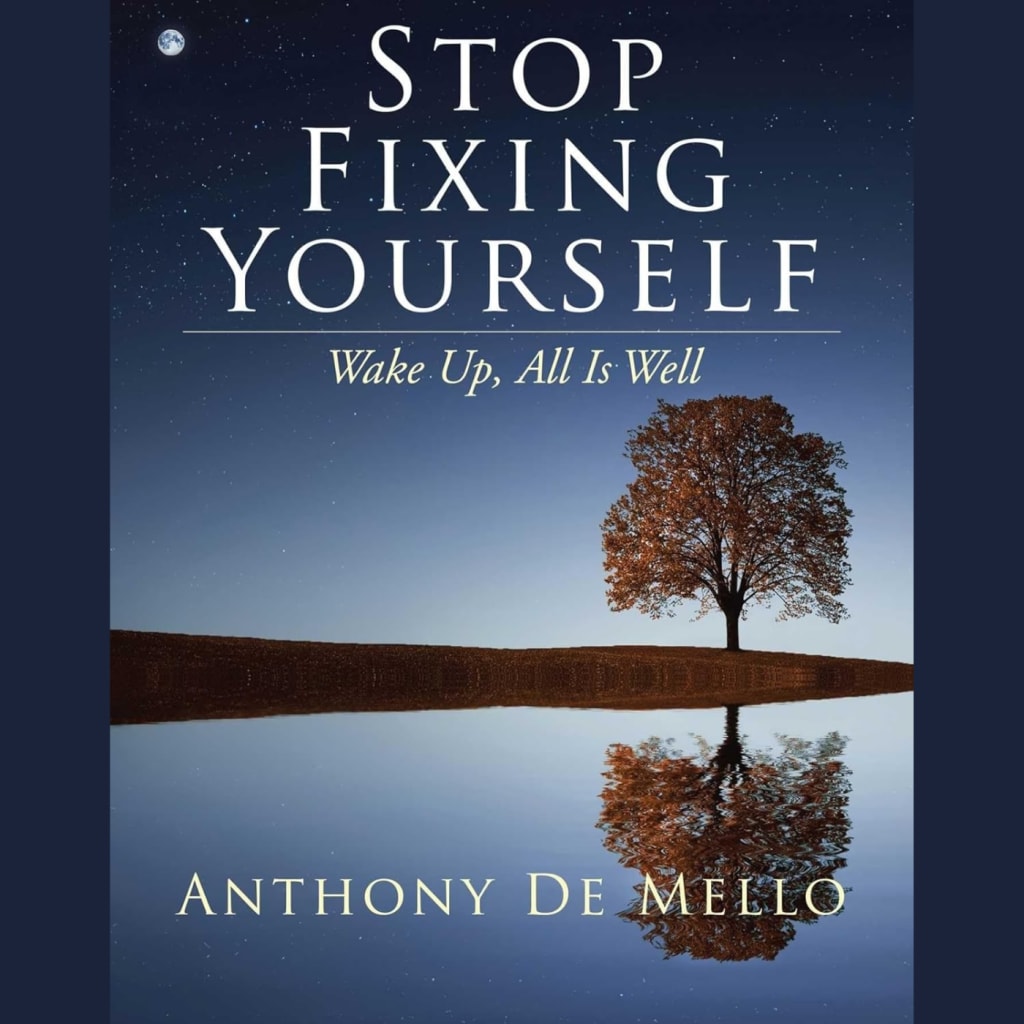
"Stop Fixing Yourself: Wake Up, All Is Well" by Anthony De Mello is a profound and transformative guide that challenges readers to break free from the self-imposed limitations of their minds and embrace the present moment. Anthony De Mello, a Jesuit priest, psychotherapist, and spiritual teacher, uses his unique blend of spirituality and psychology to help readers discover that they do not need fixing because they are not broken. The book emphasizes the importance of awareness, acceptance, and living authentically in the now. By dismantling the false beliefs and narratives that we carry, De Mello encourages us to wake up to the reality that all is well, just as it is.
Chapter 1: The Illusion of Brokenness.
The first chapter sets the stage by addressing the common belief that something is inherently wrong with us and needs fixing. De Mello explains that this belief is an illusion perpetuated by societal conditioning, upbringing, and self-judgment. He invites readers to see through this illusion and recognize that their true self is not broken or in need of fixing. This chapter emphasizes the importance of self-acceptance and the futility of trying to change oneself to fit external standards.
Chapter 2: Awareness: The Key to Liberation.
In this chapter, De Mello introduces the concept of awareness as a tool for personal freedom. He argues that awareness—not judgment or criticism—is what liberates us from our mental and emotional prisons. By observing our thoughts and feelings without attaching to them or labeling them as good or bad, we can transcend the limitations imposed by our minds. De Mello encourages readers to practice mindfulness and to cultivate a state of detached observation, which allows us to experience life more fully and authentically.
Chapter 3: The Prison of Programming.
De Mello discusses how much of our suffering is rooted in programming—automatic patterns of thinking and behavior that we have absorbed from our environment. These patterns dictate how we react to situations, often keeping us trapped in cycles of negativity and discontent. This chapter explores the importance of becoming conscious of our programming and questioning the beliefs that underpin our actions and decisions. By doing so, we can start to dismantle the walls of our self-imposed prisons.
Chapter 4: Waking Up to Reality.
This chapter is about the importance of waking up to the reality of the present moment. De Mello emphasizes that most people live in a dream state, constantly chasing desires and avoiding discomfort, which keeps them disconnected from reality. By embracing what is, rather than what we wish things to be, we can find peace and contentment. The chapter encourages readers to let go of their attachments and aversions and to accept life as it unfolds, without resistance.
Chapter 5: The Freedom of Letting Go.
Letting go is a recurring theme in De Mello’s teachings, and this chapter delves deeper into the concept. He discusses the importance of releasing attachments, not only to material things but also to ideas, beliefs, and identities. By letting go, we free ourselves from the burdens that prevent us from experiencing true freedom. De Mello illustrates how clinging to anything—whether it's a person, outcome, or self-image—only leads to suffering. The chapter provides practical advice on how to cultivate a mindset of non-attachment.
Chapter 6: The Trap of Expectations.
Expectations are a major source of disappointment and unhappiness. In this chapter, De Mello explains how expectations create a disconnect between our desires and reality. He urges readers to drop their expectations and approach life with an open heart and mind. By releasing the need for things to turn out a certain way, we can reduce our suffering and increase our capacity for joy. De Mello highlights that freedom comes from embracing life as it is, without imposing our desires upon it.
Chapter 7: Embracing Your Shadow.
This chapter explores the concept of the shadow—the parts of ourselves that we reject or deny. De Mello encourages readers to embrace their shadow selves, understanding that these aspects are also part of the human experience. By accepting all parts of ourselves, including those we deem undesirable, we can move towards wholeness. The chapter discusses the importance of self-compassion and the power of integrating rather than repressing our shadow.
Chapter 8: The Myth of Perfection.
Perfectionism is another illusion that De Mello dismantles in this chapter. He argues that striving for perfection is a futile endeavor that only leads to frustration and self-criticism. Instead of seeking perfection, De Mello encourages readers to embrace imperfection as a natural part of life. This chapter emphasizes the value of authenticity over perfection, highlighting that true growth and fulfillment come from being real, not perfect.
Chapter 9: The Power of Acceptance
Acceptance is a central theme in De Mello’s teachings, and this chapter focuses on its transformative power. Acceptance does not mean passive resignation; rather, it is about acknowledging reality without resistance. By accepting what is, we stop fighting against the flow of life and start living in harmony with it. De Mello provides insights on how to cultivate acceptance, including accepting our emotions, circumstances, and other people as they are.
Chapter 10: The Joy of Being
In this chapter, De Mello explores the joy that comes from simply being, without the need to do, achieve, or possess anything. He argues that true joy is not dependent on external factors but is found within, in the experience of being present and alive. De Mello invites readers to reconnect with their innate sense of joy by letting go of their preoccupations and being fully present in the moment. This chapter emphasizes that joy is our natural state when we stop seeking it outside of ourselves.
Chapter 11: Relationships and Freedom.
De Mello addresses the complexities of relationships, arguing that true freedom in relationships comes from loving without attachment or expectation. He discusses how most people confuse love with attachment and dependency, which leads to conflict and disappointment. This chapter offers a fresh perspective on how to relate to others from a place of freedom and authenticity, without losing oneself in the process. De Mello encourages readers to cultivate unconditional love, which respects the freedom of both oneself and others.
Chapter 12: Living Without Fear.
Fear is a common barrier to living fully, and this chapter tackles the various forms of fear that hold us back. De Mello explores the roots of fear, including the fear of loss, failure, and rejection, and how these fears are often irrational projections of the mind. He provides practical strategies for overcoming fear, such as facing it directly, questioning its validity, and focusing on the present moment rather than anticipated threats. The chapter emphasizes that freedom from fear is possible when we stop identifying with our fearful thoughts.
Chapter 13: The Illusion of Control.
Control is another illusion that De Mello invites readers to let go of. He argues that the need to control people, situations, and outcomes is rooted in fear and insecurity. This chapter explores the freedom that comes from surrendering control and trusting the natural flow of life. De Mello emphasizes that while we cannot control everything, we can control how we respond to what happens. By letting go of the need to control, we open ourselves to new possibilities and experiences.
Chapter 14: The Art of Letting Things.
This chapter builds on the theme of acceptance by focusing on the art of letting things be. De Mello encourages readers to stop trying to change or fix everything and to allow things to unfold naturally. He explains that much of our suffering comes from resisting what is, and that peace can be found in simply letting things be as they are. The chapter offers practical advice on how to practice this mindset in daily life, leading to greater inner peace and contentment.
Chapter 15: Returning to Your True Self.
In the final chapter, De Mello brings together the themes of the book, guiding readers back to their true selves. He emphasizes that our true nature is not something to be attained but something to be remembered. By stripping away the layers of conditioning, false beliefs, and ego-driven desires, we can reconnect with the essence of who we are. This chapter is a call to wake up to the truth that we are already whole, and that all is well, just as it is.
Conclusion.
"Stop Fixing Yourself: Wake Up, All Is Well" is a powerful reminder that the journey to self-improvement is not about becoming something new, but about remembering who we truly are. Anthony De Mello's teachings challenge us to look beyond the illusions of the mind and to embrace the present moment with awareness and acceptance. The book offers a path to freedom from the endless cycle of self-fixing, showing us that we are already complete and that the key to happiness lies in waking up to this reality. Through the wisdom shared in each chapter, De Mello invites us to live more authentically, love more freely, and experience the joy of simply being.
In this review, some of the links are affiliate links. This means that, at no additional cost to you, I can win a commission if you make a purchase through these links. I only recommend products and services that I consider valuable and useful. Thank you for your support!
About the Creator
Keep reading
More stories from ysaac mendez and writers in BookClub and other communities.
"12 Rules for Life: An Antidote to Chaos" by Jordan B. Peterson
"12 Rules for Life: An Antidote to Chaos" by Jordan B. Peterson is a self-help book that combines psychology, philosophy, and practical advice to offer guidance on how to navigate the complexities of modern life. Peterson, a clinical psychologist and professor, draws from a wide array of sources, including religious teachings, mythology, evolutionary biology, and his clinical practice, to propose twelve practical principles designed to bring order to the chaos of existence. His rules emphasize personal responsibility, discipline, and the importance of finding meaning in life's struggles.
By ysaac mendezabout a year ago in BookClub
My New Book is Finally Here
My poetry collection Beautiful and Brutal Things is done. It's actually done and finally published over 270 pages. Over a year of my life went into this book. More than a year, really. Long days at my computer, sometimes seven days a week because I couldn't stop even when I probably should have. Then two months of editing that felt harder than the writing itself. But it's finished, and I'm still standing, and the book is real.
By Tim Carmichael5 days ago in BookClub
The Necklace of Aphrodite
The Necklace of Aphrodite The Greek gods were supernatural beings of immense power, worshipped by the ancient inhabitants of Greece. They were conceived in human form and symbolized the fears and desires of mankind. They ruled the forces of nature, guided the sky, the earth, the sun, the rivers, the sea, the stars, the wind… and so forth.
By Gladys Isabel4 days ago in BookClub
Autonomy Is The Real Privilege
Good morning, freedom-seekers! Today we’re gonna be looking at autonomy. A strange word, I know; one many would probably look at blankly and run away from on sight. We’re gonna figure out what it actually means, consider how it’s achieved, and decipher just how deeply most of us are tangled up in dependence without realising it.
By That ‘Freedom’ Guy2 days ago in Humans



Comments
There are no comments for this story
Be the first to respond and start the conversation.