
Book review: White Fang by Jack London
White Fang is a novel by American author Jack London about a wild wolfdog's journey to domestication in Yukon Territory and the Northwest Territories during the 1890s Klondike Gold Rush. First serialized in Outing magazine between May and October 1906, it was published in book form in October 1906.


Reading White Fang by Jack London is like experiencing the wild through the eyes of a creature torn between nature and civilization, instinct and affection. It is a novel that engages not only the reader’s imagination but also one’s empathy, as it portrays a world where survival is unforgiving, yet the possibility of transformation and understanding lingers at the edge of every encounter. First published in 1906, White Fang stands as one of London’s most enduring and evocative works, a companion piece in many ways to his earlier novel The Call of the Wild, though it reverses the thematic trajectory—this time, from wilderness into the realm of human society.
The book is a classic of American literature and a cornerstone of animal fiction, written at a time when naturalism and realism were gaining ground in the literary landscape. Set in the Yukon Territory during the Klondike Gold Rush, the novel follows the life of White Fang, a wolfdog born in the wild and gradually introduced into the world of men. The novel is as much about evolution, adaptation, and socialization as it is about survival and conflict. London explores the tension between the brutal realities of the animal world and the complex moral and emotional dimensions of human society, crafting a narrative that is compelling to both young readers and adults who can appreciate the philosophical underpinnings.
The story begins in the stark, frozen North, where the rhythm of life is governed by hunger, cold, and fear. White Fang is born into this unforgiving world, the offspring of a she-wolf and a half-dog father. His early experiences are shaped by the law of the fang and claw, by dominance and submission, and by the constant threat of death. He is soon taken by Native Americans and later passed on to white men, some of whom treat him with cruelty, others with a semblance of care. Throughout his journey, White Fang endures and adapts, navigating an existence shaped by violence, mistrust, and the occasional flicker of gentleness. His ultimate transformation from a savage, solitary creature into a being capable of loyalty and even love is both believable and deeply moving.
Jack London’s prose is muscular, precise, and evocative. His descriptions of the natural world—its bleak beauty, its perils, and its indifference—are among the finest in American literature. The opening chapters, which depict two men and their dogs fending off a relentless pack of wolves, are haunting in their tension and atmosphere. London has a keen eye for detail and an unflinching willingness to show nature’s brutality. Yet his style also carries a lyrical quality, especially when he delves into the psychology of White Fang, rendering the wolfdog’s instincts, fears, and slow awakening to trust with remarkable sensitivity.
Structurally, the novel is both chronological and evolutionary. It begins with a narrative detached from White Fang, gradually narrows to his perspective, and ultimately immerses the reader in his internal world. This shift in narrative focus is masterfully handled, drawing us closer to the protagonist not just in terms of plot but in consciousness. London does not anthropomorphize his animal hero in the conventional sense; instead, he presents White Fang’s thoughts and emotions through the lens of instinct and survival. The reader is invited to understand, not project, and this restraint lends the novel much of its power.
One of the most compelling aspects of the book is its exploration of violence—both natural and man-made. London portrays violence as an inescapable part of life in the wild, but he is also critical of the cruelty inflicted by humans in the name of control or entertainment. Through characters like Beauty Smith, a sadistic dog-fighter, and Weedon Scott, a compassionate man who eventually becomes White Fang’s savior, London contrasts the extremes of human behavior. This juxtaposition allows the novel to examine themes of cruelty, justice, redemption, and the civilizing influence of kindness. It also touches on ideas of heredity versus environment, of whether a creature—human or animal—can transcend its origins through love and experience.
Emotionally, White Fang is both harrowing and hopeful. The scenes of abuse and suffering are difficult to read, not because they are sensationalized but because they are rendered with such realism and empathy. Yet the moments of connection—of White Fang learning to trust, of the first tentative bond with a human hand—are profoundly affecting. London doesn’t rush the emotional evolution; he allows it to unfold organically, making the final chapters not just satisfying, but deeply earned. The novel made me reflect on the resilience of living beings, on how even the most hardened creature can carry within it the potential for gentleness, given the right conditions.
If there is a flaw in White Fang, it might be its didactic tone in certain places, particularly when London shifts from the immediacy of the narrative to more abstract reflections on nature or morality. There are also occasional lapses into melodrama, especially in the later sections, where the sentimentality becomes a touch heavy-handed. However, these are minor blemishes in an otherwise compelling and skillfully executed novel.
What impressed me most was the balance London achieves between instinct and insight, between the savagery of the wild and the redemptive power of human compassion. White Fang is not merely a story about a wolfdog; it is a meditation on the porous boundary between the animal and human realms. It offers a vision of the world that is harsh yet not hopeless, where survival does not preclude tenderness, and where transformation, though rare, is possible.
So, White Fang is a classic for good reason. It is thrilling, thought-provoking, and emotionally resonant. Its portrayal of the natural world is unsentimental but deeply respectful, and its central character is one of the most vivid and compelling non-human protagonists in literature. I would recommend it to readers of all ages who appreciate stories of survival, transformation, and the enduring bond between human and animal. My final verdict: a powerful, elegantly written novel that speaks to the wildness within and the kindness that can tame it.
This book review was written using the following references 👇
About the Creator
Caleb Foster
Hi! My name is Caleb Foster, I’m 29, and I live in Ashland, Oregon. I studied English at Southern Oregon University and now work as a freelance editor, reviewing books and editing texts for publishers.
Keep reading
More stories from Caleb Foster and writers in BookClub and other communities.
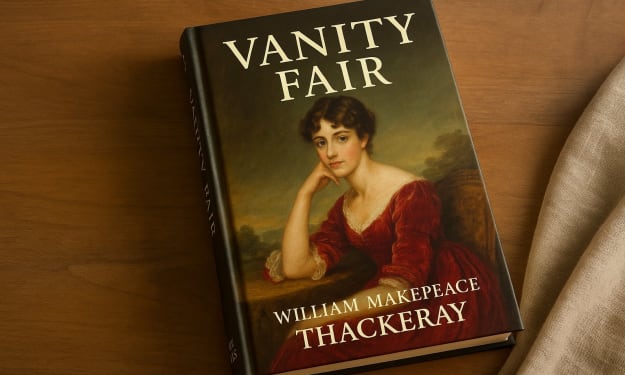
Book review: Vanity Fair by William Makepeace Thackeray
Reading Vanity Fair by William Makepeace Thackeray is like peering into a grand, gaudy mirror held up to early 19th-century English society—a mirror in which every vanity, ambition, flaw, and fleeting virtue is reflected with sharp clarity and biting wit. From the first few pages, I was struck not only by the brilliance of the prose, but by the narrator’s sly detachment and the sense that this was not just a story to be consumed, but a performance to be observed, interrogated, and remembered. First published serially from 1847 to 1848, this sprawling novel is often classified as a satire or a picaresque, and it defies easy categorization. While its tone is frequently comic and ironic, it is also deeply serious in its examination of morality, ambition, and human folly. It is aimed at readers who are not only lovers of rich narrative and vivid character but who appreciate the layered commentary that Thackeray weaves through every scene.
By Caleb Foster7 months ago in BookClub
My New Book is Finally Here
My poetry collection Beautiful and Brutal Things is done. It's actually done and finally published over 270 pages. Over a year of my life went into this book. More than a year, really. Long days at my computer, sometimes seven days a week because I couldn't stop even when I probably should have. Then two months of editing that felt harder than the writing itself. But it's finished, and I'm still standing, and the book is real.
By Tim Carmichael5 days ago in BookClub
The Other Woman in My Marriage Wasn’t a Stranger
When I first picked up "MY HUSBAND'S WIFE" book to read, I expected a dramatic story about betrayal and rivalry. The title suggests something bold and emotional, but what I found instead was a much more reflective and human narrative. This is not just a story about two women connected by one man. It is a story about how people understand themselves through love, memory, and comparison.
By Rosalina Jane5 days ago in BookClub



Comments
There are no comments for this story
Be the first to respond and start the conversation.